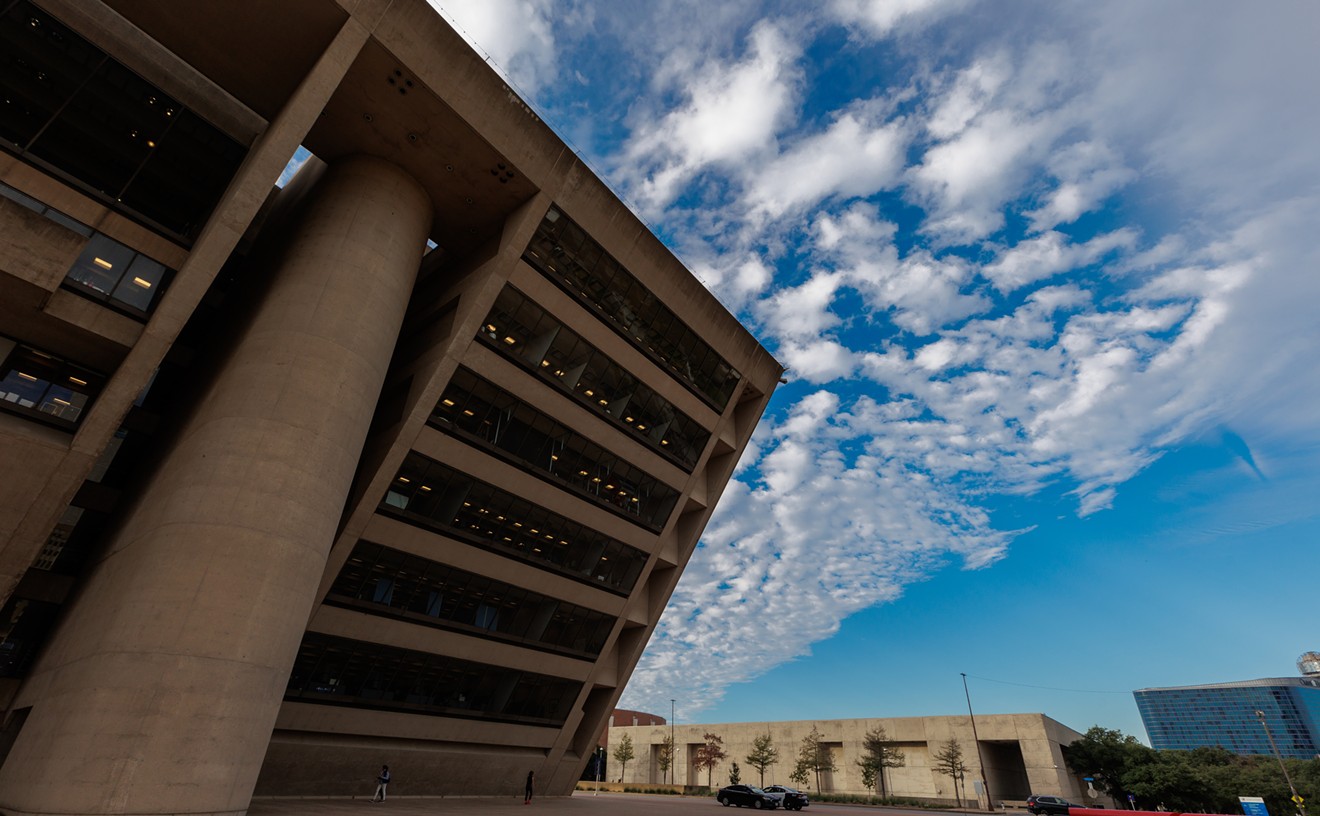

So, maybe that answers the question posed by the headline above: A man with three Academy Awards and four more nominations, a man largely responsible for one of the most influential films of the 1960s and who has the respect and affection of everyone he's ever worked with is unknown because he is unremarkable. Passers-by take no notice of him standing against a downtown Dallas building, having his picture taken. The 71-year-old with the white beard and round glasses doesn't stop traffic. Instead, it rolls over him.
There are many more reasons for his not being a household name among Entertainment Weekly subscribers. Some are offered below by people far more famous than he. But maybe the simplest answer is the one right in front of your face, the one who vanishes like smoke the instant he walks away.
His credits are estimable, enviable. Co-creator of Esquire's Dubious Achievement Awards. Co-author of a book that would come to define what's hip-not-hip for decades to come. Co-author of the screenplay for Bonnie and Clyde. Writer-director of Kramer vs. Kramer, Places in the Heart, Nobody's Fool and seven other movies, including the new The Human Stain, screenwriter Nicholas Meyer's adaptation of the Philip Roth novel about the secrets people keep and pay for. Winner of three Academy Awards, for writing and directing Kramer vs. Kramer in 1979 and, five years later, for writing Places in the Heart. Acclaimed by critics and adored by actors, among them Paul Newman, Sally Field, Jeff Bridges, Dustin Hoffman, Meryl Streep, Ed Harris--all of whom, save Field, he's worked with at least twice.
"And I've given him grief about that," says Field, who won her second Best Actress Oscar for Places in the Heart. "Always the guys." She feigns anger but quickly softens. "He is just one of the rare people--those rare, talented, sensitive, funny, good people. It is the quality that allows him to make the kinds of stories that he does make, and I think it's also the quality that keeps him from making more films. It's a trade-off worth taking. If you have to wait every five years or whatever it takes, it's worth it, rather than making more and not having them be Benton's films."
Benton takes no credit, raises no stink, lives so far outside the Hollywood spotlight he becomes a shadow. When his films are good, he gives credit to others. When his movies are bad, he blames himself.
"I must say, he's such a humble cat," says Jeff Bridges, who starred in Benton's first film as director, 1972's Bad Company, and 15 years later in Nadine, the writer-director's film set in Austin, where Benton attended college in the early 1950s. "I mean, a lot of people run their careers and their lives differently, and I don't think he particularly enjoys the limelight or, you know, craves it to the degree that he's out pursuing it. I think he'd prefer the people in the movie to do as much of that as they can. I think he enjoys being kind of behind the scenes."
Adds Peter Bogdanovich, for whom Benton co-wrote the Barbra Streisand screwball comedy What's Up, Doc? in 1972: "I think, really, most directors aren't known. If they are, it's for extracurricular activities, like my affair with Cybill [Shepherd], or a great pronounced style, like Quentin Tarantino. And Bob is kind of self-effacing and very laid-back."
This profile of Robert Benton is the kind of story he would have loathed in 1963, when he and then-writing partner David Newman were at Esquire, the frontier of New Journalism. There they lampooned "The New Sentimentality," made fun of presidents, thrust their tongues so far in their cheeks they poked holes in their faces. This story, full of the accolades proffered by the famous and legendary, would have made a young Benton squirm.
But you will not find anyone who will say a bad thing about the man. His peers believe him compassionate; his actors think him generous. He tells small stories about small people: kids playing cowboy, private dicks gone limp, fathers falling in love with their sons, mothers trying to save their families, old men raging against inevitable decline. His first screenplay coated the screen in blood and had some seeing red, but Benton's movies do not go bang anymore. His films are as quiet as the man who makes them.
Benton speaks, softly, in circles. A discussion about Waxahachie might quickly turn into a history of Bonnie and Clyde, then give way to a story about Kramer or French New Wave director François Truffaut or Sofia Coppola's Lost in Translation, which he adores. Over three hours, he will say little about his new movie, in which Anthony Hopkins plays Coleman Silk, a college professor who falls for a young woman (Nicole Kidman) and succumbs to a secret he's kept since abandoning his family years earlier. Benton prefers instead to talk about old movies made by dead directors who influenced him or young ones who inspire him.
Maybe all you need to know about Benton is this: Paul Newman, Jeff Bridges and Sally Field dialed their own phones to offer kind words and fond memories for this story. The assistant to Newman's publicist, reached by phone two weeks earlier, said that Newman was shooting a movie in Maine and not doing any interviews. A note was faxed explaining this was for a lengthy profile of Robert Benton. Newman's publicist called back within an hour, asking when was the absolute latest his client could be interviewed to make the story. Newman, without warning, phoned two days before the drop-dead date offered. Anything for Benton.
"Benton's a kind and gentle man with the will of a barracuda. Don't kid yourself," Newman begins, with a small laugh. "If he wants something, he doesn't let go of it. He's very deceptive that way--a very, very strong, tough personality. I don't think he had to display that particular gift while we were working. It showed itself in other ways. If you were trying to steal the pig knuckle off his plate or something, you were liable to end up with fork marks in your hand."
"I fell in love with this girl in college one time because she said to me, 'Given a choice between lying and telling the truth, I'll always choose the lie. Even if nothing matters, even if I have nothing to gain from it, I'll always choose the lie.' Now, that's not a great way to live your life, but it certainly made an impression on me."
--Robert Benton, 2003
On a warm fall afternoon, Robert Benton walks the streets of downtown Dallas and points out the spot of the old Telenews theater on Elm Street, where he remembers seeing Laurence Olivier's Hamlet. He used to walk over to Fitzhugh Avenue, where the long-gone Coronet screened European exotica, such as Marcel Carné's 1945 Children of Paradise, a tragic romance between a mime and an actress. "It's an astounding movie," Benton says, "a picture that wiped me out." On Main Street was the clothing store where his Aunt Rosalie's husband worked. And over at Fair Park, he took art classes at the long-gone museum, where he met kids who would become lifelong friends.
Nearly every story ever written about Benton contains at least one enormous error; the popular Internet Movie Database also has it wrong. He was born in September 1932 not in Waxahachie, but in Oak Cliff, where he lived till he was 13, before moving to University Park. He did not move to Waxahachie till he was in his teens, for reasons, he says, "I don't even begin to understand." His father, who worked for Southwestern Bell, remained behind. Again, Benton doesn't know why, because you did not ask his father such questions.
Benton talks often of his father, in contradictory terms: The old man was dangerous. The old man saved my life. His father, whose family had come from Palestine, Texas, was pulled out of school after the fourth grade, presumably to work for his father, who owned a saloon in Palestine. Benton's father was one of seven children, and the only son who was not gunned down.
One brother, so the story goes, was a traveling salesman having an affair with a young woman in a town near Palestine; he was playing in a domino parlor on a Sunday, and the girl's father came up and shot him. The other brother was a bootlegger in Oklahoma City, where he lived with a common-law wife. One day a man came to the door when Benton's uncle was away and said to the woman living with him, "Is James here?" She said no, and the man asked if she minded if he waited on the porch. When James returned, the man sitting on the porch pulled out a gun, shot him and walked away. "It was a liquor war, I was told," Benton says. For two years, he tried to make a movie about his uncles; Nicole Kidman had agreed to star.
"My father's family were all absolutely crazy," Benton says. "My father and one aunt were the sanest people among them. And my father was an extremely loving man, but he was also disconnected. He just couldn't talk. He was just isolated. I was his best friend. We would go for long car rides, and we wouldn't talk."
When Benton arrived in Waxahachie, he loathed it. Worse, he was dyslexic long before anyone had given it a name. He made it through high school, he says, only because his mother played bridge with his teachers. He got out of Waxahachie as quick as he could and headed to Austin and the University of Texas, arriving there as "the most hapless person you've ever seen." He was determined to reinvent himself like every kid who goes to college a boy and pretends to be a man, and like every boy who tells such stories, his reinvention came about because of a girl.
She smoked Lucky Strikes, so Benton started smoking Lucky Strikes, hoping she'd bum one off him. One afternoon she spoke to him, told him she was from Highland Park and asked where he was from. He was afraid of seeming ordinary, quite literally the boy next door. So he said he was from a little town called Waxahachie, believing there to be more mystery in it. She bit.
"There was a kind of romance about it, so I began to build on it and build on it and build on it," Benton says. "That's when Dallas just got wiped out. Yet when somebody says to me, 'Where you from?' I still say Texas. I've been in New York for 50 years, but I'm still from here. And my notion of paradise is walking across the University of Texas campus with this girl I was desperately in love with, not even comprehending how happy I am, not even being able to understand that kind of happiness because it's so ubiquitous."
At UT, Benton went to work on The Ranger, the campus humor mag. He met Harvey Schmidt there, a Houston boy interested in playwriting; years later they wrote a book that defined the language of cool for decades to come. It was called The In and Out Book, as in "In celebrities to see: Marlene Dietrich, Thelonious Monk, Joe DiMaggio" and "Out celebrities to see: Jack Kerouac, Leonard Bernstein, Adolf Hitler." Their creation has become the staple of every Out magazine published today.
By the mid-'50s, Benton had two choices: return to Dallas, where his father had arranged for him to work at the phone company, or leave Texas. He chose the latter and broke his father's heart, the privilege of all sons sooner or later.
Benton arrived in New York City aboard a Continental Trailways bus, "bearing the terrible responsibility country boys have for preserving the city's sophistication against the vulgarities of people already here," said Esquire's legendary editor Harold Hayes. He moved there with aspirations of selling cartoons to the slick magazines; he would also take art classes at Columbia University, from which he earned his master's degree. After just four weeks, a woman at The Saturday Evening Post asked him to come to her office. He thought, "Thank God, I've sold something." She closed the door and asked him to sit down.
"Mr. Benton, I think you ought to look for another line of work," she told him. "Really, don't pursue this anymore."
To prove her wrong, Benton illustrated a children's book and made it look as though it had been written and discarded by a little girl years ago; he even stained each page with coffee to get it just so. He took the pages back to Henry Wolf, art director at Esquire, who hired him in 1954 as assistant art director.
"I was always borrowing money from my family and having no money," Benton recalls. "And then it turned around. I started getting work, and then I got a steady job, which astounded my family. And then I got drafted."
He would have to return to Texas to serve a stint in the Army; he would see no action. Upon his return to New York in '57, he was given his old job, and when Wolf moved to Harper's Bazaar, Benton was promoted to art director. By then he and Schmidt had begun writing and illustrating their In and Outs, which the magazine ran and the authors collected in a book in 1959. Three years later, they collaborated on another slim collection, The Worry Book.
"Benton, to all appearances, should have been Out," wrote journalism professor Carol Polsgrove in It Wasn't Pretty, Folks, But Didn't We Have Fun?, her 1995 history of Esquire in the '60s. "He seemed perpetually poor, wore Army shirts and drove an old Citroën that looked like a Paris taxicab...But Benton had a talent that made him first-rate for Esquire: He enjoyed discovering people who could do some things better than he could. He [also] had a subtle, off-beat take on the times."
In 1960, there arrived in New York and in Esquire's offices a rumpled, dark-haired kid with a master's in English from the University of Michigan. David Newman was hired to read fiction and other over-the-transom pieces, but he was too smart, and too much a smart-ass, to stay hidden beneath other people's piles for long.
Benton and Newman became constant collaborators and companions. Hayes would hand them raw materials for pieces and demand their take. "They would come back with what would soon become the voice of Esquire," Polsgrove wrote, "a wise guy thumbing his nose at the world." By January 1962, they had created the magazine's Dubious Achievement Awards, consisting of photos and smart-ass captions. Beneath a photo of Esquire contributor Norman Mailer, they wrote, "White Man of the Year."
Dubious Achievement, Benton now insists, "was much more David's voice than mine. I guess I sung harmony. I feel that in some way David was a better writer than me. Really was. I survived in some ways for reasons I don't understand. I'm not a good writer. I'm a very good screenwriter."
It's amazing Newman and Benton got any work done at all at Esquire: They spent much of their time watching movies, talking movies, writing movies. (Benton, in 1962, was also dating an Esquire contributor, future Ms. founder Gloria Steinem; they, too, wrote together on occasion.) Benton and Newman fell in with another writer at the magazine, Peter Bogdanovich, who was determined to remind Americans theirs was a rich history of cinema--a rare thing at a time when most young filmmakers in the States were looking to France for inspiration, to the films of Truffaut, Jean-Luc Godard, Claude Chabrol and others. Bogdanovich had been hired by the Museum of Modern Art to program retrospectives of Hollywood directors considered unhip by the cinerati, chief among them Howard Hawks and Alfred Hitchcock.
"David and Robert were very taken with all those films and went religiously to see all of them," recalls the director of The Last Picture Show. "I remember very well that they were really very impressed with those films, and I know it had an impact on them, as it did on all of us who were starting out at that time."
Of all the films Bogdanovich screened at the museum, none resonated with Benton more deeply than Hawks' 1959 western Rio Bravo, in which John Wayne, Dean Martin, Ricky Nelson and Walter Brennan banded together against a cattle baron and proved you could make something rich and emotional out of the most conventional tale pulled from a saddle bag. Rio Bravo would provide a kind of template for Benton's own movies, with and without David Newman. They would often say their films, from Bonnie and Clyde on, were about the same thing: "the creation of the artificial family."
"I think that notion of community, which I tend to make films about, comes out of a kind of haunted influence, in a bizarre way," Benton says of Rio Bravo. "I think that I became religious because of the sense of community that came out of Hawks' films. It's like I was converted by the power of Hawks. That sense of community led me back into a more religious life, and he's the least religious filmmaker I can imagine. If somebody doesn't have an influence on your life, they have no real influence. Art can be art and accessible to everyone. Hitchcock is a great artist; Hawks is a great artist; and yet they are not artists aimed towards small audiences, and that you can have art aimed for a broader audience seems to me an essential shift in my way of perceiving the world."
Before the decade was out, Benton and Newman, with a few co-conspirators, would find an enormous audience. And theirs would become an influence they never could have imagined.
"We had to make movies the way one has to breathe."
--Newman and Benton, 1972
Before there was Clyde Barrow, there was Clark Kent.
Benton and Newman began work in 1964 on a screenplay about the lives and horrific deaths of Bonnie Parker and Clyde Barrow. They had read a book, The Dillinger Days, in which the bank-robbing couple were minor characters. But for Benton the attraction was as natural as that of a bootlegger to a shotgun; his father, he says, had even gone to both of their funerals. They wrote the movie, then waited for it to get made.
Their first publicly performed work wasn't about an impotent killer and his poetry-writing girlfriend, but, of all things, Superman. And a musical, to boot, with songs provided by Charles Strouse and Lee Adams, who had done Bye Bye Birdie in '63 and later wrote the music for Annie. On March 29, 1966, It's a Bird, It's a Plane, It's Superman opened on Broadway...and, a mere 129 performances later, closed on Broadway. Still, Strouse insists, it ranks among his favorite works, the only one he will still listen to.
"It makes me smile--the cast, the kind of laid-back attitude Bob and David had," he recalls. "They were very, very tight and very, very opposite. David was more meshugenah. They were both equally funny, but Bob was very considered and still is when I see him. He grew a beard that was very trimmed, and that defines him for me in a way. He's very considered, even in the way he dresses. David, I can't think of a word that doesn't seem so derogatory, but I don't mean it as such, but he was rumpled. His haircuts were not perfect. Bob's were. Their attitudes toward each other were a wonderful balance, too. David had the wildest ideas, and Bob kind of tamed him in a way." Years later, Benton and Newman would contribute the first draft to Richard Donner's Superman: The Movie.
Benton and Newman had always wanted Truffaut to direct Bonnie and Clyde; they had written it for him, were inspired by him. He flirted with the project twice, but it never worked. Godard likewise floated around it. But in the end, it was Arthur Penn who made the movie, and it became the movie that made Arthur Penn.
Interpreting Bonnie and Clyde's influence as the first American New Wave film has become a cottage industry for film critics. Newman and Benton, writing in the 1972 Bonnie and Clyde Book, insisted it was about only one thing: style and the people who have it. "It is about people whose style set them apart from their time and place so that they seemed odd and aberrant to the general run of society." And in the end, they are punished for their style, gunned down and then some.
For their screenplay, their very first, Newman and Benton were nominated for an Academy Award. They lost, as did Warren Beatty, Faye Dunaway, Penn, Gene Hackman, Michael J. Pollard and costume designer Theadora Van Runkle. It would be the only Oscar nomination of Newman's career.
"By David Newman and Robert Benton"--that's how their credits read on 1970's There Was a Crooked Man..., 1972's Bad Company and What's Up, Doc?, 1978's Superman: The Movie and 1982's Still of the Night (essentially a Newman-Benton leftover). Benton liked to say Newman came first, while he got the last word. So shall he again today: On June 27, Newman died of complications from a stroke. He was 66.
Newman and Benton were more than writing partners; they became family, living in the same Manhattan building with their wives and children. They wrote together during the day, ate together at night, vacationed together during time off. Of his late partner, Benton now says, "He was hypnotically wonderful," and he smiles.
"They sort of finished each other's sentences," says Bogdanovich, recalling the writing of What's Up, Doc? in 1971. "I called Bob and David, and I said, 'Do you want to do a screwball comedy with me?' They said, 'Well, we've only got three weeks because we've got another picture starting.' I said OK, so they came out, and we holed ourselves up in my suite at the Sunset Towers and worked for three weeks straight. It was tense, but we had a good time. David did the typing; Bob and I paced. They were very good together. They kind of bounced off each other, bounced off of me, bounced off the walls."
In the end, Benton says, the screenplay was saved by Buck Henry.
By 1972, the Newman-Benton partnership was dying. Newman made it clear he intended to direct, something Benton says he never had any interest in. It was too risky a proposition since they were making a nice living as writers and Benton was trying to support his wife, Sally, whom he married in 1964, and their young son. Then the worst thing of all happened: Benton, not Newman, had been given the opportunity to direct, a western he and Newman had penned called Bad Company.
"We started when we were young men, but the stakes got higher, and when the stakes got higher, it changed the chemistry," Benton recalls. "It was like turning up the flame. It brought all the problems in our relationship to a kind of head and forced what would have ultimately happened later. Since David, I have not had another close male friend. The breaking up of that partnership was so hard for me. From David's point of view, the sheer injustice that he was the one who wanted to direct and I was the one who got the chance, that was heartbreaking."
Newman would direct a single film, based on a screenplay he and Benton wrote. The Crazy American Girl, starring Patti D'Arbanville, was never released in the States.
Eventually, Bonnie and Clyde became a curse for its writers; nothing could ever live up to its impact, its legend. Newman and Benton were always asked, "What ya done since?" even after they'd done plenty, thanks for askin'. "It was very hard to escape," Benton says. "It ceased being a curse when David and I stopped being partners, because Benton or Newman alone is not Newman and Benton."
Robert Benton has directed 10 movies since 1972. Four of them he doesn't much care for: Still of the Night, a thrill-free thriller with Meryl Streep; 1987's Nadine, starring Jeff Bridges and Kim Basinger as a '50s couple on the ins-and-outs; 1991's Billy Bathgate, which was never his; and Twilight, which he will allow has good moments and a great James Garner performance. The films for which he has great affection are 1977's The Late Show, his private-eye homage-spoof with Art Carney and Lily Tomlin; Places in the Heart, a thinly veiled account of his great-grandmother's life in North Texas; and 1994's Nobody's Fool with Paul Newman.
"And," he says, "I have less affection for Kramer than you would think."
When first offered Kramer vs. Kramer, based on a novel about a newly single father abandoned by his wife and left to raise his son, Benton turned it down. There was no way to make it work, he figured, without the material turning soggy from sentiment. His wife told him to reconsider. He said he would write it, but only if Truffaut would direct. The French director said yes. The producer said no. So, a second opportunity passed for Benton and Truffaut to work together, as did a discussed project about the life of Howard Hughes.
"I am a much more sentimental filmmaker than David was," Benton says. "I was afraid I would make a really sappy, sentimental movie. But once I started working on it, I began to identify with the character and began to see that in fact I could do it, and it would be sentimental, but it wouldn't be disgustingly sentimental."
It became his most commercially successful film, grossing more than $100 million upon its release in 1979 and garnering five Oscars, including ones for Benton (directing, adapted screenplay), stars Dustin Hoffman and Meryl Streep and for best picture. (Among the films it beat was Francis Ford Coppola's Apocalypse Now.)
At that same ceremony, Sally Field won her first Academy Award, for Norma Rae; Benton would get her a second for Places in the Heart, allowing her to deliver her now-infamous "You really like me!" speech. Initially, producers didn't want Field, thinking the role of Edna Spalding too much like Norma Rae, a strong Suth'n woman. But the role was too perfect: Like Benton, Field came from Texas stock, and her family history was just as rugged and tumultuous as his. She would even come to the set the first day wearing her grandmother's perfume, which Benton recognized as the smell of his own childhood.
"It so resonated in me because I knew this woman. I knew these people," Field says. "This was mine. It all came together. This was supposed to be. I was supposed to tell the story of my grandmother, who lost her children, and Edna, who fought to keep them. There's just this little bubble of precious history and memory surrounding that movie, too, because of how we shot it and all of us being in Waxahachie. You get isolated from the world and are just in this spot, and that's when making movies is just a gift from God."
For Benton, coming off the failure of Still of the Night, Places in the Heart was an especially important movie. He needed to make something personal, not some Newman-Benton leftover screenplay. Now, he will say he should have stopped there and not bothered with Nadine. Or Billy Bathgate. Should have just waited for Nobody's Fool, waited for Paul Newman, who gives a stunning performance as a hard-drinking construction worker with a bad knee, a distant son who thinks him unreliable and a grandson who doesn't know him at all. Newman, for decades larger than the screens on which his image is projected, rarely seemed so human as he did in Nobody's Fool, for which he received his eighth Oscar nomination for Best Actor and lost to Tom Hanks for Forrest Gump.
"When Benton is working best and when the actor's working at his peak," Newman says, "it's not that he leaves you alone; it's that he allows you the freedom to experiment and to go into odd places without crippling you before you get the words out of your mouth. The biggest gift I think that he has is when you're in trouble and are kind of lamely holding up your hand for instruction, he knows what to tell ya. Usually the problem with most directors is when you hold your hand up and they got nothing to say, or they have some kind of result-oriented thing: 'Well, look to your left,' or, 'Don't put your face so much into the camera.' That's no help when you're really, desperately trying to figure out why the scene isn't working. Benton would probably give you an active verb, like, 'Crowd her.' Or, 'Measure her.' Or, 'Bait her.' Or, 'It's not important.' You can play those things, or at least I can. I know what he's talking about."
One quickly gets the sense this is the biggest compliment an actor can give a director. He stays out of the way.
"I tried to skewer Benton," Newman adds, "but I don't think that would have been cricket."
Benton speaks little of The Human Stain, except to say pieces of it mirror his life. He sees some of himself in the young Coleman, who abandons his family and his heritage to pursue a better life. So it was for a young Benton, who left Dallas a hapless nobody and returns now a celebrated, if occasionally anonymous, somebody.
"You don't know how many failures I go through, how many scripts I write that draft number 30 is sitting on the computer," Benton says. "In some ways, I'm extremely lucky that things die in the computer rather than on the screen. They do die on the screen. Nadine died on the screen. Still of the Night died on the screen. Billy Bathgate died on the screen. And Twilight died on the screen. I wish I could say this without sounding shifty, because I'm not shifty, but I stumble into things. There's no design there. It's like chaos inside here"--he points to his temple--"and I'm not putting myself down. I'm just trying to describe it without sentiment, one way or the other. I tried to do commercial movies, but I'm not good at it. I've been lucky."
And with that, he is off.