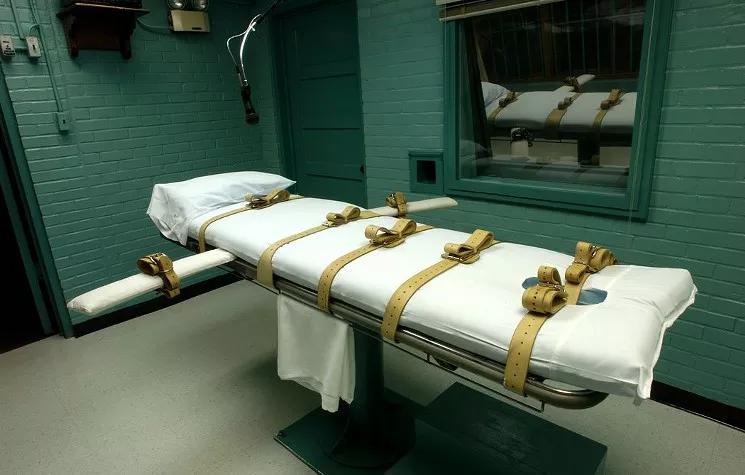
Texas Department of Corrections

Audio By Carbonatix
In late November, the Dallas County District Attorney’s Office announced that it would not seek the death penalty in the prosecution of Yordanis Cabos-Martinez, the man accused of beheading his co-worker at a Dallas motel earlier this year.
While prosecutors added that they “reserve the right” to change course — a decision that will need to be finalized in early January — it wasn’t exactly a surprising move. Cabos-Martinez is an undocumented resident, which can complicate capital punishment proceedings. (Earlier this year, Texas Sen. John Cornyn was one of a dozen Republicans who signed on to legislation that would make it more straightforward for prosecutors to go after undocumented immigrants who harm U.S. citizens.)
But even beyond that, capital punishment has not been a hallmark of Dallas County District Attorney John Creuzot’s tenure. In May, Creuzot announced that his office would seek the death penalty in a separate case, his first time doing so since taking office in 2019. In Texas, executions are set by a judge at the request of an elected district attorney.
Creuzot declined to speak to The Dallas Morning News about the decision to reintroduce a capital punishment trial to Dallas County for the first time in years. But Dallas’ move away from the death penalty is consistent with a broader shift away from the punishment across the Lone Star State.
According to annual reports by the Texas Coalition to Abolish the Death Penalty and the Death Penalty Information Center, Texas has lost its standing as the nation’s leader for executions. Over the last year, Texas judges set the fewest execution dates in three decades, according to the reports.
“Texas’s death row population continues to decline for reasons other than executions. In 2025, more men died in custody (five) or had their sentence reduced (one) than were executed (five),” the TCADP report found.
Perhaps the most high-profile instance of Texas’ capital punishment efforts being staunched came in October, when Robert Roberson, the East Texas man found guilty in the murder of his daughter — but whose prosecution, many believe, hinged on since-debunked science — received a stay of execution.
Roberson’s case has driven a new wave of attention to the issue of capital punishment. According to Robin Maher, executive director of the Death Penalty Information Center (DPIC), concerns about the cost of capital punishment and modern data suggesting that innocent Americans have been killed under the death penalty have helped shift public sentiment against the practice of state executions.
“In 1994, 80% of Americans supported the death penalty, but by 2024, that support had decreased to 53%. When you dig into those numbers, you find that more than half of young Americans oppose the use of the death penalty, so we expect to see those numbers in opposition continue to climb,” Maher told the Observer earlier this year.
What the Reports Say About Dallas and Texas
Of the five men who were executed in Texas in 2025, one was sentenced in Dallas County back in 2013. Matthew Johnson, a man found guilty of killing convenience store worker Nancy Harris during a robbery, was executed by the state in May.
Since 1982, Dallas County courts have been responsible for 66 executions, which means that, historically, Dallas County has been one of the largest contributors to Texas’ death row. Reporting by The Dallas Morning News suggests that nearly a dozen Dallas men and women currently sit on Texas’ death row.
But in recent years, Dallas County has moved away from seeking the death penalty in capital cases. Only three new death sentences were issued in Texas in 2025, one in Tarrant County and two in Harris County.
“When it comes to new death sentences, the state does not practice capital punishment — just a dwindling number of counties do,” the TCADP report states. “Of capital cases that have gone to trial in the past five years, juries have rejected the death penalty in nearly 25 percent of them.”
Texas, Alabama and South Carolina each executed five death row inmates this year, but while that number represents a waning enthusiasm for capital punishment on Texas’ part, Alabama and South Carolina have been steadily growing their use of execution in capital cases. So too has Florida, which, by the end of this year, will have executed 19 people. Florida’s record-high number of executions brought the national total of executions in 2025 to 48, the highest in 15 years, the DPIC report says.
“Contradictory trends indicate the growing disconnect between what elected officials do and what the public wants,” the DPIC report says. “The evidence shows that the death penalty in 2025 is increasingly unpopular with the American people even as elected officials schedule executions in search of diminishing political benefits.”