
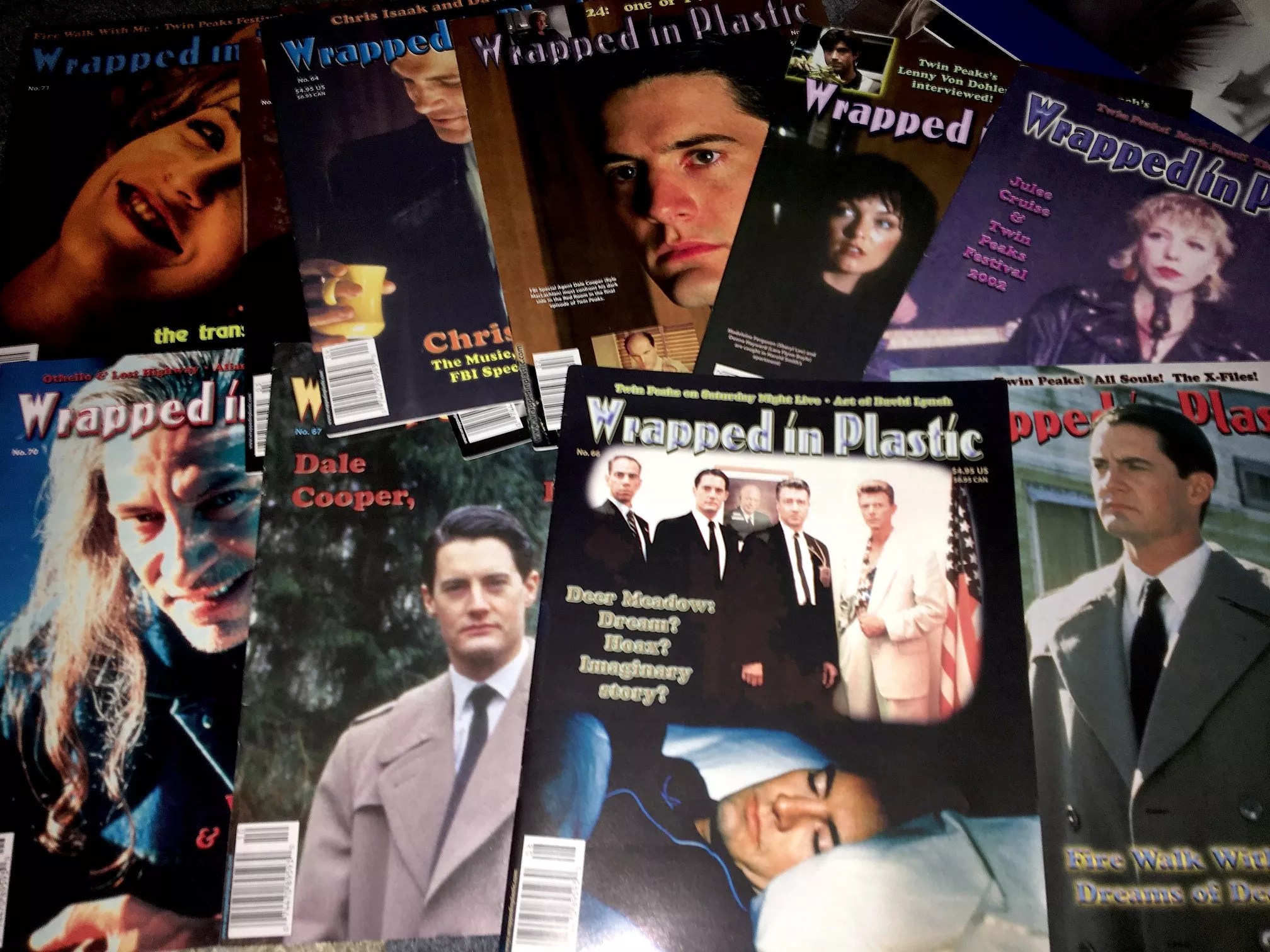
Courtesy of John Thorne

Audio By Carbonatix
David Lynch and Mark Frost’s Twin Peaks is the catalyst for the modern trend of endlessly discussing a TV show’s themes and theories until there’s absolutely nothing left to dissect. Even after two seasons on ABC’s primetime lineup and Showtime’s recent reboot – which let Lynch and Frost do whatever the hell they wanted – it’s still being debated and discussed on message boards and in social media circles.
Writers John Thorne and Craig Miller (who died at 53 in 2012) are two of those fans who could spend hours discussing their thoughts on Lynch and Frost’s ethereal TV drama, which seemed to ignore every basic rule of television logic in favor of its own unique vision. The duo’s shared love for the mysteries surrounding the death of Laura Palmer and Agent Cooper’s holistic approach to homicide investigation spawned one of the most successful fanzines on the subject.
“The first thing that appealed to me about it … it’s truly unlike anything that’s ever been on network TV before,” Thorne says. “Up until that point, network television didn’t demand a lot from audiences and was something you could dismiss – and granted, there were shows like Hill Street Blues, but Twin Peaks was expecting more and doing more with the medium. That’s what drew me to it. It showed what the strength of television could do.”
The Dallas writers started sharing their theories and general thoughts on Twin Peaks in a fanzine called Wrapped in Plastic, named for the famous line that Pete Martell utters to Sheriff Harry S. Truman (It shouldn’t be too hard to remember that, Diane) on the phone after discovering Palmer’s corpse: “She’s dead, wrapped in plastic.”
The fanzine ran for almost a decade following ABC’s cancelation of the show after just two seasons and after Frost and Lynch tried to wrap up the town’s biggest secrets with the 1992 film Twin Peaks: Fire Walk With Me. The film will be playing Wednesday at the Texas Theatre as part of a weeklong Lynch retrospective.
The fanzine produced as many as 10,000-15,000 copies per issue at the peak of its circulation and ended in 2005, 12 years before Frost and Lynch got to conclude the series the way they intended on Showtime with Twin Peaks: The Return. All 75 issues are available online at the Wrapped in Plastic magazine’s official website.
One of the major reasons Twin Peaks inspires so many discussions is the spaces that Frost and Lynch leave open for audiences to fill in the blanks themselves. So, Wrapped in Plastic used a lot of ink putting forth theories from different fans trying to unravel the episodes’ biggest questions beyond finding Palmer’s killer.
“There’s room for you to interpret it in different ways,” Thorne says. “So we had essays that interpreted it as vampire myth and feminist themes because it was such a rich test. There were so many ways of determining it.”
One of the fanzine’s biggest draws among fans was the opportunity it took to pick the brains of the show’s cast, writers and even its principal creators.
“It was a strange time,” Thorne says, referring to the months after the show’s abrupt second-season ending. “In those years following Twin Peaks, [there were] some actors who did not want to talk about it because for many, it was a failed project. We didn’t get a lot of big names like Kyle MacLachlan, but we managed to interview the Log Lady [Catherine E. Coulson] and Richard Horne [played by Eamon Farren] and as we went along, we got more like the actress who played Laura Palmer [Sheryl Lee].”
Eventually, Thorne and Miller caught the attention of Frost, who “was very generous to us,” Thorne says. He agreed to do five interviews over the course of the magazine’s run, and those chats “eventually got on David Lynch’s radar.”
“We both knew if we ever got a chance to interview him, he wasn’t going to answer specific questions,” Thorne says. “We toyed with the idea of interviewing him about being interviewed. We did talk about the process, the difference between color and black and white [TV], technical aspects and the process of filmmaking and some questions about storytelling. We did ask him some questions and he said he didn’t want to talk about that.”
One of the most eye-opening revelations they managed to pry out of Lynch’s skull came courtesy of Lynch’s first film, Eraserhead, a bleak, black-and-white, body-horror nightmare from 1977 that started its own word-of-mouth campaign with fan theories and set the stage for Lynch’s film visions.
“He said that the problems that Henry [the protagonist of Eraserhead, played by Jack Nance] experienced [were] from his own flaws and his own doing,” Thorne says. “It’s basically the internal and not an external reason why he was in the dilemma he was in. That was valuable to us. A lot of people look at the main character of Agent Cooper [played by McLachlan] and much of the plot has to do with Cooper dealing with external conflicts, something from the outside getting in his way. When we see Lynch unfiltered, particularly in that last episode, Cooper’s own fears and doubts cause him to fail.
“Having Lynch confirm that about Henry in Eraserhead helped me understand why Cooper failed and also why other protagonists within Lynch films,” Thorne adds, “not why they fail but why they struggle.”
Wrapped in Plastic also expanded its coverage to Lynch’s other films and even other shows such as FOX’s The X-Files that were clearly influenced by Frost and Lynch’s Twin Peaks. Thorne has also published two books of essays and features on Twin Peaks, including The Essential Wrapped In Plastic: Pathways to Twin Peaks and Ominous Woosh: A Wandering Mind Returns to Twin Peaks, which continues Thorne’s thoughts on the series in the wake of the Showtime continuation.
Twin Peaks: The Return created even more questions than answers as Agent Cooper escapes The Black Lodge and wanders the real world’s realm as a soulless empty shell of himself, a direct defiance of what fans might want or even expect from a new Twin Peaks series.
Thorne doesn’t think Frost and Lynch were toying with the fans or testing how much they could get away with in a new show run. It’s quite the opposite, he says. They were doing the show they wanted to do from the very beginning.
“[Frost and Lynch] were interested in trying to tell something subversive and challenged the notion of what Twin Peaks was,” Thorne says. “It doesn’t change our love of the original series, but it is really a continuation of it and isn’t really a reboot of it. It’s what Twin Peaks is. It’s almost hard to say. It’s a hypercube, a reflection of Twin Peaks.”