Nathan Hunsinger

Audio By Carbonatix
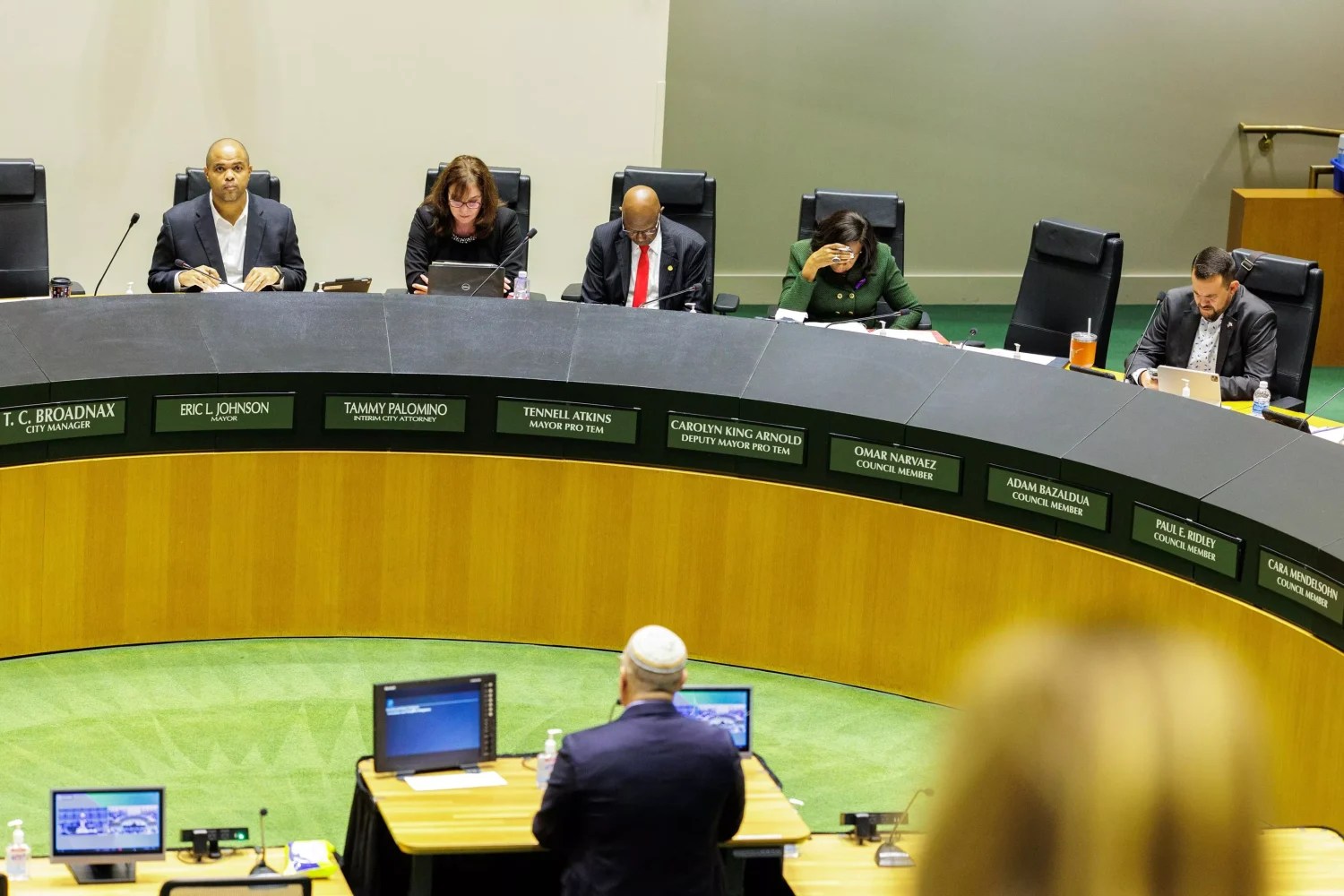
Dallas City Council members who are curious as to why $10 million in funding earmarked for homelessness efforts wasn’t discussed at the committee level are free to hear “the full story over lunch” from the chair of the Housing and Homelessness Solutions Committee herself, council member Cara Mendelsohn.
But for those of us who are not permitted to hang out in the Marilla Street break room, the tale goes something like this.
Earlier this year, Dallas pledged $10 million towards the second phase of Housing Forward’s Street to Home program, which helps provide rental assistance to individuals experiencing homelessness who are looking to transition out of shelters. While the largest chunk of that funding is allocated towards the rental assistance program, some of the money will also be put towards case management and administrative needs for the city’s various partners. At least 425 chronically homeless people are expected to benefit from the funding in the next year.
While the dollars were earmarked in the most recent budget cycle, they still needed to be formally approved by the council. Typically, high-ticket items are briefed on the committee level before they reach the full council, and this particular issue was on the agenda for Tuesday’s meeting of the Housing and Homelessness Solutions Committee.
However, the committee meeting fell apart before the agenda item was discussed.
The first briefing on Tuesday morning was given by Allen Gwinn, an SMU professor whom Mendelsohn invited to present findings that he said suggest a correlation between homelessness encampments and unexplained deaths across Dallas. Council member Adam Bazaldua responded to the analysis by stating his preference for “less subjective language” during briefings. Bazaldua attempted to call Housing Forward’s CEO and President, Sarah Kahn, to the horseshoe for her perspective, but was stopped by Mendelsohn, who said, “We’re not doing this today.”
When Bazaldua suggested that his time would be yielded to allow for Kahn to speak, Mendelsohn informed him that his time had ended. Bazaldua challenged that, and after a few minutes of debate, a city attorney suggested that the committee go into recess. That prompted Mendelsohn to end the briefing, although not every committee member had yet been given the opportunity to share their thoughts on the findings. As a result, several committee members left the chamber, and the committee was unable to regain quorum, leaving several items, including the Housing Forward funding, undiscussed.
Twenty-four hours later, addressing the entire council, Mendelsohn argued that since the issue had not been debated in committee, the council should not proceed with a vote. She also accused the body of shelling out the funding as part of a “short-term” effort to “clean up” downtown before the FIFA World Cup takes place in North Texas next summer.
“Spending $10 million on homeless services deserves a briefing, and it deserves a thoughtful discussion. We’re being told this is an emergency,” Mendelsohn said. “We have no long-term plan, just one emergency after another. When these dollars are spent, we will have nothing to show for it. Nothing.”
Ultimately, Mendelsohn was the only council member to vote against releasing the funding. But before that near-unanimous vote, the horseshoe took its time to work through an unusually candid conversation about the issue that seems to be at the heart of so many City Hall disputes: pride.
Council member Zarin Gracey remarked that conversations about the city’s most high-stakes issues are constantly interrupted by “political pettiness.” Council member Paula Blackmon reminded the officials that “people are really hurting,” and that the “games” at City Hall result in community members getting caught in the middle.
Lorie Blair, who is only a few months into her first term as a council member, bluntly said that “political posturing and personality conflicts” are directly harming Dallas’ most vulnerable.
“We have items here on the agenda that we should’ve gotten to discuss yesterday. It didn’t happen,” Blair said. “Who are we hurting? Ourselves. One of the things I’m not going to do is bow down to childish behavior. I will not go forward next year with the same type of behavior, and I challenge each and every one of you to put the people that elected us to serve first and foremost.”
As Blair pointed out, finding a way to work together is something the council needs to do in the upcoming year.
One question posed by council member Paul Ridley was whether it is most appropriate to allocate the funding towards rental assistance. In recent months, the Housing and Homelessness Solutions Committee has received briefings on the possibility of using tiny homes or pallet homes as a strategy to aid Dallas’ homeless population. Although those briefings were met with general support, the council hasn’t been able to fully commit to a plan. That is a trend that has been ongoing for years.
Kahn told Ridley that the $10 million approved on Wednesday won’t be used for any capital programs. City Manager Kimberly Tolbert said that if those strategies are something the council wants to pursue, they need to get serious about the tough questions — one such being, where in the city are those facilities supposed to be located?
“I think what we’ve got to get to are some very clearly defined standards about what you want that to be and where you want that to be,” Tolbert said. “In the meantime, we’re not stopping and waiting for that.”
Mendelsohn and Bazaldua have each defended their respective positions from Tuesday’s squabble via Facebook comments. Mendelsohn argues that she felt Bazaldua’s line of questioning was “rude” and that by inviting Kahn to the podium, he was attempting to force a volunteer presenter into a debate, “something [the committee] doesn’t do.” Bazaldua, on the other hand, has stated that asking questions and engaging in a “robust conversation” over briefing items is “a critical part of [the] committee process,” and that by “denying colleagues the ability to ask questions,” Mendelsohn was wasting everyone’s time.
On Wednesday, the majority of the council seemed uninterested in siding with either of them.
“If you want to know what doing nothing looks like, come to my community,” Council member Maxie Johnson said. “When nothing gets done, people suffer.”