
Emma Ruby

Audio By Carbonatix
Advertising Can't Do It Alone
The challenges facing local news organizations are very real. That's why reader support matters more than ever. If you believe independent journalism matters, make a contribution today and help us reach our summer fundraising goal of $12,500 by August 9.
The city of Dallas is reviewing proposals to convert one of the two main bridges linking Dallas’ urban core and North Oak Cliff into a pedestrian-only thoroughfare. Traffic concerns, unsurprisingly, are bubbling up.
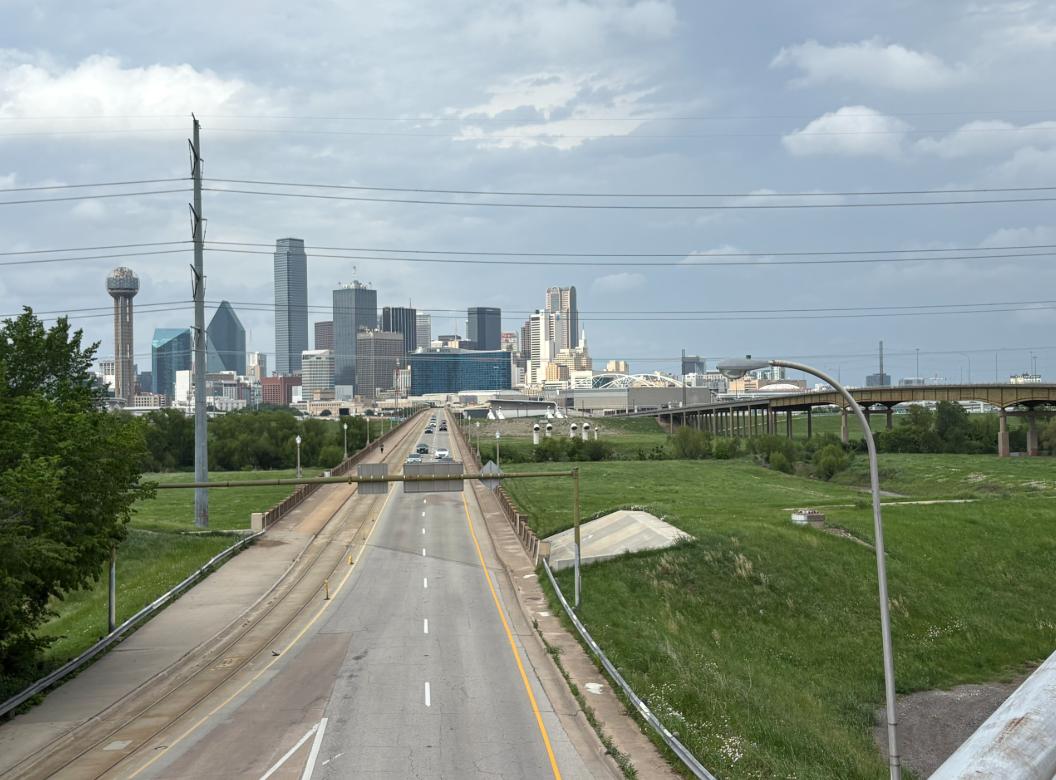
Under plans presented to City Council members at a late March meeting of the Transportation and Infrastructure Committee, the Houston Street Viaduct will become a pedestrian-only crossing following the construction of the expanded Kay Bailey Hutchinson Convention Center. The Jefferson Boulevard Viaduct’s traffic connection to the city’s urban core is expected to be rerouted under the plan.
That’s where the controversy arises.
It’s a familiar trope to frame the city’s southern and northern sectors as a tale of two cities. In terms of access to downtown, southern Dallas has decidedly fewer routes connecting it to the urban core — a discrepancy owed in no small part to the geography of the Trinity River.
Oak Cliff attorney and resident John Barr has lived in the area since 1980. While some are touting a safer route for pedestrians and cyclists, he says he’s opposed to any plan that takes cars off one of the bridges.
“Why would you want to cut off Northwest Highway from NorthPark [Center], and why would you want to cut off NorthPark from Preston Hollow? Why would you want to cut off University Park from Preston Road, or from Lovers Lane, or from any of the streets that connect it? It doesn’t make sense,” Barr said. “We want more connectivity.”
Officials Air Concerns
At present, the Houston and Jefferson bridges run parallel to each other as one-way thoroughfares. With the Houston Street Viaduct set to become a pedestrian route, city staff’s proposals addressed options to reroute traffic coming off Jefferson Boulevard into downtown, which they said is needed due to the convention center’s planned footprint. A viaduct, by the way, is essentially an elevated roadway that spans over low-lying land or a combination of obstacles.
Council member Chad West said the plans for moving traffic to a single bridge and updating on-ramps are largely based on the 258-page Oak Farms Corridor Study, which was completed in 2025. He also added that the Jefferson bridge will be closed for three years while the convention center is under construction, regardless of the proposed change.
In the meeting, Council member Cara Mendelsohn pushed back on proposals to reroute connections originally built around Reunion Arena.
“What they’ve become is essential for traffic, and we’ve got people coming to our building wearing these buttons that say ‘Connect the Core,’ and what this is actually doing is disconnecting the core.”
Originally, the convention center plan called for Jefferson Avenue to run underneath the building, which was supposed to be raised to accommodate the connection. That’s no longer viable, said staff, who explained that elevating the convention center would cost roughly $500 million as the price of steel and other construction costs rise.
The option preferred by staff involves dead-ending Jefferson at the bridge’s end with a stoplight and diverting traffic onto Hotel Street, a two-lane road in each direction that straddles the southwest bend of downtown around the convention center. That would require commuters to circle the center rather than take a straight shot downtown.
“I feel like you’re cutting something that’s really essential to the future of our entire city and how that traffic moves.”
Other council members pushed back on the plan, advising staff to consider alternative routes and engage further with community stakeholders. In a memo, City Manager Kimberly Bizor Tolbert said staff would reevaluate an option that includes a phased approach and conduct traffic studies. An update is expected at a May committee meeting.
‘Where’s Hotel Street?’
Emma Ruby
Between the two one-way thoroughfares, the bridges have five lanes of traffic, with a bike path on the Jefferson bridge and a Dallas Streetcar line on the other viaduct. With the proposed change, Jefferson would become a two-way, four-lane road. The bicycle path would be removed to shift cyclists to the newly vehicle-free Houston bridge.
Barr said he’s not opposed to the idea of a cyclist-friendly city, but thinks there are larger concerns.
“I ride a bicycle. I wrote a check for a $4,000 bicycle. I’m not a casual bicycle rider,” he said. “The point is we got to have people get to work, and got to have people from downtown come over here to Oak Cliff.”
Led by the North Texas Council of Governments (NTCOG) and the city’s transportation department, the Oak Farms Corridor Study found that “Viaduct geometry, capacity, and traffic configuration may present obstacles to ongoing redevelopment activities and long-term functionality.” A preliminary model found that a two-way reconfiguration “may” be able to accommodate traffic needs, although a comprehensive traffic study has yet to be completed.
The residents and stakeholders in North Oak Cliff Barr spoke with, he said, aren’t thrilled with the proposal.
“There’s nobody that’s in favor of this, not one business is in favor of this,” Barr said.
A virtual community meeting on the proposed changes is expected to be held soon
Barr said he’s concerned that the plan could hurt businesses and developments in North Oak Cliff. The corridor study recommended new roads for a 35-acre development led by Cienda Partners located on Jefferson Boulevard on the south side of the river.
“We have to be fair to Cienda; those people bought Oak Farms. It can be really nice,” he said. “We have to be fair to Methodist Hospital, and we have to be fair to all the people that live over here.”
Brett Shipp, a former broadcast journalist and Oak Cliff resident who’s helping Barr organize resistance to the plan, isn’t as opposed to the idea of redirecting all traffic across one bridge. But he said to make it work, the Jefferson Bridge needs to facilitate traffic better than the current setup does.
“Whenever there is a backup and a bad accident on 35, traffic into downtown Dallas is rerouted. Well, it comes down either Marsalis to the Jefferson bridge, or down Beckley to the Jefferson bridge,” Shipp said. “Now they’re talking about turning that into from three into two lanes. That’s just insane. It is such a non-starter. It’s almost funny.”
And if the city moves forward with the staff-preferred change, he said, removing direct access to downtown with a convention detour will create problems for commuters.
“I think it would just be more confusing for people coming into downtown,” Shipp said. “It’s more difficult for people to find Hotel Street. Where’s Hotel Street? How do we get to Oak Cliff? I mean, do I take a right or take a left? Where are we headed here?”
A Chance for Multimodal
At the March meeting, West, who represents District 1 in Oak Cliff, said he “didn’t love” any of the options put forward by staff and acknowledged that “there’s no easy solution.” Still, of the options put forward by staff, he said he also preferred the Hotel Street detour.
He’s supportive of the plan to turn the Houston Street bridge into a pedestrian crossing overall and told the Observer he feels his community is behind it as well.
“I think it’s a good plan that has been supported by community members and neighbors,” West said. “Car commuters are only losing one vehicular lane… it would still include four lanes of traffic, two going in each direction. So from my end, and from what I’ve heard from neighbors for the last couple of years, that is the preferred configuration.”
He said he thinks the options put forward by staff are largely aligned with the corridor study, and that the only significant change is the proposed Hotel Street connection, which, again, he has concerns about.
The NTCOG seems to have been left out of the process thus far, despite its leading role in the corridor study that’s being used as a template for changes to the viaducts. Michael Morris, transportation director for the NTCOG, told the Dallas Morning News earlier this month that he thinks the convention center detour will force commuters onto congested roadways and hasn’t consulted NTCOG.
“Which is concerning to me,” West said. “They absolutely need to be brought into the conversation, and so folks just need to get out of their silos and work together and make sure we communicate with the community.”
West said his support for the plan comes from the opportunity for multi-model transportation. The corridor study includes a bike lane in each direction on Houston and proposes extending the Dallas Streetcar. Both the plans put forward by the study and the city allow for the potential addition of another streetcar track, the Morning News reported.
The council member often cycles on the Jefferson Viaduct’s bike lane, he said, which can be dangerous given the vehicle traffic and the lack of a significant barrier.
“It’s harrowing getting across that bridge, across Jefferson Viaduct. It’s scary taking children through downtown on the streets,” West said. “I went on a 25-mile bike ride over to White Rock Lake and then down the Katy Trail over the weekend. And the most dangerous part of going into downtown was going over the Jefferson Bridge.”
In 2025, the council approved the first update to the city’s bike plan in 14 years. At the time, the city had around 204 miles of bike paths, many of which are unprotected along busy traffic routes. Dallas is also far behind cities like Austin and San Antonio, which has over 600 miles of bike lanes. West has been vocal in his calls for safer streets and fewer pedestrian and cyclist injuries.
There have been two fatal collisions involving cyclists and 13 involving pedestrians in 2026, according to the city’s Vision Zero Plan dashboard.
Whatever the path forward is, traffic from the Jefferson bridge will be diverted onto Houston during construction. Pedestrians and bicyclists will be rerouted along Beckley Avenue, West said, adding significant travel time to their routes downtown.
He still doesn’t have enough data to recommend a path forward, he said, and will communicate with residents as the process unfolds.
“For cars. It becomes a trade-off… This affects me personally, just like it does a lot of neighbors,” he said. “I use it at least once a day. And we’ve got to be thoughtful of people making their daily commute via car to downtown and back, or taking kids to the Montessori school over there and back each day. And a big part of that is understanding how this configuration that’s being proposed by city staff at Hotel Street will add to their commute at the end of the day.”
Peddling Forward
Oak Cliff is home to Dallas’ first dedicated bike lane on Bishop Avenue. That’s something cyclist advocate Jonathan Braddick, a board member of the Dallas Bicycle Coalition and Oak Cliff resident since 2006, is proud of.
He’s supportive of the proposed changes and said that the coalition won’t support any changes to cycling access as proposed by staff and the study. While he knows traffic will be impacted with construction, Braddick said car commuters will adjust.
“There’s obviously going to be more traffic on Houston, but what will happen again, people will find alternative routes,” he said. “They’ll adjust to the traffic pattern for the temporary closure, just like anywhere else it happens.”
He said his main question on the plan centers around how cycling routes will be diverted during that time and “urges the city to release that information as soon as possible so we can clear up any kind of confusion.”
Overall, the proposed change feels like a logical next step for him.
“We feel like this is a natural progression of these bridges,” he said. “And making sure that you’re not removing vehicular traffic, you’re shifting vehicular traffic, and you’re separating it, and that’s ultimately the best practice when it comes to planning for multimodal transportation.”
On the other hand, Barr, still vehemently opposed to the plan, said it won’t just hurt his neighborhood.
“It’s not only important to Oak Cliff; it’s very important to the people downtown,” he said. “I buy my groceries at Whole Foods and Tom Thumb downtown, that’s where I go across the bridge and buy my groceries. I cross the bridge to go to church. I mean, it’s foolish.”