
Jason Mendez/Getty Images for Netflix

Audio By Carbonatix
When Emmy Award-winning director Greg Whiteley first came to Dallas in preparation for “America’s Sweethearts: Dallas Cowboys Cheerleaders,” he experienced the high-octane “Thunderstruck” dance routine for the first time. He was surprised to see the crowds looking at their phones, slowly finding their way to their seats, not paying much attention to the girls who had bled and sacrificed so much to get the chance to perform on this stage.
After the success of his Netflix docuseries chronicling the cheer team’s season, he noticed people were still on their phones, but instead of doom-scrolling, they were now recording the performance, captivated by the signature pre-game routine.
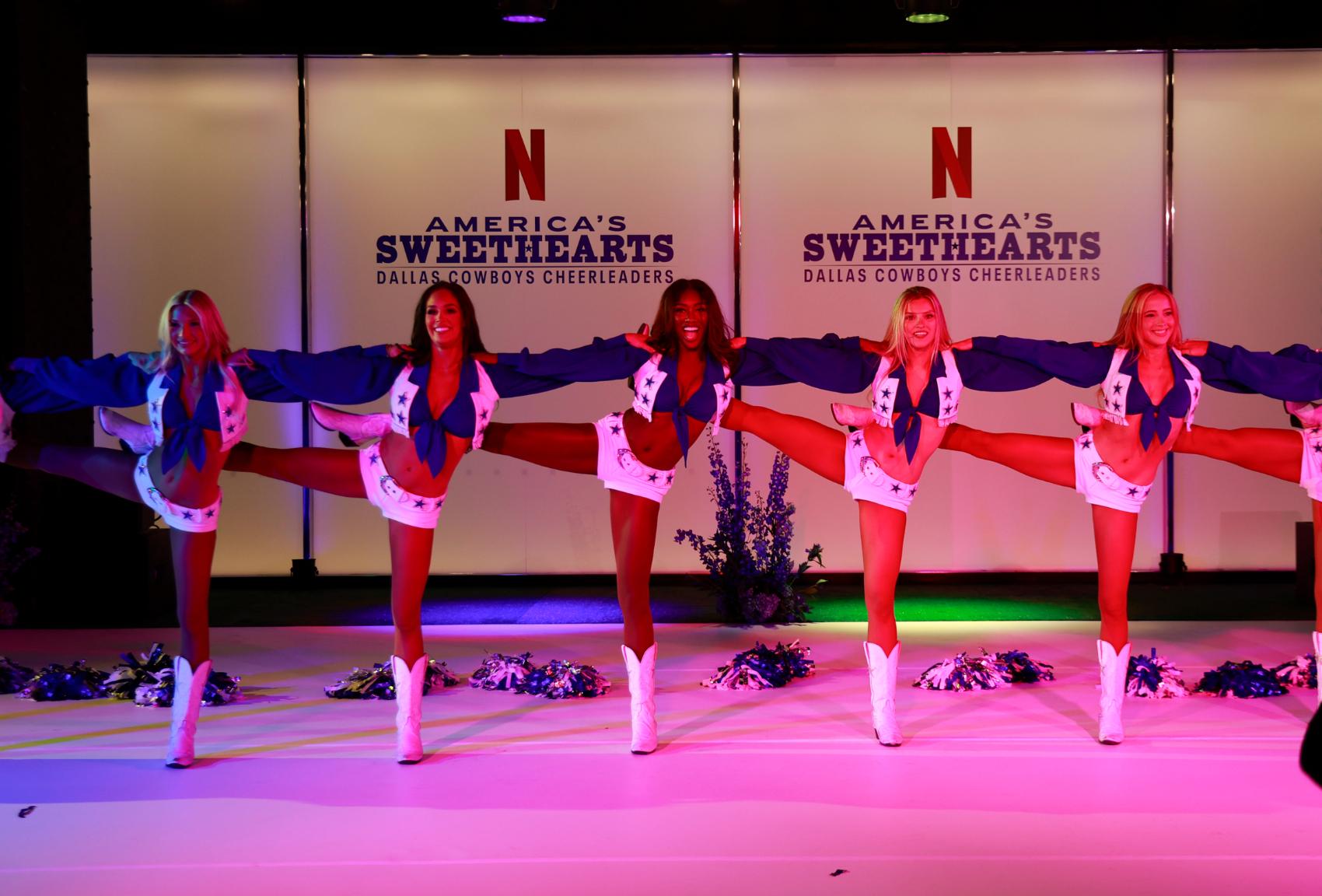
With a nationwide tour, millions of followers on social media, and big brand partners like the cosmetics line Charlotte Tilbury, the recently released third season of the show follows the cheerleaders as they grapple with their new level of attention and mounting pressures, chronicling the veteran members’ efforts to balance viral visibility with the pursuit of perfection.
With the life-changing experiences that the cheerleaders have gone through, Whiteley remarked that it would be “impossible” to tell this year’s story without accounting for the fact that their profiles have been raised to new levels that haven’t been seen within the brand before.
“They’ve always been famous,” he says. “The Dallas Cowboys Cheerleaders (DCCs) have been a world-recognized brand since the mid-70s, but I don’t think the cheerleaders as individuals had ever become famous in this way. During Season 1, we were documenting not just the DCC as a whole, but these individuals and what it’s like to be a cheerleader. The natural by-product of that is that you get to know them as people, and then the natural by-product of that is that some of them become famous. With that comes some perks, and with that come some downsides.”
Come hell or high kicks
Alongside highlighting the privileges of becoming a DCC, like a marketable spotlight and a paved road to full-time influencing, Whiteley also captures the challenges and pitfalls they might face. This authenticity is what makes “America’s Sweethearts” such a popular show, watched by a global audience.
“One of the things audiences respond to is when you can take a stereotype, crack it open, turn it around and show it in a different light. I think there’s something deep down in all of us that hopes that’s true of ourselves as well … When you see it’s true of somebody else — someone beautiful and seemingly flawless who looks like they couldn’t possibly have a problem in their life — and then you discover that they wrestle with many of the same insecurities, issues and problems that we all do, there’s something comforting in that. I don’t think we feel quite as alone in our own struggles when we learn that,” Whiteley says.
Working on the third season, the returning cast members have become more accustomed to media attention and to preserving character, and Whiteley has had to reimagine how to capture the girls’ authentic experiences and emotions to deliver the captivating series his audience insatiably devours.
“What we’ve learned over time is simply to give it time,” he says. “The muscle it takes to put on a facade that may not be your most authentic self requires a level of energy that’s unsustainable. If we can just wait that out, a more real, but also a more flattering, portrait invariably results.”
The moments captured by Whiteley’s patience in “America’s Sweethearts” are what differentiate the program from its very successful predecessor, “Dallas Cowboys Cheerleaders: Making the Team,” which exclusively featured the team’s cutthroat audition process, and rarely cataloged the emotional rollercoaster experienced by both the girls and the commanding duo at the DCC helm, Kelli Finglass and Judy Trammell.
“I’ve always been fascinated by the fact that the things we try to edit out as humans when somebody is taking our picture or chronicling us in some way are often the very best parts of who we are — the flaws, the quirks, the things that make us human, relatable and empathetic,” Whiteley says.
A Texas-sized team
Raised in Washington, Whiteley felt it was important to immerse himself in Texan culture to truly understand the magnitude of sports in the city.
“Texas has been a great gift and a blessing to this show,” he says.
The city of Dallas is damn near a supporting role in the series, and the skyline, one of the best in the country, makes more cameos than we can count. Eagle-eyed viewers may have even seen the “Observer” get a shoutout last season.
“They say everything’s bigger in Texas, and when you’re trying to make a show about people that ambition for bigness is actually a good thing,” Whiteley says. “I don’t think it’s an accident that the most famous football team and the most famous cheerleading squad in the world both exist in Texas. I think the Dallas Cowboys Cheerleaders could only exist in Texas.”
“America’s Sweethearts: Dallas Cowboys Cheerleaders” was released exclusively on Netflix on June 16.