
Emma Ruby

Audio By Carbonatix
Last week, a couple in Red Oak, Texas, decided they’d had enough.
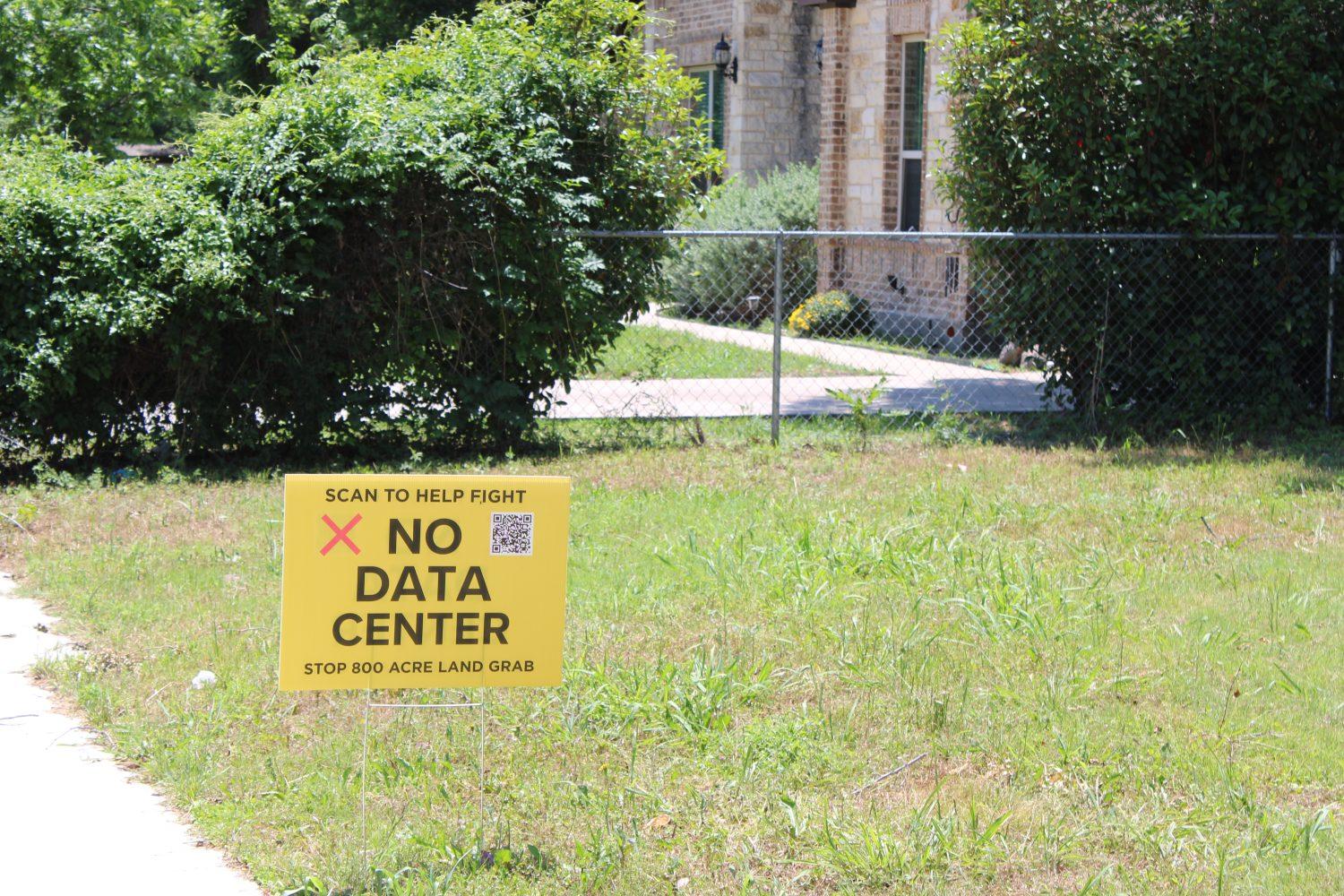
Over the last year, the town has found itself at the center of Texas’ data center boom. On one end of town is the 300-acre DataBank campus, where imposing gray data centers have sprouted up amongst pasture land. On the other side of town, Compass Datacenters’ 830-acre facility was recently approved by the town council.
In total, six sprawling campuses have been built or approved for the town of fewer than 15,000 residents, despite community concerns about the impact on traffic, infrastructure, and noise and light pollution.
So Deanna Tiffany’s husband got on his lawnmower and did what a man cutting grass does: he rode. He rode until the phrase “NO DATA CENTER” was cut into his land, large enough for anyone flying overhead to see.
“I don’t want them in my neighborhood,” Tiffany told WFAA.
Texas has the second-most data centers of any state in the U.S., with more on the way. Dallas-Fort Worth, in particular, has emerged as a hotbed for data centers, which house servers that power programs like ChatGPT and OpenAI. DataBank, a leading data center developer, cites the robust workforce, geographic connectivity, infrastructure and state tax incentives for fueling North Texas’ boom.
But as public opinion has shifted away from the massive developments, state leaders have also begun questioning their role in Texas. Last month, Gov. Greg Abbott unveiled recommendations for sweeping new policy changes he is asking the state Legislature to consider in 2027. Among the priorities are requirements that data centers pay for their own infrastructure costs and add power generation to the state grid.
“We must prohibit them from building AI data centers in rural Texas neighborhoods,” Abbott said during a campaign stop on June 30. “I made clear already: Any AI data center even thinking about coming here — they got to bring their own money, bring their own power, reuse their own water and do it in a way that reduces the cost of electricity for residents across our state.”
Abbott also highlighted the state sales tax exemptions for data centers as an “outdated” incentive in need of fixing. According to the Texas Tribune, Texas is losing more than $1 billion in tax breaks each year to data center development, a figure lawmakers could never have anticipated more than a decade ago, when the breaks were approved.
Data center skeptics are also asking for stricter reporting requirements for the centers’ energy and water consumption. As Texas grapples with surging energy demand, some centers have already anticipated requests like Abbott’s — for the centers to provide their own power source. That in itself, though, causes a new environmental concern.
More and more frequently, the data center industry is turning to gas power plants to fuel their facilities. A new report by the Environmental Integrity Project identified 32 gas plants dedicated to powering data centers across Texas, likely due to more favorable tax breaks enacted by state leaders. In 2024, Abbott and Lt. Gov. Dan Patrick introduced a $5 billion energy fund that offers low-interest grants and loans to gas-fired power plants, provided the plants dedicate energy to both a nearby data center and the state grid.
Seventy-four gas plants have been built nationwide, and their environmental impacts could be severe. Altogether, the plants will be able to generate enough energy to power the state of California three times over, and the report claims that the pollution emitted as a side effect would be equivalent to what is produced by the entire nation of Australia in a year.
The Texas plants could be responsible for 287 million tons of greenhouse gases annually, all while emitting thousands of tons of particulate matter, the microscopic air particles that can get into a person’s bloodstream or organs if inhaled.
“What is the point of winning the AI race if it costs the lives of the people you’re supposed to protect?” said Kendra Seawright, organizer for the Texas-based group Panhandle 1 which is fighting a West Texas data center, in a statement.
The gas plants closest to Dallas are planned for Hood County, Hill County and Anderson County.