
Preston Barta

Audio By Carbonatix
Advertising Can't Do It Alone
The challenges facing local news organizations are very real. That's why reader support matters more than ever. If you believe independent journalism matters, make a contribution today and help us reach our summer fundraising goal of $12,500 by August 9.
There’s a strange arithmetic to “Boyhood.” Most movies celebrate their anniversaries on the round numbers, the tens and the twenty-fives. But a film shot over a few weeks at a time, over 12 patient years, earns the right to mark 12 more.
“We’re the only one who kind of qualifies to do a 12-year anniversary that isn’t entirely arbitrary,” director Richard Linklater said. “But it was really just a delay tactic.”
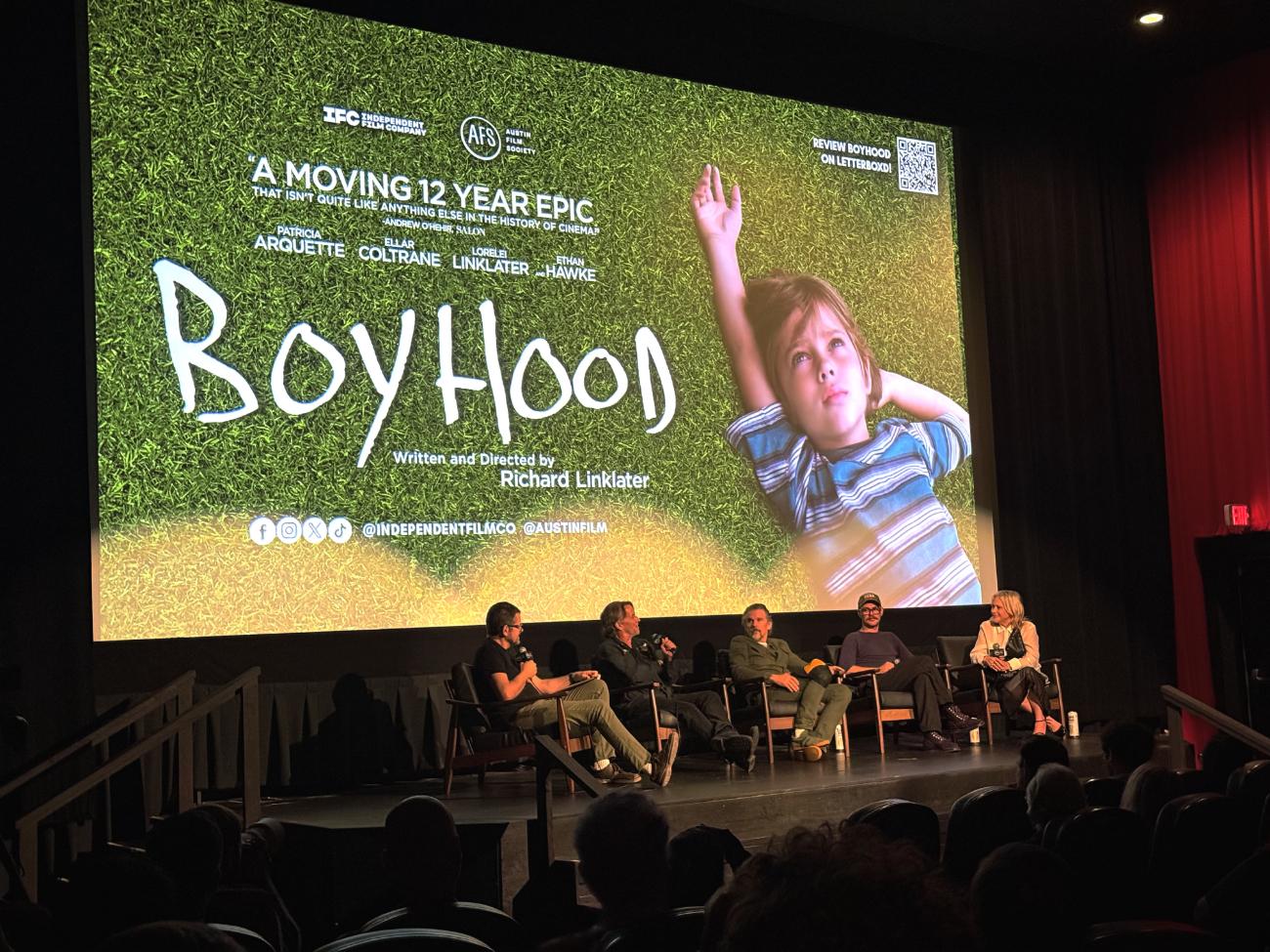
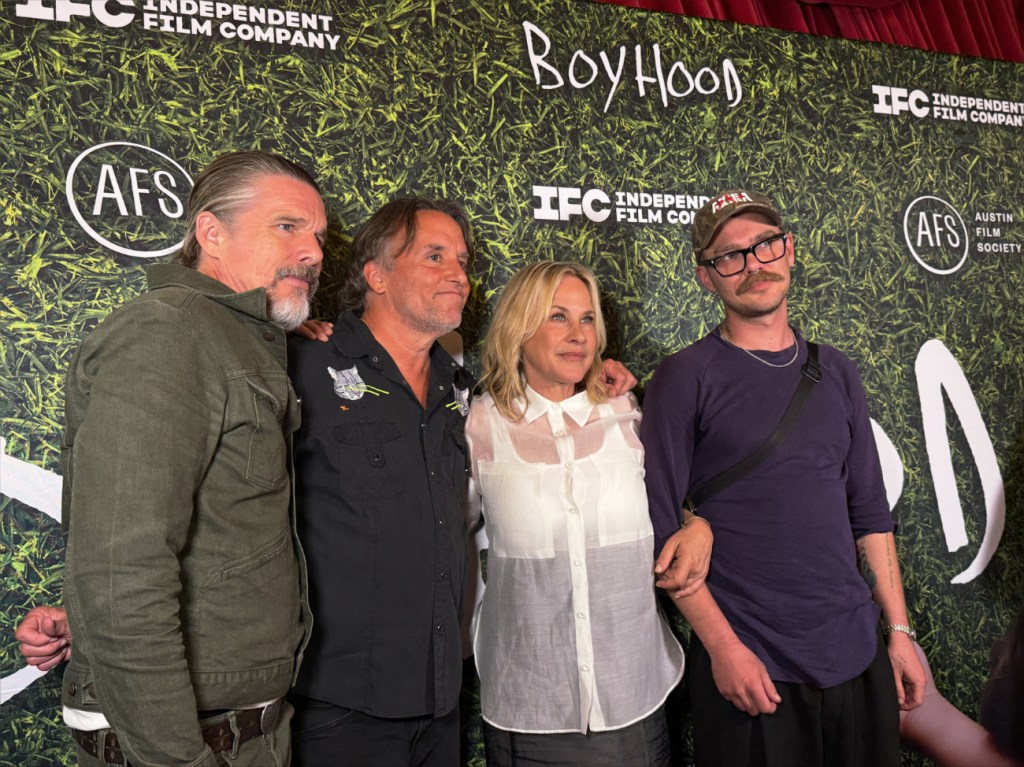
Delay tactic or not, on July 18 the cast gathered at AFS Cinema in Austin — the theater Linklater built, in the city where the film was born — for a one-night reunion. A red carpet. A screening. A room full of people who had, in some quiet way, grown up alongside Mason Evans Jr., the child at the heart of “Boyhood,” played by Ellar Coltrane.
“If I have an orientation point in this world”
Ask most movie stars about Dallas, and you’ll get a polite press-stop pleasantry. Ethan Hawke — who plays Mason Sr., father in the coming-of-age film — gave us something else entirely.
“My father lives in Dallas, and my mother lives in Fort Worth, and if I have an orientation point in this world, I guess that would be it,” he says in an interview with the Observer after the screening. “It’s a huge part of my psyche and worldview, and it means a tremendous amount to me. I wouldn’t be on the phone right now with any other paper.”
His father lived in Arlington for a long stretch of his own boyhood, and Hawke’s earliest picture of Dallas was through a car window.
“My real memories of Dallas were riding in the car with him as a kid,” he says. “Sometimes he would have to work on Saturdays, and he would drive me in. We didn’t have air conditioning in the car either, so it’s just unbelievably stiflingly hot.”
And there, hanging over that sweltering commute like a patron saint of the interstate: “The giant red Exxon horse in the sky I always liked.”
He remembers the sprawl, too — the endless ribbon of commerce between the two cities convinced a young Hawke he had the region figured out.
“It seemed like all of Texas was a strip mall, because the drive between Dallas and Fort Worth does kind of seem like that. I basically thought everyone sold cars because that’s what it seemed like happened in Arlington.”
But the affection underneath is unmistakable.
“I just have nothing but love for the place, and largely for the people who raised me.”
That Texas gravity has shaped his whole career, mostly through one friendship.
“One of the great blessings of my life is my friendship with Richard Linklater,” he says. “That’s brought my life and my work back to Texas for my entire adult life … I wish I had gone to UT because I would have met Rick 10 years sooner.”
The movie the internet froze
“Boyhood” captured a childhood that already feels analog — bike rides, unlocked doors, kids vanishing into an afternoon and drifting home by dinner.
“[Kids today are] going through the same experiences,” says Hawke. “One of the things that’s wonderful about being an actor is when you do these Shakespeare or Chekhov plays — what people are really worried about is falling in love, getting along with their parents, understanding their identity and how to overcome adversity. The clothing changes, the phones, swords, guns — the superficial accouterments of life change wildly. But what’s essential remains, and that’s what people are most attracted to.”
Preston Barta
Linklater, on the carpet, arrived at the same truth from a different door.
“There’s something eternal about the maturation process,” the director said. “If we started today, it’d be different, but I don’t think the relationships would be noticeably that different.”
He’d expected the film to look like a time capsule, but instead, one event flattened everything. When “Boyhood” opens, there are no smartphones; by the end, they’re FaceTiming, and nobody blinks.
“The big event that happened was the internet,” Hawke noted. “So, it kind of froze a lot of other elements.”
But even through the digital revolution, “Boyhood” remains a poignant piece on parenting and being parented.
“It’s an essential conundrum as a parent about whether you’re trying to save your child pain, or whether we accept the fact that pain is the source of growth,” says the actor. “The point of life is not to not suffer. The point of life is to live.”
A song of humans
For Patricia Arquette, revisiting Olivia — Mason Jr.’s mother in the film, and the role that earned Arquette an Oscar win — meant revisiting herself.
“I have so many layers in this movie,” she said on the red carpet. During the 12 years of filming, she got married, divorced and lost both parents. “This next phase I’m in now, which is like the Crone phase — what do you want to do? What are you interested in? Almost like a rebirth, but almost like a new childhood.”
She described the film as a reflection of humanity.
“To me, this is a song of humans,” she said. “Not of two, but of all. The American experience of growing up in this time and families that stick together and how they try to make it work.”
Twelve years on, the movie keeps a mirror held up over a stiflingly hot Texas highway, the red horse still glowing in the sky. “Boyhood” returns to theaters beginning on July 31. If you’ve grown up at all since 2014, go sit with it. You’ll recognize someone in that dark. Probably yourself.