
Steve Visneau

Audio By Carbonatix
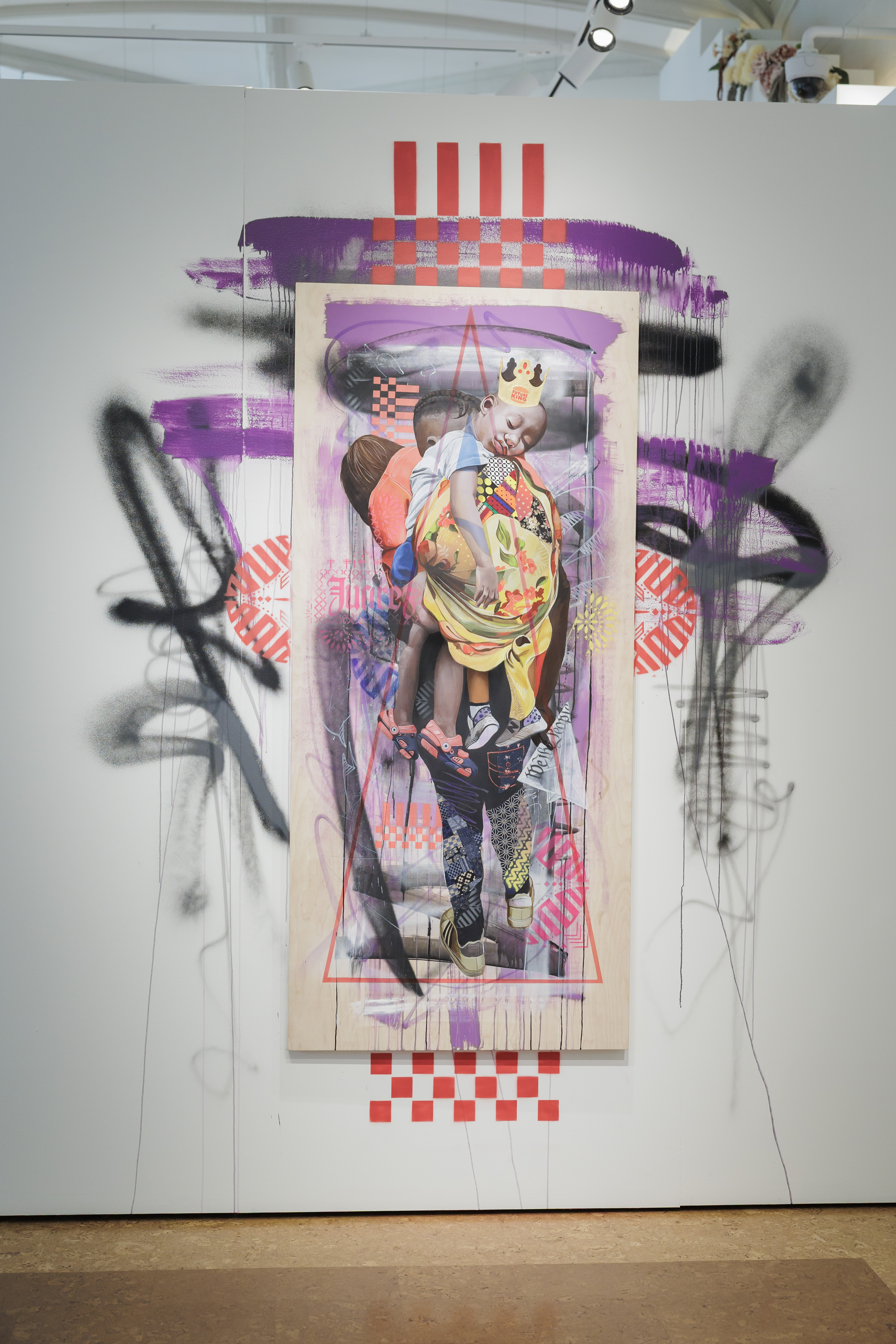
Soon after his family crossed the border and settled in Old East Dallas, muralist Victor “Marka27” Quiñonez’s father was deported for the first time. At four years old, he didn’t understand what happened until his father was deported again in the late ‘80s when the artist was 10. By the time he was a teenager, his father, a day laborer, was deported a third time.
In the ‘90s, Old East Dallas was riddled with crime, and turf wars between rivaling gangs ruled the area. Surrounded by violence and constantly fearing deportation, Quiñonez’s only solace was street art, bringing vibrant color to underpasses and building walls. An undeniable skill granted the young artist enrollment at Booker T. Washington High School for the Performing and Visual Arts, and then a full-ride scholarship to the School of the Museum of Fine Arts at Tufts University.
Earlier this month, after the artist achieved national recognition, he had two scheduled installations in North Texas, one titled Ni de Aquí, Ni de Allá (Not From Here, Not From There) at the University of North Texas College of Visual Arts and Design (UNT CVAD), and another, Elevar La Cultura, at the Latino Cultural Center (LCC) in Dallas.
But the exhibit at the university, which had several references to Immigration and Customs Enforcement (ICE), was canceled without warning or explanation. Now, the charged messages that brought him national recognition are launching him back into the spotlight, this time, ironically, because of censorship.
“I’m fighting against something that is pushing so hard to take away the humanity and the people that they’re affecting,” he says of the university’s installation closure. “If I’m showing the beauty and the humanity in people that are being affected by this administration and everything that’s going on with immigration right now, then it’s not suiting [people in power’s] purpose.”
In the face of the impromptu closure, the community rallied around Quiñonez, demanding an explanation, which has yet to be provided. The artist, who spent decades voicing the struggles of undocumented citizens, finds himself silenced. But it won’t stop the artist from shedding light on the current administration’s immigration approach, as the art inspired by his childhood as a proud Mexican immigrant breaks through with colorful messaging.
Art Imitates Life
In the absence of his father, Quiñonez’s family depended on the community of other immigrants facing the same struggles.
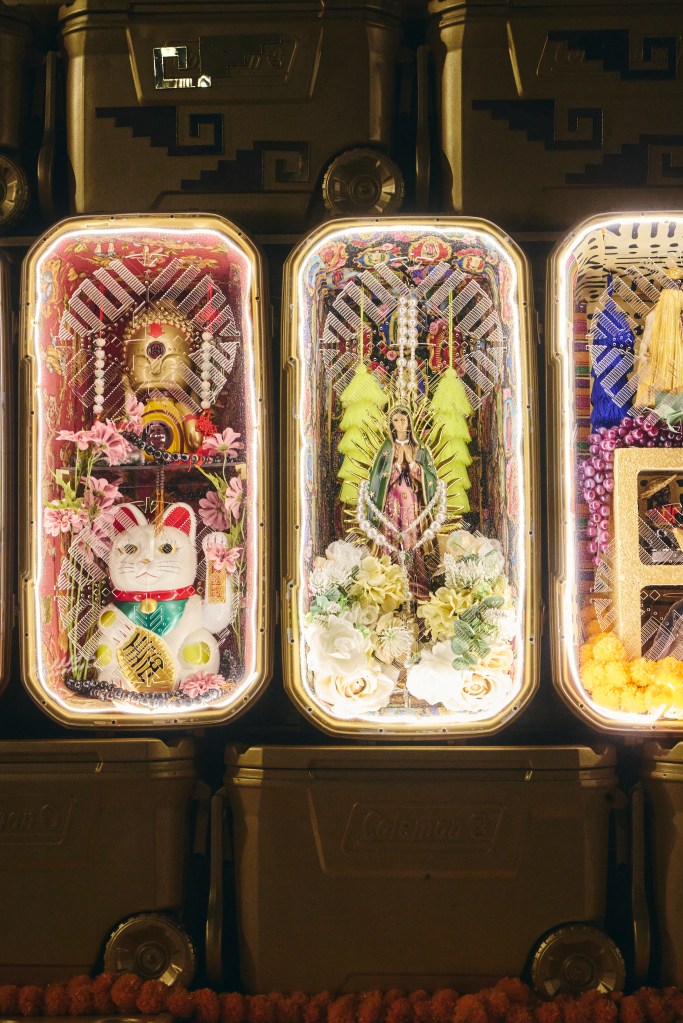
“When my father was deported, women would support each other when they knew that their husbands were deported or were no longer able to help,” he says. “There were many times that [street vendors] would just give us food from the coolers, and I would never see any money being exchanged. Those are some of the memories that I have as a kid about community support for each other when they know there’s some challenges going on.”
Moments like those influence his work now. Coolers, a building block for undocumented citizens’ livelihood, build Elevar La Cultura, a 22-foot Mesoamerican-style pyramid constructed from the barbecue staple. The center row of coolers is converted into ofrendas, traditional honorific altars common in Mexico. The work defines Quiñonez’s signature style, which he describes as “neo-Indigenous.” The art is a fusion of traditional art from the Mexica people of the Yucatán Peninsula and graffiti street style, an homage to his identity as a Mexican-American.
“I thought it was such an interesting object to work with because it means the complete opposite to most people,” he tells us. “They look at a cooler, and they think about tailgating, they think about the Fourth of July, they think about barbecues. It means that you’ve made it and they’re used for leisurely things. But for immigrants and people who just got here, it’s actually a tool for survival.”
The artist pinpoints attending Booker T. Washington as a turning point in his life. There, he discovered the work of Los Tres Grande – Diego Rivera, José Clemente Orozco and David Alfaro Siqueiros, the three Mexican master muralists who played integral roles in reshaping culture after the Mexican Revolution in the ‘20s.
“I saw what the Mexican masters were doing and how they were creating artwork that was about social justice, that was really fighting against the Mexican government, which at the time was exploiting laborers, exploiting Indigenous people,” he says. “It gave me a voice as a very young man to think about, not just doing graffiti, but doing things for the sake of the culture. I wanted to do something that was reaching a broader audience.”
His desire to create boundlessly led to his arrest in early adolescence. Charged with vandalism as a teenager and handed a punitive 30-day sentence, the stern slap on the wrist prevented Quiñonez from gaining citizenship. After several application rejections, his lawyer advised him to wait until Donald Trump’s first presidential term ended before applying again. After more than four decades living in the United States, he became a legal resident in 2022.
Living with the awareness that, without citizenship, he would face the very real fear of deportation under the current administration, Quiñonez’s art emphasizes the humanity of immigrants.
“[This] has nothing to do with protecting the borders and everything to do with making a terrible, corrupt system even more powerful,” he says. “The biggest message [in my art] is that this is a humanitarian issue. It’s not an immigrant issue.”
All Art is Political
The anti-ICE exhibit at UNT, which opened Feb. 3 and was scheduled to remain on the campus until May 1, was covered from view just a week after opening. The nationally touring installation, which was on its second stop at the college, won the Frieze Los Angeles Impact Prize in 2025.
The artist wasn’t aware that his work was being removed until students from the university began reaching out on social media. Quiñonez still has not received a detailed explanation from university officials, who informed him of the closure in an email with fewer than 100 words.
“I created Ni de Aquí, Ni de Allá to honor the in-between spaces so many of us live in,” reads an official statement from the artist in response to UNT’s move. “To have the work installed, welcomed, and then suddenly hidden behind covered windows without explanation feels like being told, once again, that our stories are too uncomfortable to be seen.”
While administration remains tight-lipped, students and faculty have openly condemned the school for alleged censorship.
“Its removal, carried out silently and without accountability, echoes the very condition the work sought to illuminate,” wrote the college’s faculty in an open letter to the university. “In this moment, we find ourselves occupying that same in-between space: caught between institutional values that are publicly affirmed and actions that remain unexplained.”
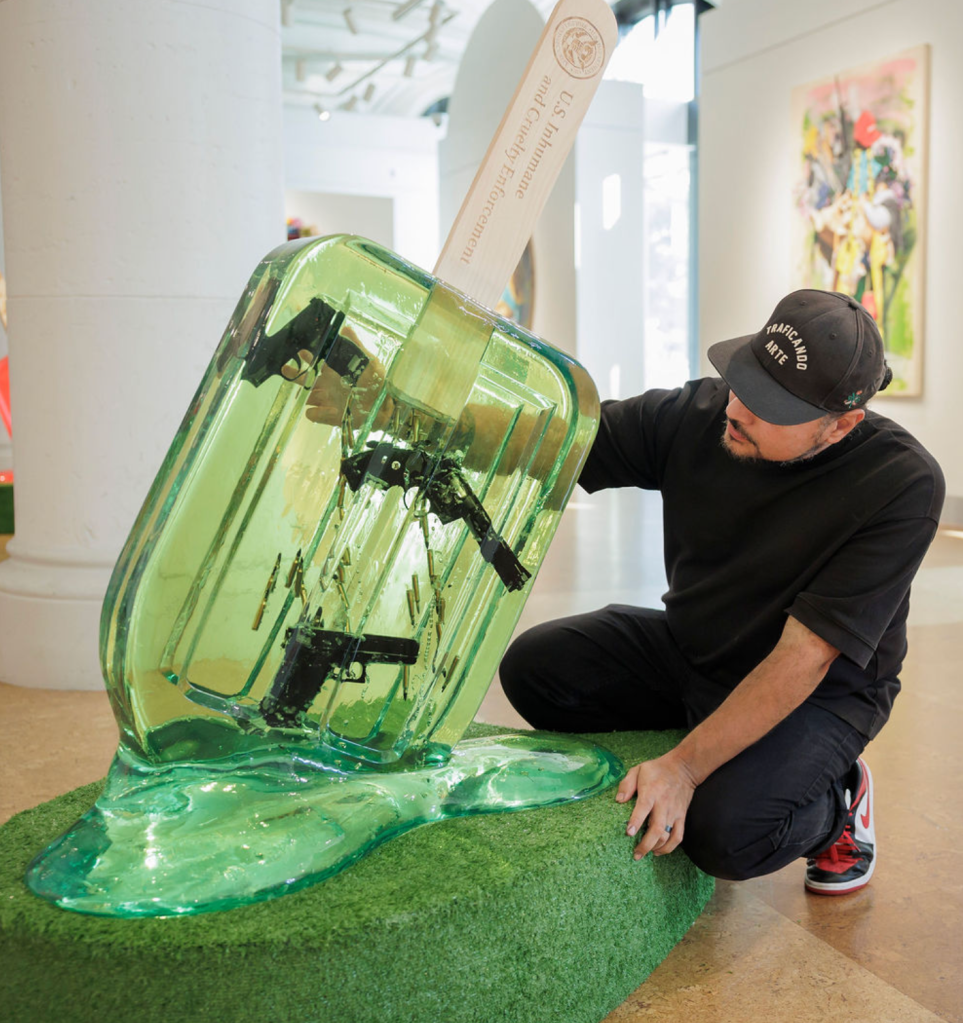
An open letter from graduate students at the college expressed the same sentiments, and a memorial for the installation, with veladoras (candles placed in ofrendas) lit in remembrance.
“These actions have created an atmosphere of uncertainty and fear among students and employees,” reads an open letter from the school’s master’s students. “This has had a chilling effect on free speech across the college. Many now question whether presenting challenging ideas in their artwork or even discussing recent censorship events could expose them to retaliation.”
Amid the controversy, the region continues to celebrate Quiñonez and his unique style. An opening ceremony for Elevar La Cultura, hosted by the LCC just a few days after UNT removed Quiñonez’s art, sold out with over 300 attendees.
“[This] sheds a light on how effective art can be,” Quiñonez says. “Exhibitions, murals, public art – it’s therapy. It’s art therapy. It’s healing. It’s also empowering. When we hear music, when we see something that moves us, the feeling becomes more important than the actual work. What people are feeling right now is a deep injustice, and they want to restore their faith in humanity, their faith in their university.”
Elevar La Cultura is on display in the LCC courtyard through March 30. The work that was on display at UNT has been returned to the artist.