
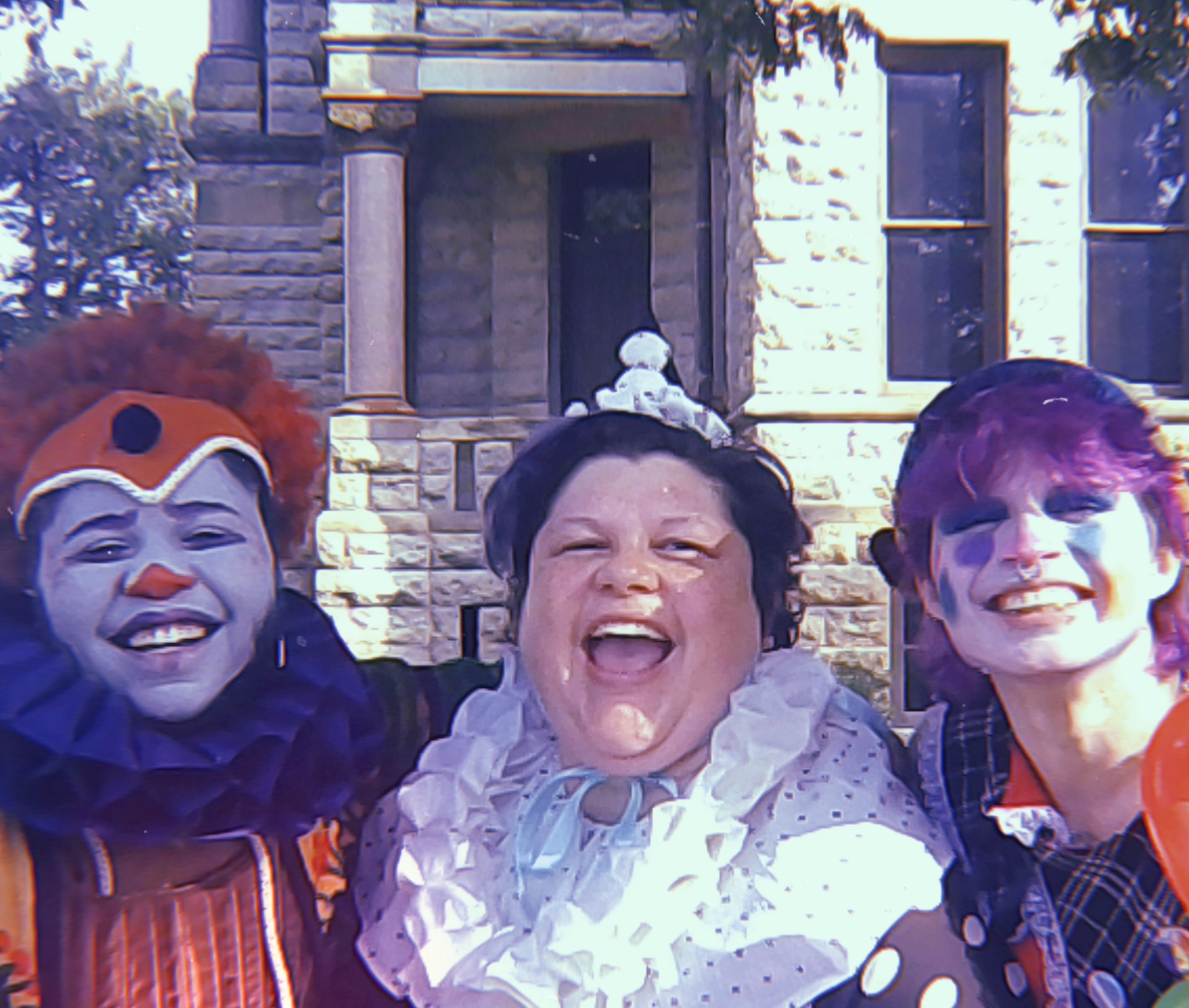
Courtesy of Denton Clowns

Audio By Carbonatix
Once a month, the city of Denton is invaded by a troupe of novice clowns. With red noses and garish clothing, the troupe engages in true tomfoolery in the name of community. Without staging performances, the Denton Clowns are a group that dons their clown apparel for nothing other than fun.
The outing started when three friends saw a clown picnic in Minneapolis on social media. Wanting to participate, they decided investing in checkered-print pants and big shoes was much cheaper than a flight to Minnesota, and they could stage their own clown picnic in the Denton Downtown Square. With a flyer and a dream, the three organized the event, expecting a low turnout.
When 40 clowns unpacked from their tiny cars, the group knew they had found their unlikely calling. Since then, the group has hosted a series of monthly events at varying locations, ranging from picnics to craft nights.
“There’s a real desire in DFW for clown-themed events,” said one of the organizers, Jeanette Laredo, who had never dressed as a clown before hosting the event. “We tap into a desire for clown events that aren’t performative, that aren’t a show for people.”
Laredo said clowns from across the region attend and bring all their tricks of the trade. Experienced clowns have led impromptu juggling lessons, balloon sword fights break out and one time the clowns all joined together for a kazoo symphony.
“We don’t have backgrounds in clowning,” Laredo said. “I feel very strongly that anyone could be a clown… I like to say ‘I was a clown all my life, and now I’m just putting on the uniform.’”
Laredo says the lack of experience and the limited rules are what keep the informal troupe together. Less of a performance group, the Denton Clowns offer social networking for those celebrating absurdity with a few ruffles and paint. Since the first event in December, attendance has remained high.
“I like to say we are by clowns, for clowns,” she said. “A bunch of clowns getting together on the square really naturally attracted people.”
Escaping the Madness
For most of the clowns in the troupe, the silly escape from reality is needed in perilous times, and Laredo says it’s not a coincidence.
“We’re repeating history,” she said. “All artists embraced absurdity and surrealism because of the horrors of World War II — I feel like that’s what we’re doing. Collectively, as clowns, we are choosing to embrace joy as a form of resistance.”
In 1942, Coco the Clown famously entertained British troops. Legendary mime, Marcel Marceau, created his character, Bip the Clown, in 1947. In 1946, American audiences were introduced to the oft-referenced Bozo. For Laredo, her troupe of novice clowns is an homage to the past, and an escape from the present.
“Clowns are levity when times are dark,” she said. “Jesters can speak truth to power because they’re buffoons. Clowns have always protested injustice.”
Clowns Are Scary
Coulrophobia, the fear of clowns, is a widely accepted phenomenon. And the horror genre has no shortage of jagged-tooth, face-painted, inaudible slaughterers. It wasn’t too long ago that the “killer clown” mass hysteria kept front doors double-latched. Laredo acknowledges that clowns can be unsettling, but says her gaggle has yet to experience a negative reaction.
“[Clowns] are freaky,” she said. “I think it has to do with the heavy makeup and how it obscures the face… Part of the fear of clowns is not being able to really know how they feel, and that forced fake frivolity can be unsettling to people, especially people who crave authenticity.”
One of Laredo’s co-founders, a first-time clown named Maxby, was hesitant at their first meetup, knowing the negative connotations of clowns. But the fears faded fast.
“People are going to judge us anyway, so might as well have fun with it and break a little bit of that societal mold, even if it’s just for a day or a couple of hours,” said Maxby.
But the clown facade, Laredo says, is exactly what brings people to the unconventional meetups.
“When you dress as a clown, it’s like all of a sudden, [societal] rules essentially don’t matter,” she said. “It was really nice to see how people weren’t necessarily afraid of us. They were actually interested in us and wanted to play with us. The garb of a clown, putting on that red foam nose, can really change the dynamics of people.”