Mike Brooks

Audio By Carbonatix
In a dugout in Richardson, Anthony Massa recites the normal pregame speech, running through the opposing team’s stats, deciding who’ll start on which base, then, right before the compulsory “Let’s kick some ass,” he runs through the entire roster’s ailments. A good portion of the team has metal rods holding some part of their bodies together; others have heart conditions they monitor under the guidance of a cardiologist; one was recently diagnosed with bladder cancer. Massa’s team, the Lewisville Lonestar Bandits, within the Metroplex Senior Citizens Softball Association (MSCSA), is a 65-and-older softball league for seniors, and while they still dive to the bases, they have a tougher time getting back up.
In a different dugout over in Oak Cliff, Jo Pearce delivers a similar pregame speech to her ragtag group of ball players. Her team, the White Rock Mudbugs, are a little younger than Massa’s, but most have less experience. The Mudbugs don’t play competitively; it’s a rarity if anyone on the team knows the game’s score at any given time. And instead of a list of injuries and illnesses to pray through, Pearce tells her team to grab another beer before they take the mound.
On a field in East Dallas, Todd Maria delivers his own version of the speech to his Lost Souls, an inclusive rugby team preparing to travel to Brisbane, Australia, to compete in the Bingham Cup, the world’s largest LGBTQ+ rugby tournament. His speech reminds the team to stay safe and protect one another while emphasizing the league’s brotherhood.
Mike Brooks
Each team is exceptionally different, catering to vastly different groups of people. But they all provide the same thing: a way to enjoy movement, a strong community and a reclamation of sport.
The loneliness epidemic is a very real thing beyond the cries of chronically online young men, and according to the U.S. Surgeon General, it’s threatening the mental and physical health of the American people at large. The solution is simple: for a nation still leveling out from the throes of a pandemic, grappling with modified work environments, increased political polarization and the broader shift in social structures, people are craving new ways to be together.
Recreational sports have surged in popularity as people seek community. While there are plenty of leagues for the obvious market demographic of young men who grew up throwing around the pigskin, there’s a rec league for just about every Dallasite. Filling the gaps that most rec leagues create through exclusivity is a large network of leagues and coalitions that instead aim to keep people off the bench and keep sports accessible to all, filling a basic hierarchical need. And they’ve never had bigger rosters than they do right now.
You can’t teach an old bandit new tricks
A few weeks ago, Dane Shillan was playing baseball, as he does five days a week, when he experienced irregular shortness of breath. The retired police officer visited an allergist first, which led to a referral to a cardiologist and ended in an urgent surgery to clear a blockage in his main coronary artery. Five days after being stitched, he was back on the field hitting home runs.
Shillan is one of many players in the MSCSA who had stints in Major League Baseball, trying out for the Boston Red Sox at 17, only for a pre-season injury to end his professional baseball career before it even began. Still, he’s one of his team’s best players, and on a good day, can still hit the ball out of the park and easily run the bases. It’s clear that even in retirement, holding a bat is as easy for him as breathing, and potentially just as essential.
“It brings life to a lot of guys,” says Massa, who started playing the game again 10 years ago.
Most of Shillan’s teammates on the Bandits can make it all the way back to home base, steel hips securing them as they round the diamond and maintain an impressive pace all the while. Some of them are even happy to dive, wearing the dust just as pridefully as they did in the ‘70s. Experience isn’t necessary to join the league, though it is competitive, and every player, no matter their skill level, will bat.
“You can tell just by the way a person moves whether they know how to play the game or not,” says Massa. “There is just as much head in this as there is physicality to the game.”
Yvonne Calloway
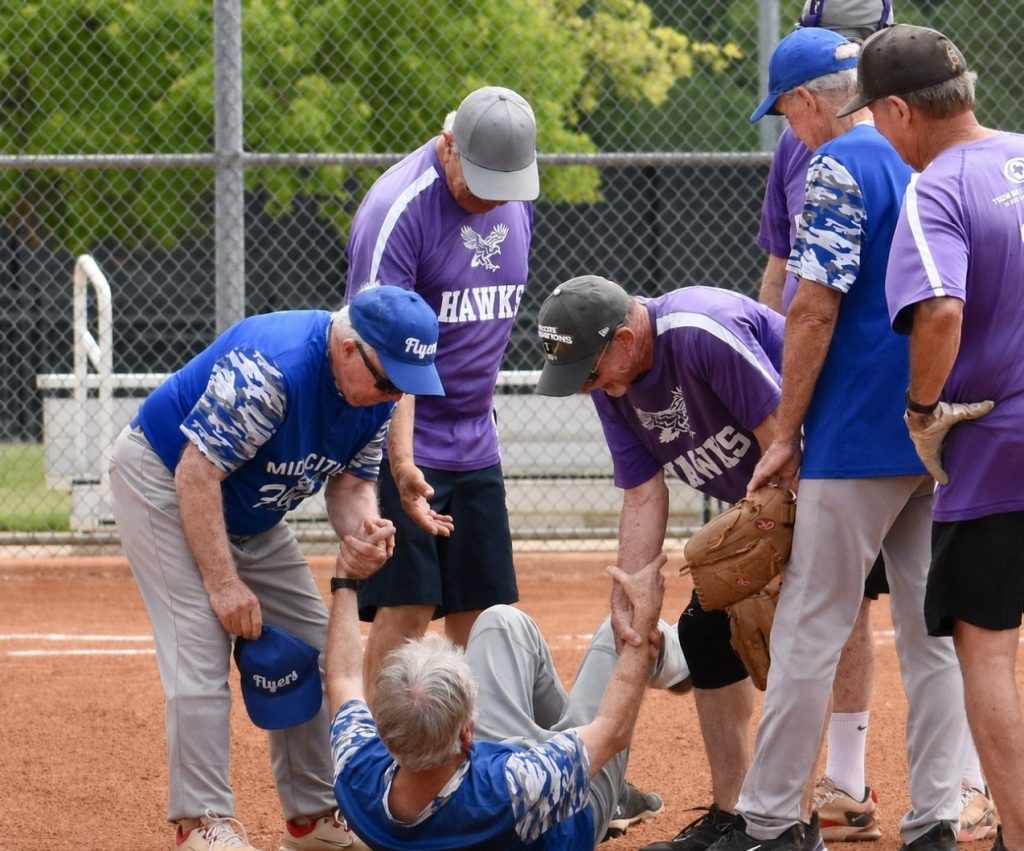
In MSCSA, there are 27 teams, split across three age divisions (60 and over, 65 and over, and 70 and over). There are 516 active players in total, and 109 of them joined this season. Massa, 72, plays a division down because there are too many in the 70 and over division, which is the highest in demand, and because he can swing as well as the “youngsters.” The rules for the league are fairly flexible; if you want to play, you can. The oldest member of the Bandits’ rival of the season, the Richardson Roadrunners, is 91. He doesn’t run the bases, but he sure swings, and on occasion, fills in as umpire.
Most of the men in the senior league are retired, going to their softball games every Tuesday and Thursday morning like church. One player and his wife, the team’s honorary cheerleader, drive down from the Oklahoma border twice a week during softball season. Some of the players are retired airline pilots and CEOs; others have the long hair and willowy builds of the original Deadheads who saw Jerry Garcia play live; and some of the players (about 25) are even former college women’s softball stars, giving the best of the old-timers a run for their money.
“Some of the guys are really old school and don’t want to play against a girl,” says Massa. “‘Dude, she played D1 college softball. She’s better than you, so shut up.’”
In their 60s, not much has changed. The players still jeer the other team, challenge calls and layer the dugout floor with tobacco-less spit.
“What happens within the dugout hasn’t changed,” Massa says. “It’s the same stuff. It’s probably one of the best things that I’ve done since I started playing again.”
Massa says the conversations are the same, but the context is a little different.
“It’s funny, when you’re 16, you’re talking about who has what drug,” he says. “We’re kind of still talking about that same thing now, but we’re really talking about those things for ailments.”
While the Bandits may have traded LSD for extra-strength Advil, the heart of the game remains the same, and the players mock each other like they’re still throwing in the high 90s.
“We all still think we’re 17 years old,” he says. “Boys will be boys. A lot of the guys, they just want to get back out on the field.”
For most of the players, softball has become all-encompassing, giving them new reasons to rise out of bed in retirement. The league doesn’t just keep them young; it keeps them alive and proves that you’re never too old to have a little fun.
“It does bring back a lot of camaraderie with a lot of the guys,” Massa says. “It builds a really strong community. When someone’s significant other passes on, we’re there to help each other out. My team has gone through several – all sorts of older injuries. But the team pulls together as a community, and we do what we need to do to help each other out.”
A league for loveable leisure
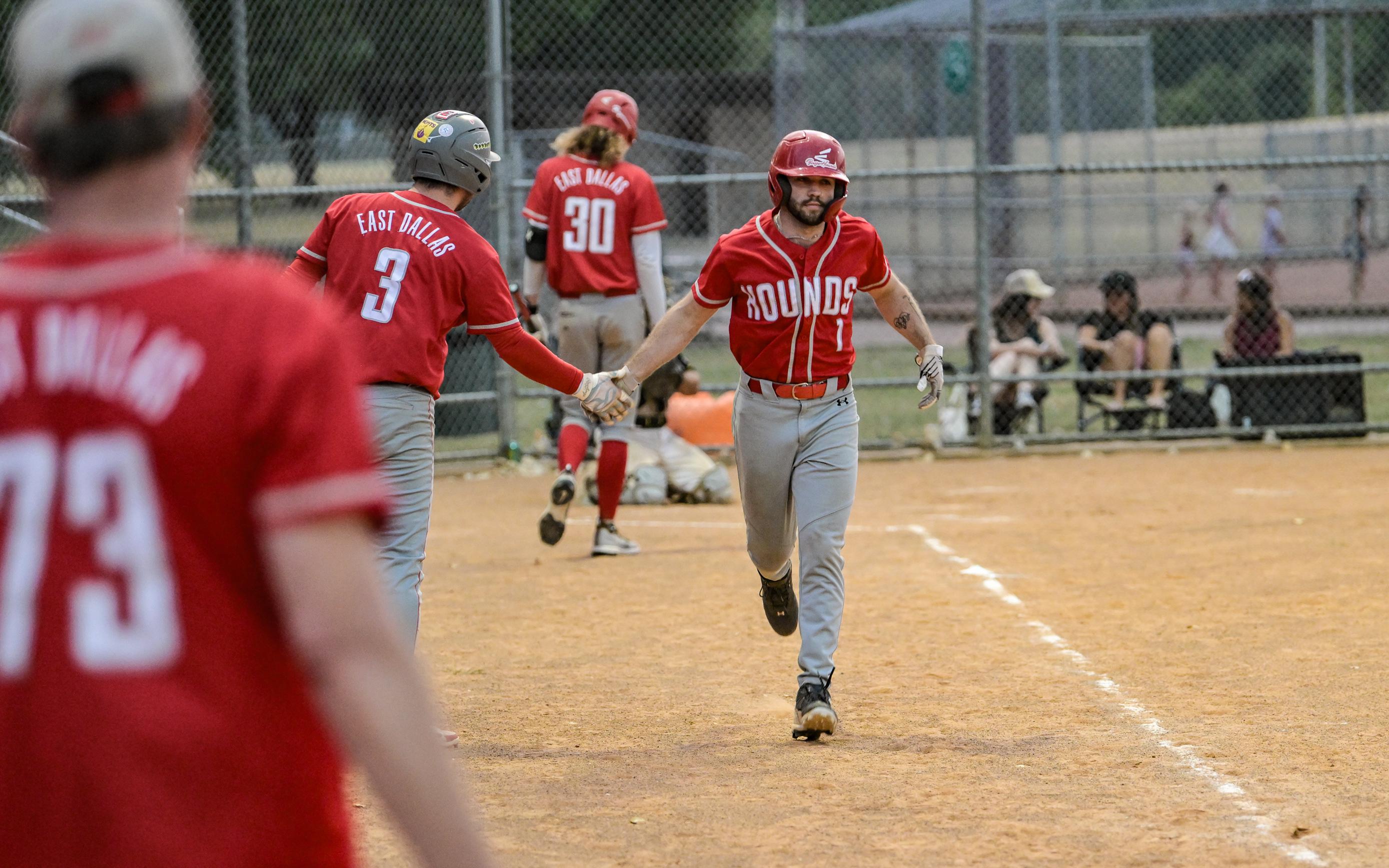
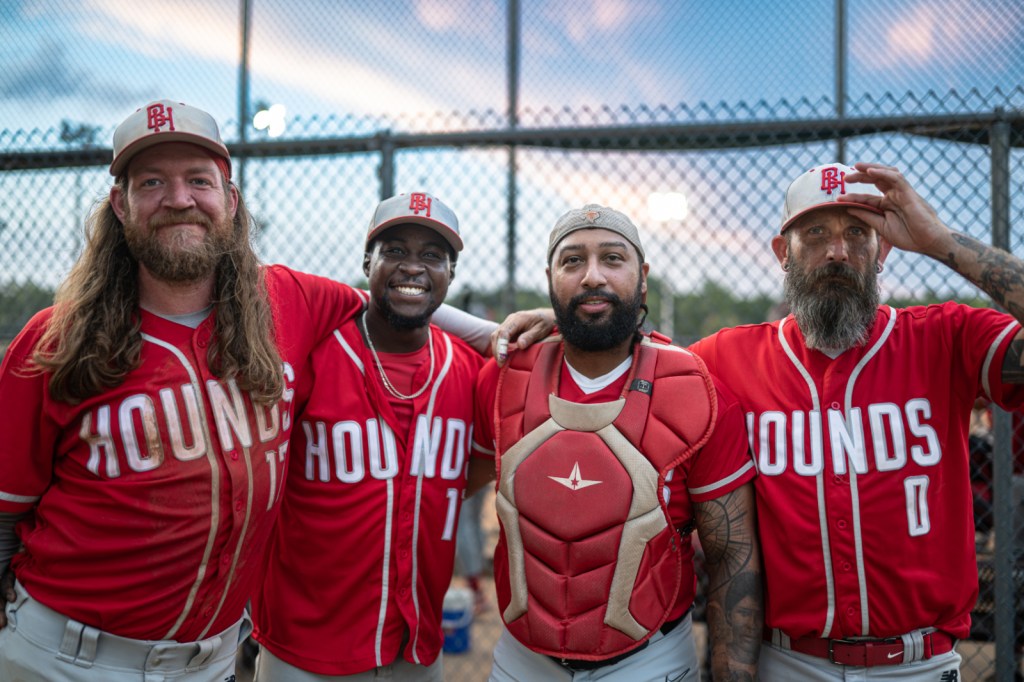
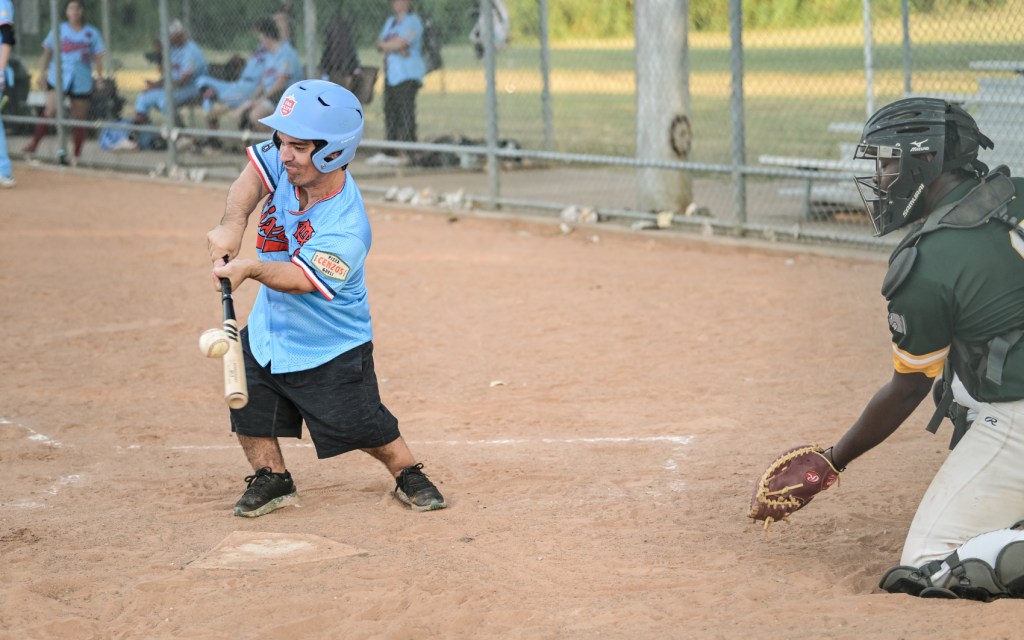
Every first Saturday of the month from March to November, the Oak Cliff Sandlot (OCS) plays a pickup game of baseball in a park. A good percentage of the balls pitched won’t be hit, so making it off home base elicits a loud celebration, but that’s if the people in the dugout aren’t too busy chatting amongst themselves. There are lots of competitive recreational baseball leagues in Dallas; OCS isn’t one of them, by design.
Patty Evans started the association (he doesn’t describe it as a league and prefers “coalition of the willing”) in 2022, after managing a team in a competitive circuit became exhausting. He wanted post-game drinks, win or lose. In fact, he wanted the beer cracked before the game was even over, and he wanted everyone to experience the joy of being on a team, even if they were bad.
“I had always noticed that during [competitive league] tryouts, there were lots of guys that honestly were never going to get picked up by these teams,” says Evans. “They were just dudes out there wanting to play baseball, and their skill level wasn’t really on the competitive side. I realized there was a market for it. There were players available. I just had to find them.”
Mike Brooks
Not only do the competitive leagues eliminate many decent players who hope to enjoy their favorite sport, but they also offer few opportunities to women. The OCS welcomes all with open arms; there aren’t many unrepresented demographics in the coalition.
Since its inception, OCS has grown to 10 teams, totaling hundreds of players citywide. The coalition recruits new members at each pickup game, with demand increasing tenfold over the last two years, according to the Mudbugs’ coach, Jo Pearce.
OCS doesn’t do standings, and there are no tournaments, either.
“That’s why we don’t like to use the word ‘league’ because that has connotations of wins, losses, who’s ahead, who’s not ahead… last place, first place,” says Evans. “We don’t do that. That’s very against the ethos of sandlot [baseball], really. It’s more about just the actual playing of the game and hanging out.”
Evans says a harsh reality of baseball is that you can be on a team for your entire life and have not played a single minute in a game since childhood. His coalition isn’t like that — everyone makes it out of the dugout.
“All they wanted to do was play baseball,” he says. “We have lots of people that, at some point, were told ‘You can’t play baseball anymore.’ We’re just giving them that opportunity.”
Occasionally, OCS will get an exceptionally good player; usually they’re happy to tone down their skills, understanding that the coalition is about creating community and that striking everyone out is a bad way to make friends.
“Winning and losing doesn’t matter; it’s just all about the experience of getting to play baseball and hanging out with people and being outside, fresh air, and getting a little bit of exercise and having a beer,” says Evans.
The Lost Souls of Dallas
Aaron Hilbert was never picked first for kickball as a kid. He grew up “an overweight, closeted, fat kid” in Louisville, Kentucky, in the ‘90s when the country’s culture was far from what it is today.
“It was a different time then,” he says. “There was never an inclusive team where I could openly walk down and show up.”
By the 2010s, he was proudly out, working as a bartender in Dallas’ gay nightlife scene and building a chosen family in the historic Oak Lawn area. But when the pandemic shut down almost every bar in the city, his network was shattered.
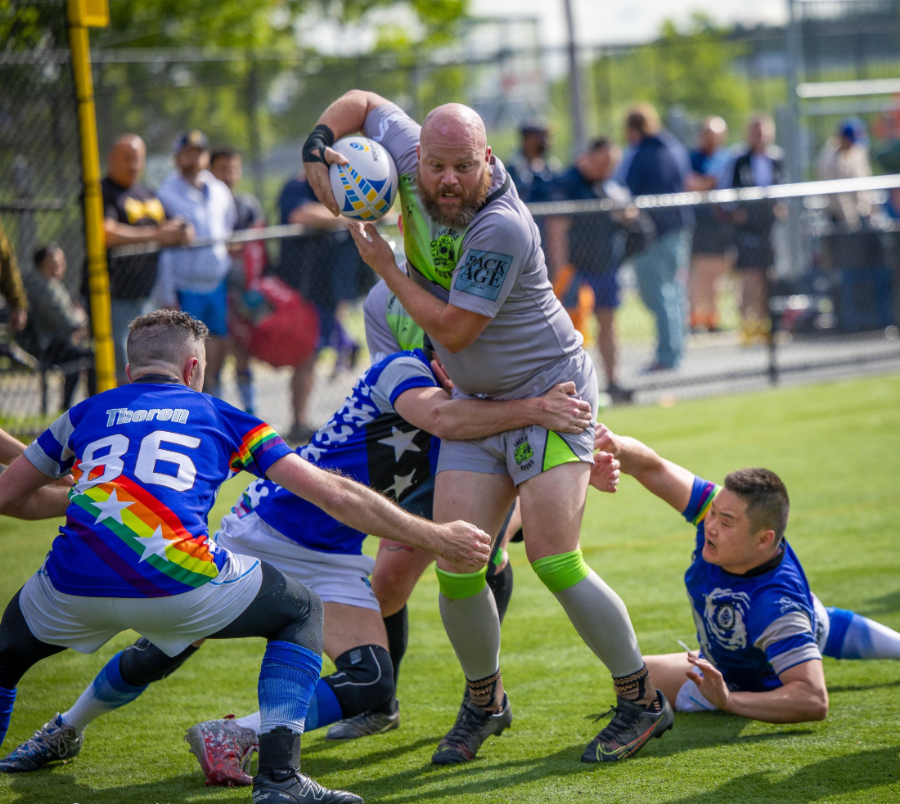
In the absence of a crucial piece of his social life, he poured himself into his partner’s recreational rugby team, the Lost Souls. The team, which defines itself as inclusive, is 80% LGBTQ+ and a member of the larger network, International Gay Rugby (IGR), a nonprofit organization that offers community members competitive opportunities across the globe. The IGR has three teams in Texas, and the Lost Souls travel to Austin and Houston regularly for matches.
For a while, Hilbert stayed on the sidelines with a Yeti full of chardonnay, standing weary of the contact sport and happy to remain honorary team mom. Then, one season, he was convinced to walk onto the field, and now he’s the president of the team.
“There was a part of me that became missing,” says Hilbert. “Getting into rugby gave me that back. It gave me 40 brothers.”
For Hilbert, building community was just as important as reclaiming a piece of life that felt designed to exclude him. Now, the Lost Souls take anyone and everyone, regardless of their socioeconomic status (the team has no dues, and even offers health insurance through IGR membership), sexual identity or sporting experience.
Statistically, there are very few openly gay professional athletes in contact sports. But Hilbert and his team are making space for themselves, highlighting the special bond that can only be built from a large man running directly at you at full speed.
Greg Kindel Photography
“We don’t allow each other to give up on ourselves,” says Hilbert. “Good is good enough, and we won’t let you fail on your own because we win as a team, we lose as a team.”
Being on the team gives players a different sense of pride. Chances are, if you know a Lost Soul, they will never let you forget it.
“Literally everybody knows us as the rugby boys,” says Hilbert. “We go out, we talk rugby all the time. We get people interested in it. Even people who don’t think that they would want to play, we’re like, ‘Come, just come watch us, support us, ring a cowbell.’”
Hilbert says the people who test the limits of their comfort zone on the field are easily adopted into the “quasi-family.”
“For those who stick around and for those who embrace the team, the team embraces them,” he says. “They feel that. They feel that they have that community. We are a team, but we are also a brotherhood.”
Hilbert says for a lot of the LGBTQ+ community, finding safe spaces outside of bars, especially in the South in the current political climate, can be difficult. He speaks from firsthand experience. But teams like the Lost Souls offer his community a place to find peers before the sun goes down.
“[Some members] may have just moved here or they didn’t like going to the bar scene,” says Hilbert. “They wanted to do something outside of the bar scene, and they found they don’t have to go to the bar to have people they’re comfortable with.”
Batter up
The value of team sports isn’t just improved cardiovascular health; it’s a deeply bonded community. You’re never too old or too inexperienced to find a place on a team in Dallas, and once you do, it’s not going anywhere.
“To see that teammates are willing to put their body in front of somebody to protect me — it’s just something that, until you play a game and experience it, you can’t understand,” Hilbert says. “Especially in this context: you rely on other people, you’re trusting these people to protect you. You’re trusting these people to take care of you and to make sure that you are safe. But at the same time, we’re having fun, and it’s okay to mess up, and they’re there to pick you up.”