
Courtesy of Han Cao

Audio By Carbonatix
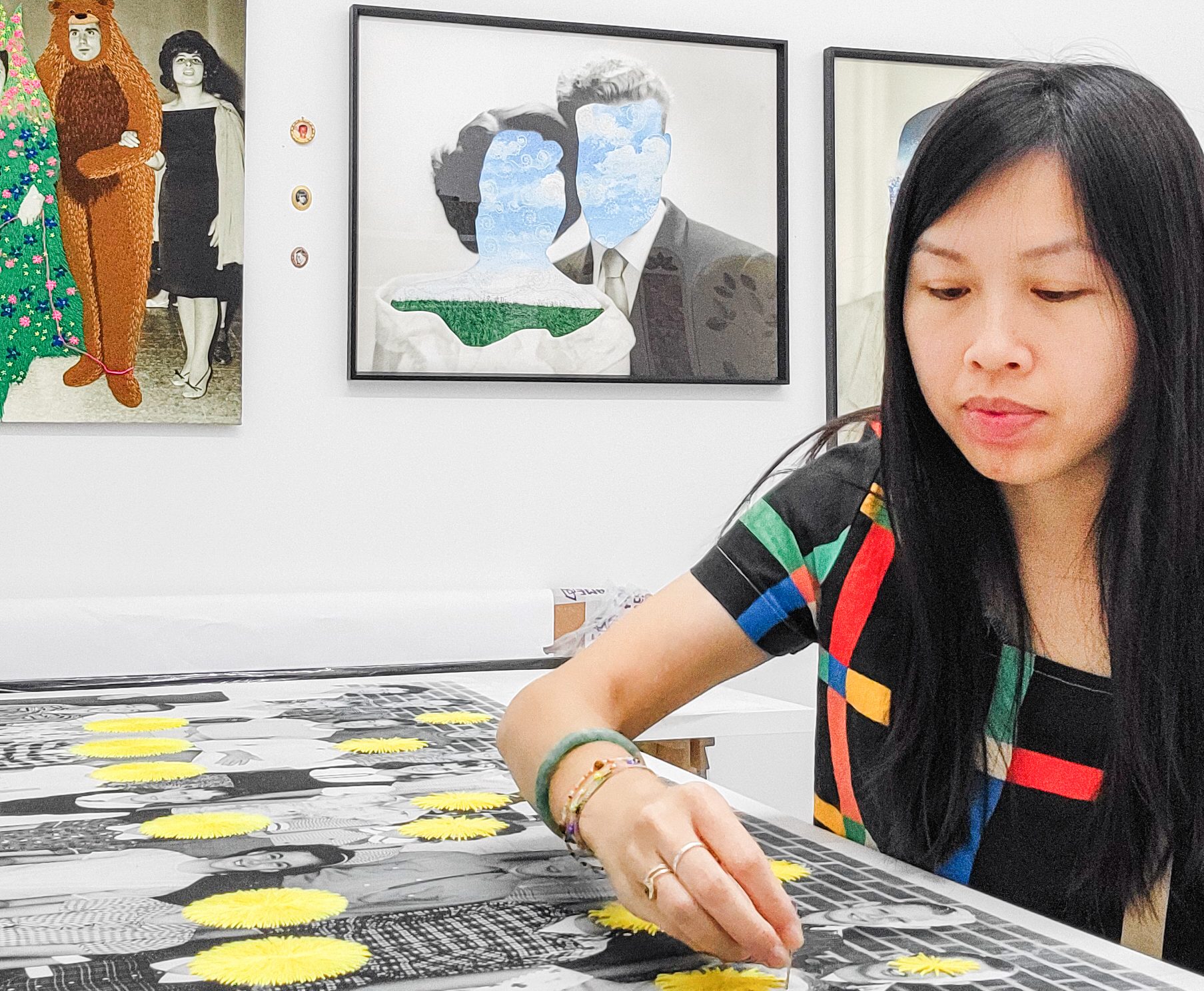
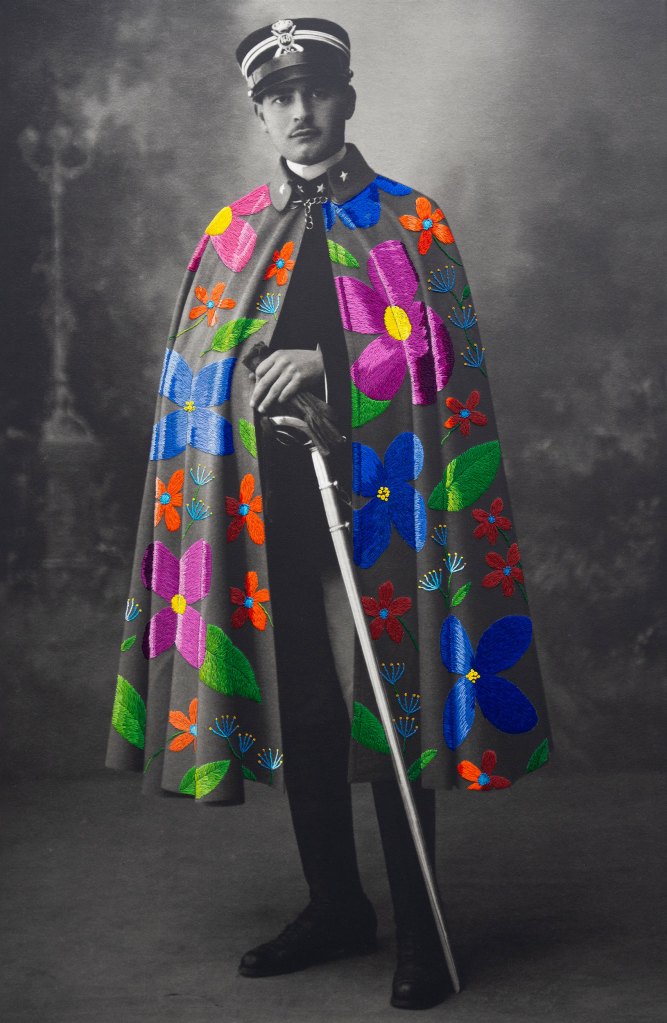
In the dusty corners of flea markets, tucked away in forgotten boxes, lie the ghosts of moments past. Anonymous faces stare out from brittle photographs, their stories silenced by time. But for Dallas-based fiber artist Han Cao, these cast-aside images are not endings but rather new beginnings. With a needle and brightly colored thread, she pierces the surface of these vintage photographs and postcards, stitching new life into them and transforming them into intricate visual narratives.
Her solo exhibition, Second Nature, kicks off the new year at Art on Main Gallery in East Dallas, running from Jan. 15 through Feb. 7. The collection is a poignant exploration of memory, identity and the quiet ways we integrate the world into our inner lives. Through delicate embroidery, Cao reimagines the histories embedded in everyday snapshots, suggesting that seeing is never passive, but an act of constant re-creation.
Cao’s artistic journey began not in a studio, but at home, influenced by her Vietnamese upbringing and her mother’s work as a seamstress.
“I think I was always drawn to fibers, watching my mother work,” Cao recalls. A childhood incident involving a broken sewing machine suppressed her early interest, but the pull of textiles remained. Years later, after leaving a demanding career as a strategy consultant, she found herself drawn to the slow, meticulous nature of craft. Her path to the medium was sparked by a visit to a flea market.
“I was just seeing these boxes full of these old photographs,” she tells us. “People are just walking by and laughing at them or they’re dismissive. When I stopped to look at the photographs, I found the expressions on these people’s faces were so poignant and timeless.” Saddened to see these images cast aside, she felt an invitation “to connect the past to the present.”
Courtesy of Han Cao
In Cao’s hands, a stoic black-and-white portrait blooms as a vibrant, three-dimensional bouquet bursts from a subject’s head. A faded landscape ripples with geometric patterns of thread, and forgotten figures are given new focus. This interplay between the stillness of the original image and the tactile presence of the embroidery creates a striking visual dialogue. It’s a slow, meditative process, one she sees as a way to honor the forgotten lives within the frames.
“Embroidery is one of those things where you’re very present because it is a very slow and meticulous craft,” she says. “The act of stitching with these images becomes kind of a way of honoring the image. You’re spending a lot of time with this photograph.”
What’s Old Becomes New Again
The exhibition’s title, Second Nature, is a nod to how our memories and ways of seeing evolve until they feel instinctual. Cao uses natural elements to explore this idea. The dandelion, a recurring symbol in her work, represents womanhood and nurturing.
“We just think about them as weeds and pull them,” she says. “But they’re so important for nature because they’re the early pollinators… they prepare really bad soil… preparing the soil for other things to grow. In this way, women are inherently like these flowers because of their inherent second nature of nurturing and growing life.”
This idea — that we are a product of our environment — is central to the show. Our relationship with the world is not merely observational; we carry it within us.
“There’s a set of pieces that are silhouettes, where the images inside of the person’s silhouette is, like, these natural forms, like ocean waves and flowers,” Cao describes. “Just to kind of manifest that we are walking around our environment — we’re also a product of our environment as well.”

Courtesy of Han Cao
However, her work is not without its critics. The act of altering an artifact, even a discarded one, can be challenging for some viewers.
“When I first started doing this art form, I got some flack because people are saying it’s disrespectful,” Cao says.
She notes the curious paradox of people who feel protective over memories they have no connection to, while others readily offer her photos of their own unknown ancestors. This tension highlights a broader conversation about memory, ownership and relevance. By intervening, Cao argues, she is extending the life of these memories and imbuing them with contemporary meaning.
“Now, when we’re making art out of these things, it’s become more relevant,” she tells us. “People have eyes on it.”
Having recently returned to Dallas after 15 years in New York and California, Cao is still rediscovering her hometown. She notes the city’s rapid diversification, particularly the growth of the Asian community, as a welcome change. Yet, she finds Dallas still feels “a bit commercial” and is searching for her place within its art scene. This year, she is focusing on shows exclusively in Texas, making her exhibition at Art on Main a significant homecoming.
“I think it’s unique,” she says of the gallery. “I love the community feel. There’s not a lot of pretension, which you sometimes feel with some of the other galleries that are a little bit stiff and sterile.”
Second Nature features both large-scale works — enlarged photographs stitched onto canvas — and smaller, original pieces. The effect is an invitation for viewers to engage on multiple levels, from the immediate impact of the larger works to the intimate detail of the small postcards. Each piece is a testament to the layers of memory, a new thread added to an old story, proving that what is forgotten can always be found and remade into something beautiful.
“They’re little moments that are offering a little bit of escape,” she says.
Second Nature is on view at Art on Main (4428 Main St.) from Jan. 15 through Feb. 7.