
Disney/Pixar

Audio By Carbonatix
Pixar’s newest animated feature, Hoppers, arrives in theaters nationwide this Friday. At its core, the film tells a deeply resonant story about preservation, empathy and the fragile spaces where human ambition meets the natural world.
Mabel, voiced by Piper Curda, the film’s fiercely determined 19-year-old protagonist, takes on the monumental task of saving a sanctuary called The Glade. A relentless mayor named Jerry, voiced by Jon Hamm, wants to pave over it, declaring that “people love highways.” For Mabel, the stakes are painfully clear: “To some people, it’s an empty piece of land. But for those animals, it’s home.”
The artists behind Hoppers bring impressive resumes to the project, with decades of experience on Pixar’s most beloved films. Ian Megibben, the film’s director of photography for lighting, has helped shape the look of Pixar hits including WALL•E, Soul and Lightyear. J.D. Northrup, a technical supervisor, guided the detailed animation of the film’s rich backgrounds, building on a technical skill set honed over years at Pixar. Jon Reisch, the movie’s effects supervisor, is a veteran whose credits include Cars, Monsters University and Elemental.
Bringing a world this lush and emotionally complex to the screen takes a village. And for Hoppers, that village is rooted deep in Dallas’ storied neighborhoods, long before they were shaping digital ecosystems in California.
Northrup and Reisch sat in many of the same classrooms at Cistercian Preparatory School in Irving, where Northrup’s early fascination with computer science and creative problem-solving took hold, and where both began to see the world through lenses shaped by art, science and collaboration.
“Out of college, I moved back,” Northrup tells the Observer. “I was working odd jobs — driving for Jason’s Deli, all kinds of things. That’s where I met my wife, who was working as an art director at a small motion graphics house off 75 and Mockingbird. Dallas was a place where you crossed paths with creative people every day.”
For years, Reisch’s understanding of visual storytelling was grounded not only in the images on a screen but also in his father’s influence as a commercial photographer in Dallas. He still teaches photography at Cistercian to this day.
“My dad’s classes would always be packed, and it was in those darkrooms and photo studios where I learned to see the world in terms of light, texture and story,” he says.
Meanwhile, Megibben credits his distinctive visual sensibility to both his father’s career as a creative director at a local ad agency and his own formative experiences in East Dallas.
“I’ve got to rep the east side of Dallas really quick. I saw Toy Story at [the now-shuttered] Casa Linda Theater on the other side of town [from Northrup and Reisch]. That was the beginning of my freshman year of college,” Megibben says.
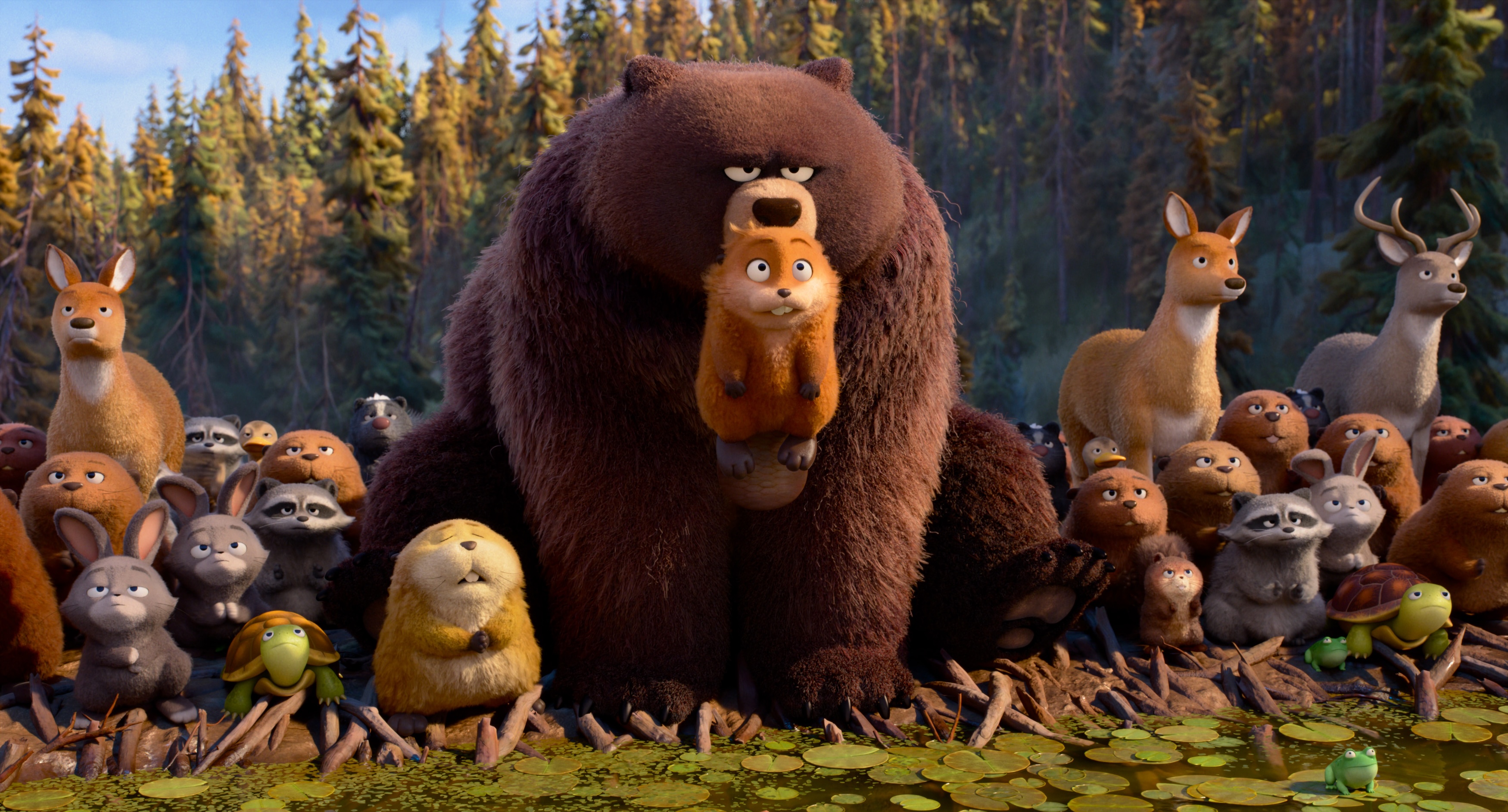
Their local upbringing heavily informed the work of all three artists on Hoppers. Northrup, who oversaw the sprawling background crowds of animals, insects and humans, spent his youth mountain biking the trails around the Elm Fork of the Trinity River. He understood the quiet majesty of wetlands and hidden natural pockets. When animating the wildlife of the movie’s Glade, he wanted to ensure the creatures possessed both humor and appeal while paying homage to their natural instincts. His team ran extensive visual tests, “going back and forth from very naturalistic to very stylized,” Northrup explains, searching for a vibrant middle ground that truly popped.
Northrup also worked closely with the Activist Trust, a group of youth activists who provided crucial feedback on early versions of the film. Their most consistent piece of advice perfectly mirrored the film’s ultimate message.
“You can’t do this alone,” the organization said to the crew. “This takes community.”
Responsibility to capture the essence of the community fell to artists like Megibben. As the film’s director of photography, he faced the delicate challenge of balancing breathtaking environmental realism with the sharp, rhythmic comedic timing of director Daniel Chong.
“The real challenge was meeting naturalism versus the sense of humor that [Chong] brings to this,” Megibben says. “Everything had to support that sense of naturalism, but also never step
on the humor.”
By collaborating across departments, Megibben and his team developed clever ways to stylize and simplify backgrounds, ensuring the emotional beats and jokes always landed. Meanwhile, Reisch and his effects team handled the heavy elemental lifting. Crafting the physical atmosphere of Hoppers required immense dedication to studying the outdoors. Going out and looking at the natural world in real life is, as Reisch puts it, “always just a humbling moment.” That careful observation pays massive dividends in the film’s climax. Reisch describes the entire third act as a visual “tour de force” featuring a complex, high-stakes interplay between the elements.
Yet, even amidst the spectacular visual effects, the human element remained paramount.
Reisch points to the studio’s “internal pond rules,” which served as a mandate from Chong and producer Nicole Paradis Grindle, emphasizing the importance of teamwork. Hoppers asks its audience to look past differences and find common ground to solve massive problems. Reisch sees this reflected in the animation process itself, noting that the magic of the medium relies entirely on “these small acts of heroism that we all do every single day in collaboration with each other.”
You can hear that collaborative heartbeat pulsing through the film. When Mabel boldly declares, “We’re all in this together,” she speaks for the characters on screen, sure, but also for the hundreds of artists behind their creation. The film reminds us that “Animal homes, human homes — they’re all just one big place.”
For Northrup, Megibben and Reisch, that big place started in Dallas. They took the lessons of the Trinity River, the collaborative spirit of their youth and the inspiration of local movie houses, and projected them onto the biggest screen possible. Hoppers proves that whether you are trying to save a local bald eagle’s nest from a superhighway or animating a digital beaver to save a cinematic forest, it always comes back to community.
Hoppers opens Friday in theaters nationwide.