
Mike Brooks

Audio By Carbonatix
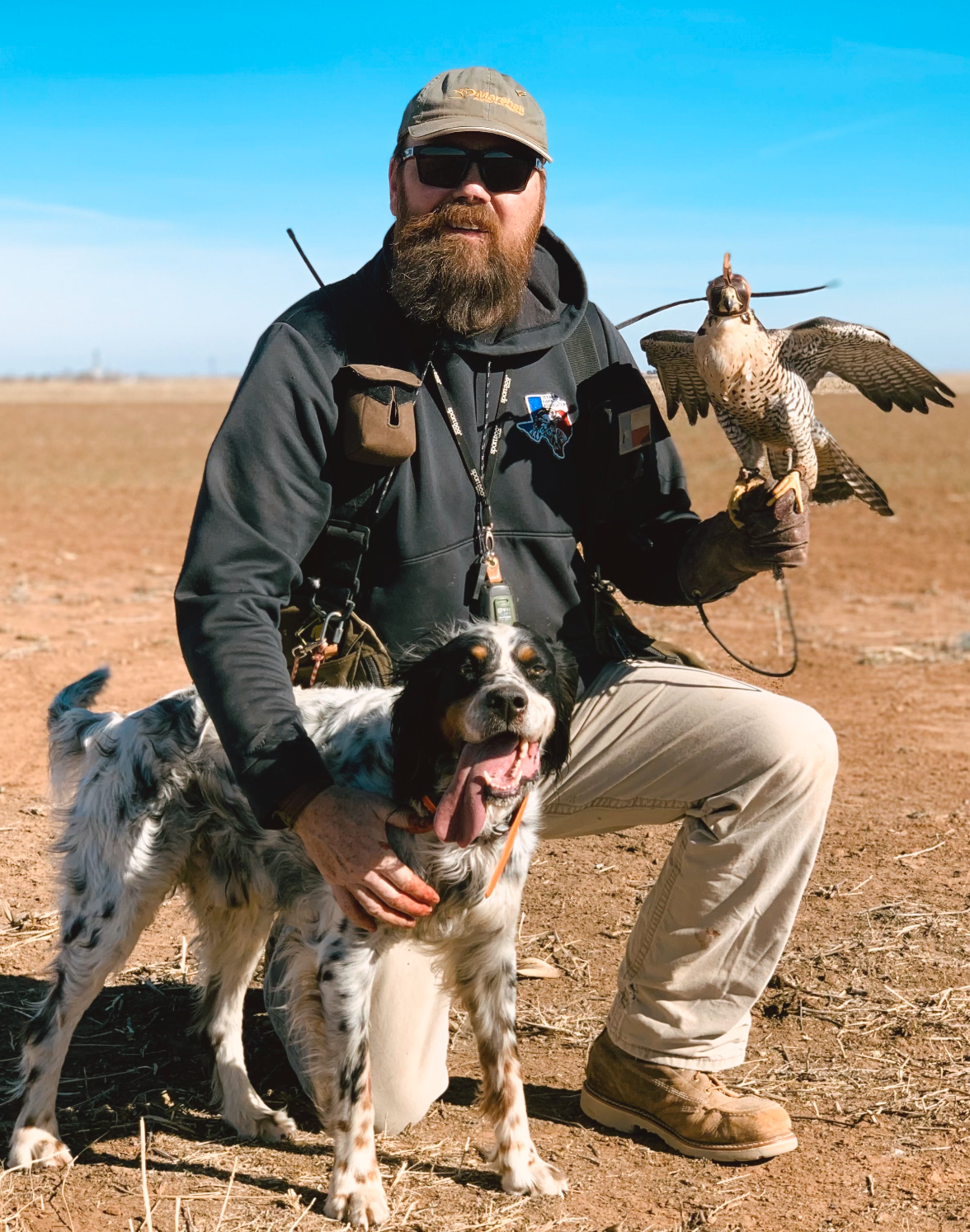
Through clear winter skies, the peregrine falcon dances above the blackland prairies, 3,000 feet above the ground, arabesquing through the frigid air, waiting on her cue as she circles high over a pond decorated with vibrant green mallards sporting their winter plumage. With a sharp yelp from her partner, a well-trained bird dog, the game begins.
In seconds, startled by the noise, the flock of ducks makes a slow ascent into the sky, but the falcon, without a sound, rips through the air like a bullet, reaching 200-mph dive speeds in a few blinks and striking a bird mid-air with a talon. The hunt is over.
The duck plummets to the ground, landing without a squawk, only a hard, lifeless thunk. In the perfect hunt, a fatal blow delivered to the vertebrae causes instantaneous death. The falcon gracefully swoops to the ground, ready to feast on the fresh meat. The bird dog will near, and soon after, so will the falconer. When the falconer — the hunter who has trained the bird and the dog to collaborate — lifts a double-lined leather-gloved hand in the air like a perch, the falcon willingly hops onto its owner’s arm. The three, working as a hunting team, will collect the kill and return to their suburban North Texas home, ready to serve duck for dinner. It’s a job well done.
This process will repeat nearly every day, far outside the city limits, as they visit pond after pond in search of a flock to hunt. It could take hours to find the perfect conditions for just minutes of hunting. Some days, the falcon, still wild and undomesticated, will refuse to hunt, simply not hungry enough; other days, there will be no prey. Still, the three trek to the ponds before nightfall, hoping for magic but accepting frequent disappointment. Time is one of the great sacrifices a falconer will make.
Hunting is a divisive sport, and falconry involves bloodshed. An animal will die. But falconers, who are first and foremost hunters, consider themselves conservationists too, and place the livelihood of the birds above almost all else. To them, flying a bird of prey (hawk, falcon or eagle) is a privilege, and it’s one that takes years to earn through an arduous process overseen by the state and federal governments and, most sternly, the master falconers who want to keep their sport alive as long as possible.
For the few hundred falconers in Texas – with the highest concentration in the state being the Dallas-Fort Worth area – who have gained their wings, falconry is not a hobby; it’s a lifestyle. But it’s worth it to the few and far between who are willing to make the sacrifices required to go hunting with a bird as their weapon.
Longwinged Weapons
“That’s the smallest falcon in the United States – little kestrel,” Melody Thompson said while pointing at a diminutive, blueish bird sitting on the power lines in the countryside far northeast of Dallas in Hunt County.
Thompson, her husband, Tony, their bird dog Lima and their peregrine falcon Katniss (named after the expert hunting protagonist in the Hunger Games series), were scouring the blackland prairie for a good pond with ducks to hunt. Tony is a master falconer, and Melody is one year shy of the final level. They go hunting almost every day.
They began falconry together, a saving grace for the couple, as the activity and its hefty time commitment have been known to split up couples, especially among retired men, who are the most common demographic group of new recruits. But for Melody and Tony, neither of whom is retired, falconry keeps them closer, allowing them to bond over their shared lifestyle.
Mike Brooks
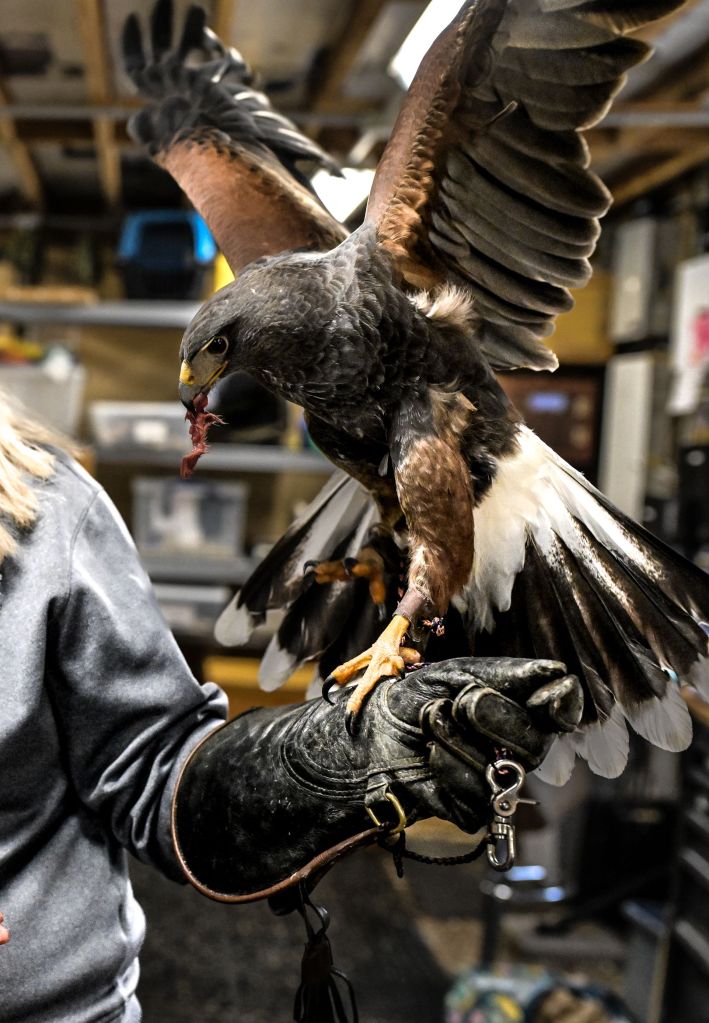
“Oh, a red-tail,” Tony says, as a large bird with a fire-colored tail swoops through the sky.
Raptors, another word for “birds of prey,” are common, and the Thompsons can identify most of them.
The Thompsons captured Katniss in 2021. She’s their 12th bird since they became falconers in 2017, and the only one they’ll hunt with this duck season. Soon enough, they’ll release her back into the wild, as is common practice for modern falconers, or one day, she just won’t return.
As unleashed wild animals, hunting birds always have the choice to fly away and never return, and many do. It’s a reality ethical falconers accept and don’t try to fight, cutting their losses on the lightweight GPS equipment, usually painlessly attached to a falcon’s ankle.
“Most of these birds, if it’s good, can just be released back into the wild, and they will fully acclimate,” Melody says. “The supplement treatments or any replacement food do nothing. They can hunt and sustain themselves fully. But they’ve had medical care. They’ve been treated for parasites. We’ve given them a West Nile vaccine. Someday, eventually, we may be able to vaccinate them for bird flu.”
Raptors are not domesticatable, and state laws that require falconers to capture their birds at a specific age (when they’re out of the nest but under a year old), prevent the birds from developing dependencies on their temporary owners. Often, birds are released when they reach sexual maturity, as they become less compliant and more focused on finding a mate during hunting trips.
“The whole purpose is that when we return them to the wild, they’re in better condition than when we got them,” Melody says.
Baby raptors, on their own, have a high infant mortality rate, with 80% dying in the first year of life. Birds that spend time working with a falconer can easily live up to 10 years. But falconers’ only contribution to conservation isn’t bolstering the mating pool; they have been instrumental in the preservation of raptors. In 1999, partnerships with the government, biologists and conservationists resulted in successfully removing the peregrine, one of the more popular hunting species, from the endangered species list.
“There were falconers breeding them,” Melody says. “They were protecting [babies]. They were out counting migration numbers. This wasn’t wildlife rehab groups; it was truly falconers.”
Even now, she says that same commitment to conservation has endured as the crux of the practice.
“The whole point of falconry is that we teach the birds new techniques for hunting [and] safer areas to hunt,” she continues. “It’s conservation, and how we can contribute to conservation efforts.”
A Century of Bird Laws
Falconry wasn’t always so regulated. For a long time, it wasn’t regulated at all. The birds were often mistreated – stolen from their nests far too young, made dependent on humans for food and starved to ensure their return. They were trained to be devoid of their natural instincts and caged in tiny enclosures for their entire lives. Falconers of the past all but clipped their birds’ wings.
In the past century, a number of laws and treaties have finely regulated avian possession, ownership, and hunting, and the world of falconry has changed significantly under these laws. The first, the Migratory Bird Treaty Act, passed in 1918, banned the possession and mass killing of migratory birds without a permit. The move protected 1,100 bird species that migrate between Canada and Mexico during the seasons and introduced the first form of registration for falconers by accident.
Then, in 1976, the U.S. Department of Fish and Wildlife required each state to implement a rigorous process for becoming a falconer, the first law of its kind. Melody jokes that there are more laws concerning birds than human beings; it’s a hyperbolic saying in the falconry community, but it’s not terribly far from the truth.
“With falconry being so heavily regulated, and there are so few of us, if [game wardens] get tired of dealing with us from an enforcement standpoint, falconry can just go away,” she says. “We are not making the state money. We don’t have a large enough interest group to force the state’s hand. We’ve got to police ourselves, and then we’ve got to work cooperatively with the state of Texas.”
But even if there wasn’t a constant impending fear of the end of falconry, just like a rifle hunter still oils the barrel, a falconer takes care of their weapon.
“The better I take care of this bird, the better it’s going to perform,” Melody says. “It is not beneficial to us to mistreat these birds.”
Since 1970, Texas has had an official association for falconers, the Texas Hawking Association (THA). The self-described “conservation-oriented association” is the premier organization for falconers, and it weaves together the small community, holding them to high standards.
“We try to be very careful and speak to our people about honoring the sport,” said THA President Kyle Irlbeck. “Let’s honor the birds. Let’s honor our prey. Our prey is everything. … We’re conservationists; we want to take care of our prey base more than anything, because we can’t fly without something to chase.”
Membership in the THA is crucial to fit in the small and tight-knit community of Texas falconers, and they have few who misbehave, likely because Texas has some of the strictest falconry laws in the country. The THA, ardent about self-policing, stands as a robust barrier to the unqualified.
Getting Your Wings
Irlbeck rejects the notion that there are gatekeepers in falconry, but there’s a reason you probably had no idea North Texans are hunting with birds of prey. The THA and the falconry community aren’t generally recruiting, relying more on the stumble-uponers, and leaving discovery to the ultra-determined.
Alan Wilson
“The dedication and what [falconry requires] takes people out one by one,” Irlbeck says. “When they finally realize that it is so much commitment … it weeds them out, purely due to how hard it is. It’s not to say that you won’t do it again. You can try again.”
Tony Thompson discovered falconry in a hunting magazine when he was 12 years old. For years, he dreamed of doing it, trying once around 2007, but abandoning the sport because he didn’t have the time. That happens a lot in falconry. Never do they undersell the incredible dedication the sport takes, and it’s not an exaggeration.
To be a falconer in Texas, you must first find a sponsor, a master falconer, who has been legally hunting with a bird of prey for at least seven years. The THA assists in matching prospective falconers with sponsors. There are 426 licensed falconers in Texas; Melody estimates that 200 are active. She organizes an annual statewide falconry competition, produced by the THA. Their January meeting had 176 participants and roughly 85 raptors. Finding a sponsor is the easy part. Earning their trust is hard.
Falconers know they have critics, and with hundreds of avian laws already on the books, they will not risk losing their sport because of one bad apple. A good sponsor won’t vouch for just anyone, and Texas Parks and Wildlife, the department that distributes falconry licenses, requires a signed “statement of sponsor” form before you can even begin your apprenticeship.
In the first year, attending annual meets, accompanying masters on their hunts as a spectator and learning all there is to know about birds of prey is the usual audition process. Then maybe a master will write a worthy raptor fanatic a letter of recommendation. If your application is approved, prospects are invited to take the state falconry exam, which lasts 2.5 hours and is held only four times a year.
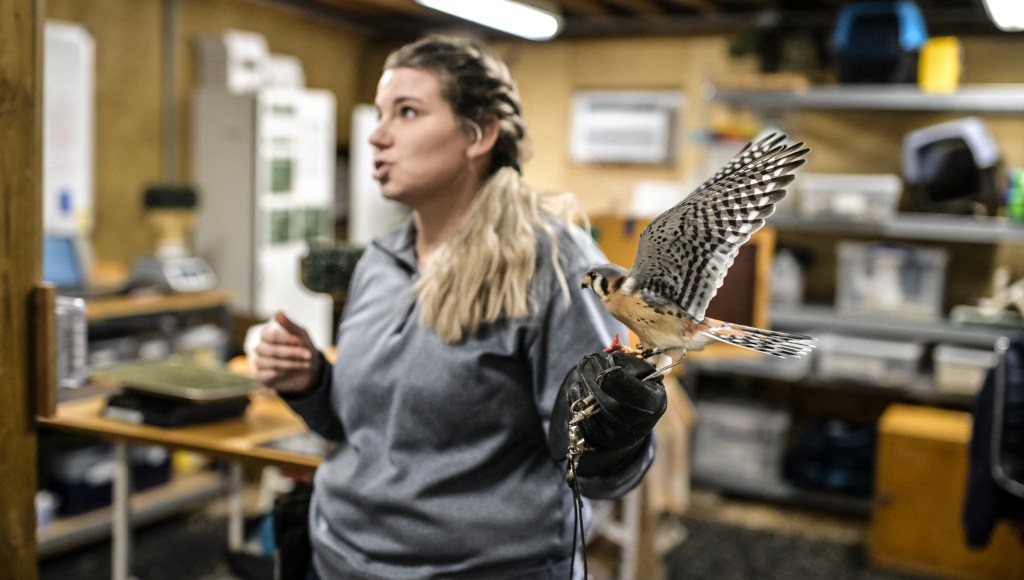
Assuming you pass, a game warden will then inspect your mew, the custom-built enclosure where you’ll keep your falcon when it’s not hunting. There are several requirements regarding weather and predator protection, cleanliness, warmth and bird stimulation. By this point, apprenticeship is achieved, and you are permitted to catch a bird. Apprentices are limited to two species: the small American kestrel and the red-tailed hawk, and can only own one bird at a time. All falconers, no matter the level, are permitted to capture only two wild birds each year.
The apprenticeship takes two years before graduating to general falconer. At this stage, hunters can capture a wider range of bird species and are permitted to own captive-bred birds, though most still capture them in the wild.
Master falconers are permitted to train eagles and can own more birds at one time. Each bird requires separate documentation. And the fines for violating the Migratory Bird Treaty Act can reach $250,000.
Hunters, Conservationists and Birders
Before bird enthusiasts, falconers list themselves as hunters.
“The Texas Hawking Association is a hunting club,” Irlbeck says. “We are hunters, first and foremost. Basically, we just swap our guns for falcons and hawks. We employ all the same techniques. We follow all the same rules and guidelines.”
He says a lack of hunting experience is usually a red flag for someone who wants to become a falconer, worried they’re just fixated on legally owning a bird of prey.
“It’s getting to have blood meals,” Melody says. “I don’t shy away from that. I think that’s an important aspect because I don’t ever want people to get into falconry thinking, ‘I get to have a pet bird of prey.’ No, you get to hunt with a bird of prey. And that is an important distinction.”
Beyond the usual ethical dilemmas associated with hunting and generally keeping animals in captivity, modern falconers do their best to keep their lifestyle as ethical as possible, highlighting that raptors are natural-born killers.
“It’s really just cruel for a bird to sit there and not be able to fly, to not be able to hunt. It’s just, in my opinion, cruel,” Melody says.
Irlbeck says he has never had issues with members mistreating their birds, in large part because of the dedication it takes to become a falconer and the constant supervision from sponsors.
Concerns have been raised about the long-term effects of capturing wild birds and then releasing specially trained raptors back into the wild. But realistically, there are millions of raptors, and even more millions of ducks and pheasants. There are fewer than 5,000 falconers in the country, and they have limited hunting bag sizes. They’re legally allowed to take home half as many ducks as rifle hunters can; three per day, if they can catch them.
In the past, falconers did not prepare their birds for release. Instead, they euthanized them or kept them as pets until the end of their lives. This isn’t the status quo anymore, but there are rare instances of unreleasable birds, and captive-bred birds cannot be released into the wild, per state law.
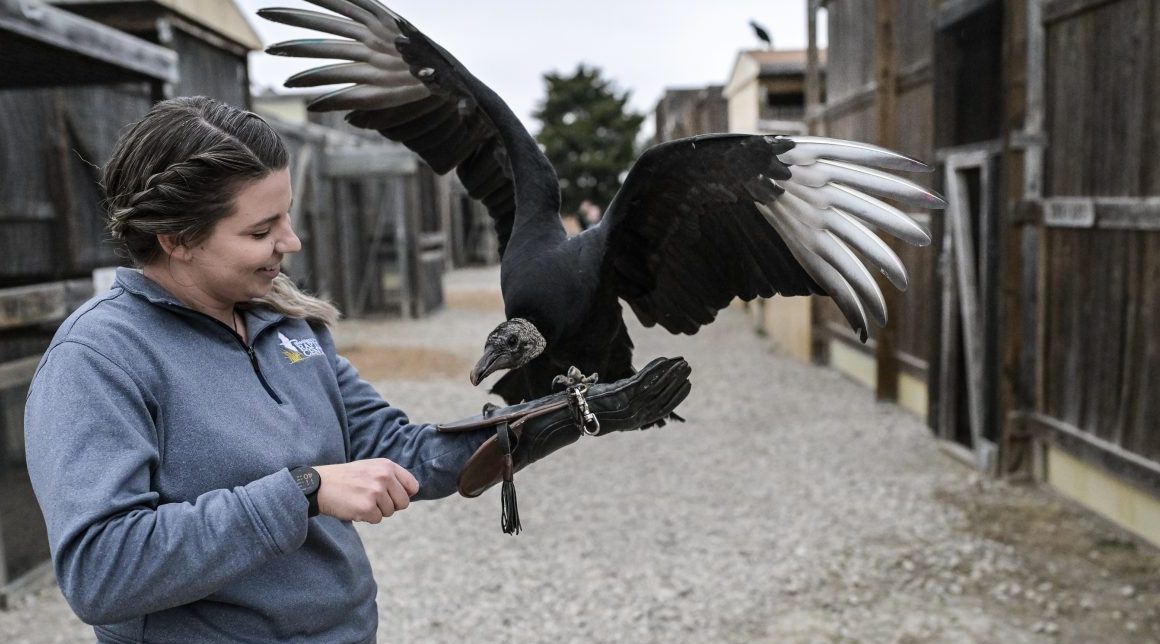
Cheryl Circo is the raptor ambassador manager at the Blackland Prairie Raptor Center, a federally and state-licensed rehabilitation center. She considers herself as close to a falconer as you can possibly get, training and flying the birds, but she doesn’t hunt with them.
The raptor rehabilitation center, which treats roughly 600 birds a year, has a stable-like collection of enclosures for birds that cannot be released for various reasons. One of them, Genesis, is a 16-year-old peregrine falcon who was surrendered to the center after her aging falconer could no longer provide proper care. Genesis was captive-bred and cannot live in the wild. Circo is a firm supporter of falconry when it’s done right.
“Falconry is great,” she says. “They take in that young juvenile bird, and they give them the chance to keep hunting and feed them if [the birds] are not able to. Then send out a fully grown adult back into the wild, one who can hunt and start a family. It’s a great sport.”
Wild Things in Wild Places
Mike Brooks
The vision of a beautiful bird, cutting through the air with a wonderful caw before landing on the outstretched arm of its owner, is straight from a medieval-set movie. But the reality of modern raptor ownership is much more involved. Birds of prey are not pets; they’re athletes, or, as the case may be, weapons.
Irlbeck, who would be happy to watch the sport grow, calls them wild animals.
“We do wild things in wild places,” he says.
For falconers, the sacrifices, the time, the scars from thick talons ripping through thick cow-hide gloves, are all worth it for just a few moments of mid-air magic in the wild.
“I want to keep my bird as close to wild conditions as possible because that’s when you see the most amazing stuff you’ve ever seen,” Irlbeck says. “We don’t make these birds slaves.”