

Jordan Maddox

Audio By Carbonatix
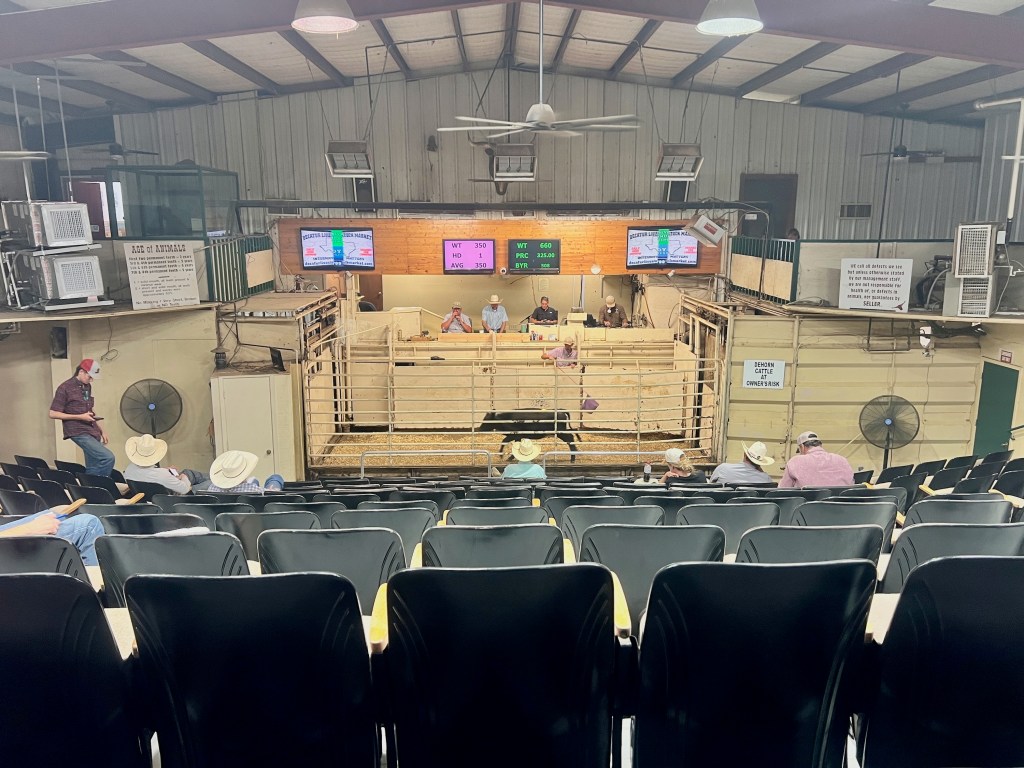
The 109-degree temperature wasn’t the only heat at the Decatur Livestock Market auction Monday afternoon. A fire in the distance threatened to end the bidding early; thick gray clouds of smoke from a grass fire rose into the sky, inching closer.
Meanwhile, inside, a dispersed crowd of mostly men in well-worn cowboy hats and ball caps nonchalantly waved auction ballots. The sweet smell of chewing tobacco lingers with wood shavings, cow manure and sweat. It’s hard to tell who is bidding — it’s all a well-oiled machine and perhaps a quicker-than-we-thought-dying art.
A man working the chute slaps a long flagged pole against cows’ rumps to move them along. An angry black cow huffs its way into the chute and bellows at the crowd of cowboys.
An auctioneer spits out bid prices at lightning speed. Two young children pass the time playing along the stairwell, swinging on the railing. When the auction is over, buyers make their way downstairs and crowd the small entrance to claim their bids.
Jordan Maddox
Here’s where we caught up with Hayden Scarborough, one of the buyers at the auction and the son of one of the market’s owners. He didn’t mince his words when asked about Trump’s announcement on Friday that beef from abroad would be tax-exempt and bought at 25% below market price. Would these policies hurt or harm local ranchers?
“I think ‘hurt’ and ‘harm’ are nice words for it,” he said. “It’s going to brutally impact them.”
In an interview with Successful Farming, University of Arkansas assistant professor of agriculture and agriculture economics, James Mitchell, verified that Trump’s announcement has “injected fresh uncertainty into the market.”
He explained that this week will provide clarity on the true impacts of the temporary tariff lift.
“The timing of last week’s news is not great for cattle producers as they prepare to start marketing fall-weaned calves,” he told Successful Farming. “Recall, the industry faced similar challenges last fall, albeit much smaller compared to this announcement.”
Trump said the policy was intended to allow ranchers to rebuild their cattle herds, a reason often cited for current record-breaking beef prices.
‘We’re finally getting what it’s worth’
“I talked to a lot of big-time guys — I’m not big-time, but I buy a lot of cattle for some big-time guys,” Scarborough said. “There’s about seven or eight ranches bigger than 30-40,000 acres. The reason they haven’t sold their ranches to data centers is because of the high prices they’re getting for these cattle. Words out of their mouth are, ‘We’re finally getting what it’s worth.'”
Tens of thousands of acres of Texas ranch land turning into data centers isn’t the play anyone imagined after Trump’s beef deal. But squeezing ranchers makes it one stop closer to reality.
“So this tariff deal, this is a temporary fix,” he says. “Everybody that’s cheering for it, honestly. I’m just using common sense … this is a 90-day fix. In those 90 days that this thing tanks like it’s tanking, you’re going to see about 50% of people quit.”
He says to do the math: 50% of people quit, meaning 50% less beef. He doesn’t understand why people making these decisions won’t listen to honest ranchers.
“Now you’re going to have to import more beef,” he explains.
He hopes most ranchers will hold out for a price turnaround. But this business is already rife with risk.
“A lot of us guys risk a lot. I mean the cattle business is one of the only games that people don’t realize tying up $2 million to make $200,000,” he explains like it’s Vegas. That’s if they win.
“But, a cattle guy will do it all day long,” he says.
The big 4
Scarbourough explains that cattle prices aren’t set by ranchers, but by the big four: Cargill, JBS, Tyson Foods and National Beef. Ranchers rear cattle. Typically, they send it off to packing plants for slaughter, and from there the big four process it.
“So, that [imported] meat will help them manipulate us into thinking they don’t have to have our meat. And here’s what people don’t understand: in the feed yards, it’s costing you $1.25 right now. Corn’s going up to about $1.15 to $1.25 to get this steer to weigh 1,300 pounds. That’s as big as he’ll get.
“So, we’ll run him by, say Tyson, and Tyson says, ‘I’ll give you $1.20 for him.’ We know he’s worth $1.50, but Tyson knows that we can’t say we want $1.50 because now we’re just feeding this 1,300 pound steer that ain’t getting no bigger. Whatever they say, you gotta take it.”
Now add in foreign beef at 25% cheaper, and the ranchers lose another bargaining chip.
The rebuild
In terms of the rebuild, Scarborough is (was) starting to see the herd increase play out. Slowly. In large part because the prices were so good.
“The rebuild is starting,” Scarborough says. “What you’re not seeing is patience.”
In terms of lowering prices, he emphasizes it’s not up to them.
“Know this, though. This guy today that sold his calves, they got $400 a head less than they did last week. And you’re not going to see it go down in stores,” he explains.
He also points to the high cost of fuel that keep prices high for ranchers.
“Fuel is at an all-time high, isn’t it? I bought 15 head today, let’s say. I’m going to pay a guy to haul to my pens. I’m going to keep them there for 45 days. I’m going to pay another guy to haul them to a feed yard in Kansas to finish them out. When they get there, I’m going to pay another guy to haul them to packing plant. From there, I’m going to pay another guy to haul my beef to a Walmart or wherever after that process. So I pay freight four times at $6 fuel,” he says.
As a rancher, he’s frustrated watching the prices of everyday goods rise, but not catch as much heat.
“In 2014, a Reese’s Peanut Butter Cup cost $1.29. A Dr Pepper cost $1.09. Beef cost $3.97 a pound,” Scarborough lays out. “In 2026, a Reese’s cost $3.49, a Dr Pepper $3.09 and beef costs $6.89. Now all those prices are above 2014 prices. Beef’s not at $8, so it didn’t double.
“Reese’s and Dr Pepper more than doubled.
“How many people are complaining about what Dr Pepper and Reese’s cost? None. Because that’s what they want.”
As for what beef should cost, Scarborough just wants to see honesty.
“I don’t know the exact answer to that … we don’t need to import meats. We can import jackets or something, but not meat,” he says. “If our numbers are high, let’s keep these prices high. Let’s get these herds rebuilt and the meat will come down. And if we just keep the market honest, I think a guy like me wouldn’t complain much.”
He wishes Americans understood more what goes into the cattle business. It’s risk, trust, luck (good or bad), labor and the work that goes into it.
“At 1 a.m. this morning, I was up fixing a water leak. Cattle didn’t have no water,” he says. “It’s not a 8 to 8 job. It’s not a 7 to 7 job. It’s whenever.”