
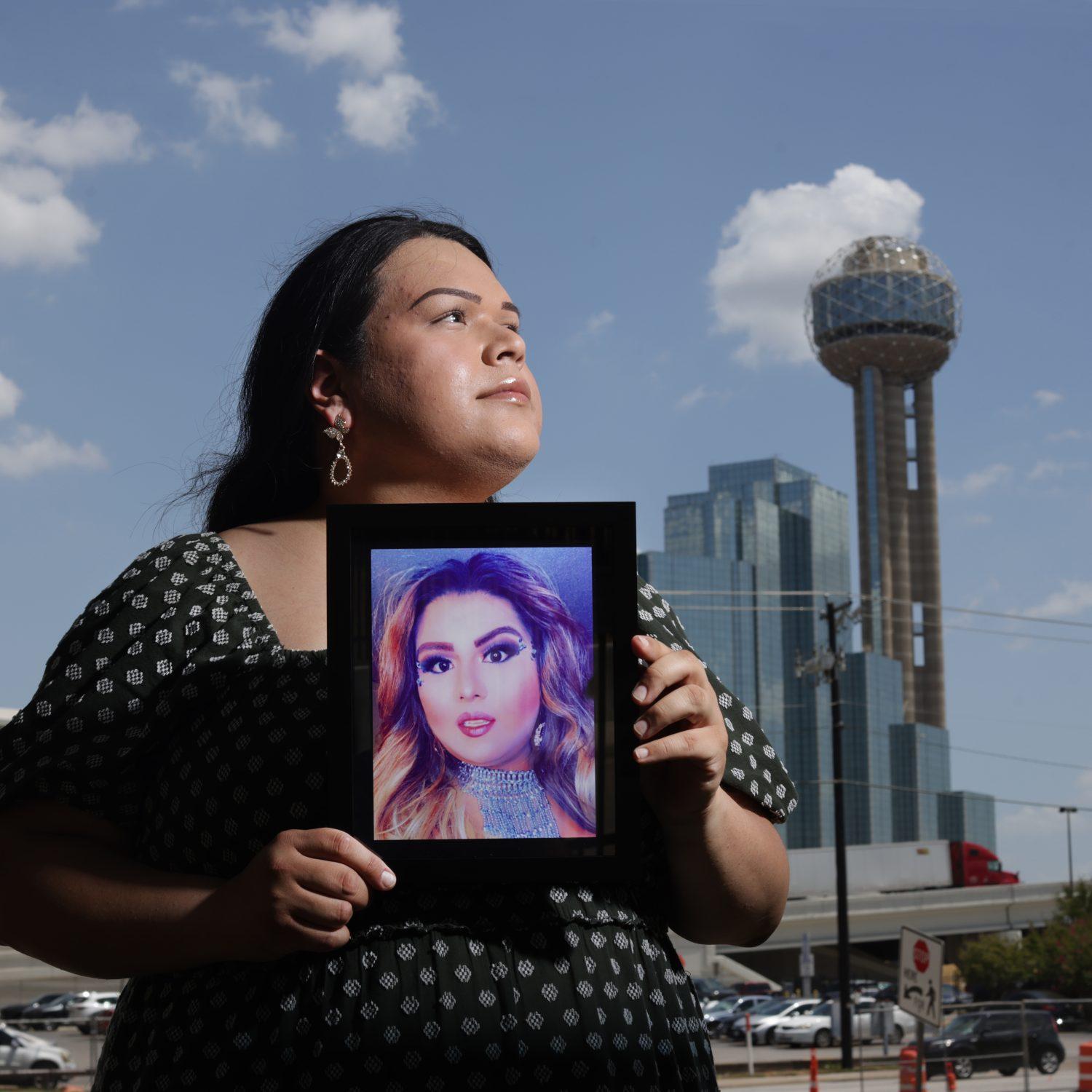
Jason Janik / janikphotography.com

Audio By Carbonatix
As told to Tyler Hicks for the Dallas Observer
Transgender people face heightened risks of violence and mistreatment behind bars, especially if they are transgender women housed in men’s prisons. A review of research on transgender prisoners found that their experiences are “almost uniformly more difficult than other prisoners,” including higher risks of discrimination, inadequate health care and physical and sexual violence. In Texas and elsewhere, transgender people are often isolated in solitary confinement as a purported means of protection. But experts have warned for decades that “solitary,” as it’s often referred to in shorthand, can cause severe and long-lasting psychological harm.
Terry Kupers, a psychiatrist and longtime researcher on solitary confinement, says prisons should “separate, not isolate” transgender prisoners who need protection. “Solitary is a false solution,” he says, to the problem of transgender people being victimized behind bars.
But it appears that’s what’s happened to Gaby Vidana Pereyra, an undocumented 32-year-old trans woman from Dallas who was a sex worker before being arrested in 2021. On paper, the Texas Department of Criminal Justice (TDCJ) doesn’t use solitary confinement; they call it “security detention,” “administrative segregation,” or “restricted housing.” In some instances, prisoners are allowed to keep tablets — which may or may not have service — but their contact with the outside world, or even those in the same prison, is extremely limited.
In 2021, amidst an alarming spate of murders of transgender women of color in Dallas, Vidana Pereyra shot and killed a man who she says solicited her for oral sex in a parking lot, then attacked her. (The gun, she says, belonged to the man.)
On the advice of her legal counsel, she accepted a 15-year plea deal in 2022, in which she agreed to give up her self-defense claim. More recently, after she told family and friends that she was attacked in prison, she’s spent much of the last six months in solitary confinement in multiple Texas prisons.
Below, Stacey Monroe, an advocate for the trans community in North Texas and a friend of Pereyra’s, shares her dire concerns about her friend.
. . .
It could’ve easily been that we had another trans woman murdered in Dallas. But my friend Gaby did what she needed to do to survive. She didn’t wake up that day in 2021 and think about killing someone. That’s not the kind of person she is. But for being a survivor, she was charged with murder.
I first became involved with Gaby’s case in 2022. At the time, she was incarcerated and facing a long prison sentence. At first, the majority of my work involved talking with Gaby’s lawyer.
Gaby had a court-appointed public defender, and she gave me permission to speak with her. The original plea offer was 30 years. Later, the offer went down to 25. Her attorney asked for 10 years in exchange for a guilty plea, and the prosecution came back with 20.
During that time, I also reached out to the district attorney’s office to plead Gaby’s case and try to get them to see that this wasn’t a murder. They heard me out, then recited the Texas Penal Code related to murder. That told me we were caught in a stark, black-and-white interpretation of the law. There would be no gray, no room for possible understanding.
I started reaching out to the media. Many outlets seemed hesitant to cover the story, possibly because of the crime Gaby was charged with, or because she is a trans woman. Probably both. But the case eventually received some attention, and around the same time, the state reached a 15-year plea agreement with Gaby and her attorney. I was hoping for 10 or less, or a manslaughter charge, but I was told this was the best-case scenario. So I focused on supporting Gaby’s mom — who is also undocumented — and doing everything I could to help Gaby while she is incarcerated.
I didn’t know that a few years later I would be fighting to get her out of solitary confinement.
. . .
In February of this year, Gaby was at the Mark W. Stiles Unit in Beaumont, a men’s prison notorious for multiple offenses in recent years. Their staff has falsified temperature records, and their guards have been formally charged with fighting prisoners or with allowing fights to happen.
Gaby is HIV-positive, and she had already raised concerns about access to her medication while in prison. Then, on the last Sunday of February, she told me she had been attacked in the prison church.
She told me another prisoner stepped in when she was being attacked and was stabbed while protecting her. Gaby barely escaped the incident without any major injuries. But instead of feeling protected afterward, she said she was placed in an outdoor enclosure, where she spent three days. After that, she was placed in solitary confinement. Ever since then, she’s been in and out of solitary confinement in multiple prisons.
I needed to see her, especially after talking with her over the phone after all of that went down.
Gaby had told me, “I don’t feel safe telling you on the phone. Please come see me in person.”
I didn’t have transportation at the time. Her mother and father helped me get a rental car and paid for the gas. Because of the ICE raids happening throughout Texas and the country, they were afraid to travel themselves.
I went to Stiles on March 14. A horrible day.
Gaby didn’t know I was coming, and when she saw me, she started crying. She looked very disheveled and completely out of it. This wasn’t the Gaby me or her family knew.
The first thing she said was, “Thank you for coming.” Then she started telling me what she was afraid of.
I wasn’t allowed a pen, paper or anything to write with. So we had to constantly keep repeating everything we talked about. I didn’t want to forget anything.
“I think they want to kill me,” she said, over and over. “They’re going to do it. They’re going to do it, and if you don’t get me out of here, I’m going to die.”
Then she told me she tried reporting the incident in the church, but she was worried her complaints would be shared with the same people that attacked her. I told her to give me the names of individuals and describe them so I know, and I can be as descriptive as possible in our complaint or request to TDCJ. Then she told me she received a note warning her that her food was poisoned.
The whole conversation was mind-boggling. I was sitting there thinking, “Is this really happening?”
Prison is supposed to be a place with all kinds of monitoring. They’re supposed to have oversight. But she felt just as victimized by the guards as she was by the other prisoners.
After that visit, I started putting together what she had told me. I emailed TDCJ, telling them everything Gaby shared and asking why she was still held in isolation off and on. They responded with a lengthy list of steps Gaby needed to take to advocate for herself and return to the general population. She followed the steps.
Finally, Gaby was transferred from Stiles to another prison. I thought, maybe this would mean something would change.
Instead, when she contacted me after her transfer, she told me she was still in solitary.
It made no sense to me. If the reason she was in solitary was that she was supposedly being protected from the people who had threatened her at Stiles, then why was she still isolated after being moved somewhere else?
For a while, communication became another problem.
Gaby’s tablet broke. She told me the prison wouldn’t provide another until her family deposited money in her Securus account, but even when they did, Gaby didn’t receive another tablet.
For weeks, we were hearing through other people.
She would see people walking by and ask them to tell us she still didn’t have a way to communicate with her family. Eventually, after I kept calling the jail and asking what was going on, she got a tablet.
From my perspective, it was clear the prison didn’t want Gaby telling the world what was happening.
Then came the handcuffs.
. . .
On a Tuesday in June, Gaby spoke to her mother after I connected the call. She told her mom the guards weren’t bringing her any food. She was also being physically restrained with handcuffs inside her cell.
I couldn’t understand it. If someone’s already in solitary, what’s the purpose of handcuffing them?
Gaby herself didn’t understand it either. Her mother asked her why they were doing it, and Gaby had no idea.
I started thinking about the bigger picture.
I couldn’t personally say why prison officials were doing this. I could only say what I was seeing and what Gaby was telling us.
But I kept coming back to the fact that Gaby is transgender.
There are other transgender people in the Texas prison system who have been placed in so-called protective custody after receiving death threats. And protective custody can mean solitary confinement.
I couldn’t ignore what I was hearing.
Gaby’s mother and family kept calling. They kept asking the prison to help. We kept calling even when we weren’t getting answers.
As summer approached, her calls to us became less frequent. She wasn’t getting enough food, and her family was struggling with anxiety.
And I kept thinking about the woman I saw at Stiles in March.
That’s when she looked at me and cried. Then she told me she thought she was going to die.
I still have that moment in my head.
That’s why I keep calling. That’s why I keep asking questions. That’s why I’m still trying to understand why all this harm was done to a person who was attacked.
And that’s why I keep trying to get somebody to listen. Because Gaby has already told us what she is afraid of. She’s already told us she doesn’t feel safe. She’s already told us what she thinks is happening to her.
And she’s still there.
…
Editor’s note: The United Nations says solitary confinement lasting longer than 15 consecutive days is considered torture. In the days prior to the publication of this story, Vidana Pereyra had an immigration hearing. Her communication with her family and Monroe is still sporadic, so the results of that hearing were unclear at press time. She is currently being held in the Thomas Gorree Unit in Huntsville, a men’s prison.
