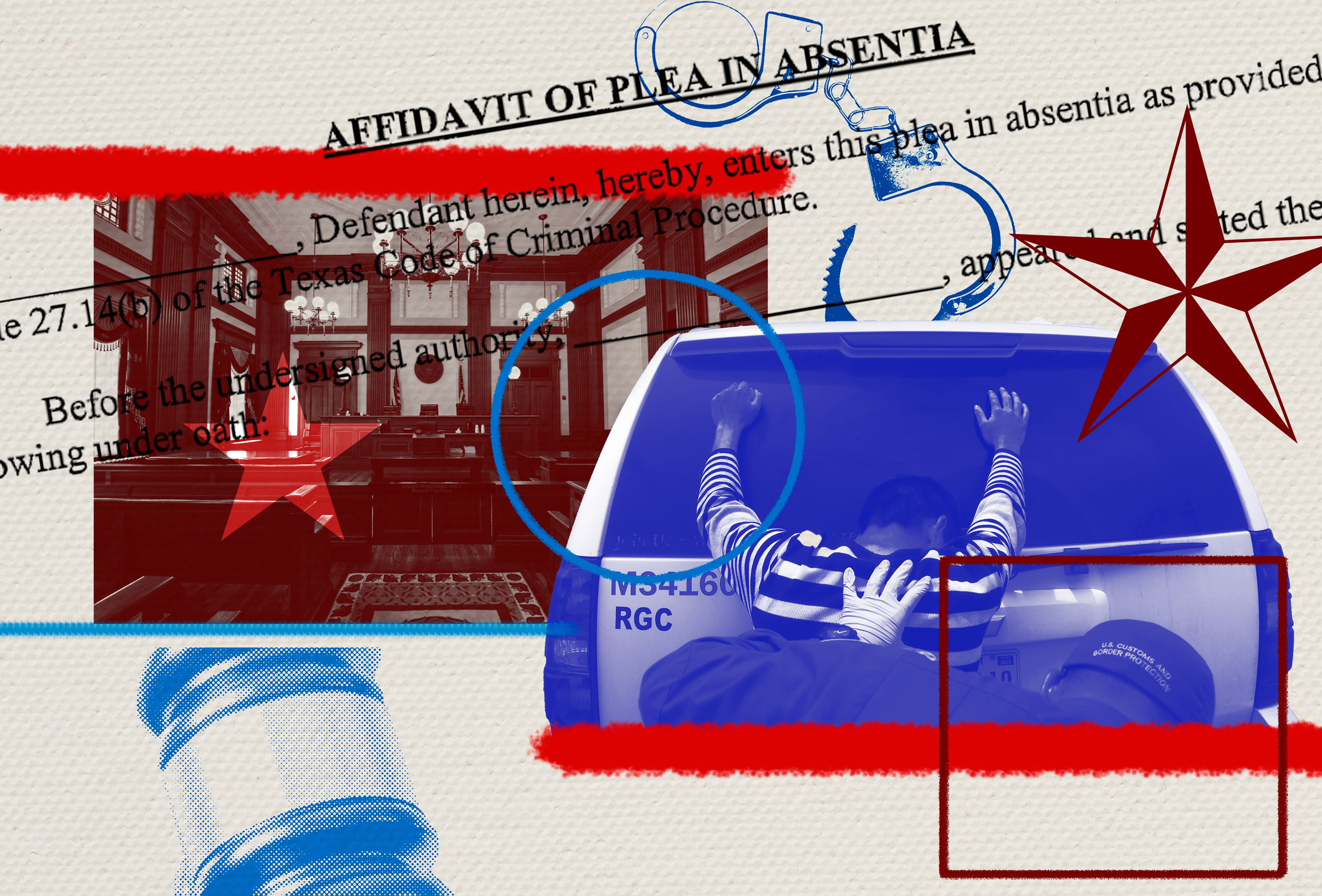
Photo-illustration by Sarah Schumacher; Getty Images; Adobe Stock

Audio By Carbonatix
On the day he was scheduled to appear in a Dallas federal immigration courtroom late last year, a young Honduran man lay in his bedroom, curled in a ball, his chest tight with fear. His case was one that his attorney Paul Zoltan expected to win.
As a member of the LGBTQ+ community, the man had come to the U.S. to escape the risk of violence and discrimination that pervades his home country. A report from 2024 by CONADEH, Honduras’ National Human Rights Office, found that between January and October of that year, 38 members of the LGBTQ+ community were murdered in the Central American country. Most of that violence was targeted toward homosexual men.
Ninety percent of crimes against the country’s queer community go unpunished, creating a situation that the International Rescue Committee, a humanitarian aid group, describes as “dire.” Those factors left Zoltan, who has practiced immigration law in Dallas for decades, sure that his client had “a compelling asylum claim.”
But the man never arrived in court.
Despite Zoltan’s assurances, the man was haunted by the images of immigrants being dragged out of courtrooms by masked federal agents that began to circulate online shortly after President Donald Trump took office last year. A panic attack inspired by the fear of being deported, maybe back to Honduras, or maybe to the infamous El Salvadoran prison where 250 Venezuelan men were sent by the U.S. government last March, overrode the rationality of a standard court appointment.
It is not clear how many people were arrested by ICE directly from courtrooms in 2025, but the strategy was rampant across the United States, including at Dallas’ downtown federal courthouse.
“[My client’s panic attack] was precisely and consequently because of those arrests. I told him that his case did not fit the pattern,” Zoltan told the Observer. “But it just terrified him. His emotional response overcame his readiness to believe me.”
Because of his failure to appear in court, the Honduran man’s case was closed with an in absentia order, which calls for the person’s deportation for truancy. When the deportation order is issued, the person is barred from further seeking asylum, relief from deportation or, in a majority of cases, any appeal. If they attempt to reenter the United States after being deported, they can be subject to criminal prosecution.
Across the U.S., the number of in absentia orders issued skyrocketed in 2025 as undocumented immigrants increasingly no-showed during their scheduled hearings. Dallas’ immigration court was a leading contributor.
In January of last year, 53% of completed immigration cases in Dallas resulted in an in absentia order, according to data analyzed by NPR. By November, that number had grown to 79%, the most of any city in the U.S. That increase represents thousands of immigrants who likely would have shown up to their court hearings prior to 2025, but now face deportation orders and are permanently ineligible for legal status in America.
“I would expect it to be higher, and I think that this is evidence of how firmly immigrants still cling to their faith in the American justice system,” Zoltan said.
Compounding Fear of Detention and Deportation
The number of in absentia removal orders issued by judges in the U.S. has trended upward since 2021, according to Department of Justice data measured in fiscal years. What were nearly 8,540 removal orders in 2021 became 223,154 orders by the end of 2024. Then, in 2025, the number of deportation orders spiked again, jumping to 310,436.
Early data shows that 2026 is on pace with the last fiscal year. In the first quarter of FY26, which ran from October through December, 74,804 removal orders were issued in immigration courts. That means that each month, 24,935 people who’d started the process to obtain legal residency failed to appear in court.
Once an in absentia order is issued, it is nearly impossible to fight. A motion to reopen a person’s immigration case may be granted in “exceptional circumstances,” which is defined by the DOJ as “battery or extreme cruelty,” “serious illness” or “serious illness or death” of the applicant’s spouse, child or parent. If it can be proven that proper notice to appear in court was not granted to the individual, or that the failure to appear was no fault of their own, a case may be reopened.
“Fear of arrest is categorically not a reasonable cause to reopen a case,” Zoltan said. “If you missed your hearing because you were afraid of apprehension, you will not be excused.”
Of the deportation orders issued in FY25, nearly 30% were in cases in which a person had applied for asylum. Asylum grants protection for individuals who believe they will be persecuted in their home country due to their race, religion, nationality, political opinions or social group, which includes sexuality. A person must be present in the U.S. but for less than a year to be eligible to apply.
The complexity that applying for asylum entails is part of what Flavia Santos Lloyd, an immigration attorney based in California, describes as a “biased system” that has historically rewarded undocumented immigrants who have the financial means to obtain legal representation and punishes those who do not. These days, she is seeing that inequity more than ever.
“If you’re going to court, and if you’re seeing other people getting picked up [by ICE], that has a chilling effect,” Santos Lloyd said. “When you see other people getting picked up, you think you’re going to get picked up.”
While failing to appear in court damns a person in the eyes of the U.S. legal system and paves the way for potential deportation, showing up increasingly puts a person at risk of immediate detention.
To prevent her clients from being exposed to the “visual of people getting picked up,” Santos Lloyd has begun petitioning for their hearings to be held online over a video service called WebEx. The requests can be denied, and if an individual does not have legal representation, their appointments are defaulted to in-person. For those who are not granted a virtual appearance, appearing in court is the only way to seek judicial relief, regardless of the stage of the case. To show up is to accept the risk of being arrested.
Before 2025, clients rarely asked whether they’d be detained in court, Santos Lloyd said. Now, that’s all they ask. And as ICE changes tactics month to month, targeting courtroom attendees who are there for different types of appointments than the individuals detained the month before, she increasingly does not know how to answer them.
ICE has been active in the San Diego and San Francisco courtrooms where Santos Lloyd practices. The New York Times reports that in a two-week period last October, 120 immigrants were detained following their hearings at a federal courthouse in San Diego.
“It is spreading. It’s like a cancer,” Santos Lloyd said. “[The arrests] started in the removal proceedings, and now we’re seeing them in adjustment of status [cases].”
Approaching Immigration and Citizenship the ‘Right Way’
Santos Lloyd knows what it’s like to have one’s fate decided in a courtroom.
Originally from Brazil, she came to the U.S. on a student visa and overstayed it after giving birth. It’s a situation that isn’t commonly talked about but one many women find themselves in, she said. Responsible for an American child, she couldn’t simply board a plane home or the baby’s father could accuse her of abducting her own infant.
Figuring out how to stay in the country was its own beast. She spent years through the early 2000s stuck in a “vicious cycle” of either “paying the rent or the filing fees” for various applications to stay in the U.S. Unable to afford a lawyer, she didn’t know she qualified for fee waivers. During bouts of homelessness, shelters were often inaccessible to her because they required proof of employment, which she could not get as someone in the country illegally.
Eventually, she caught a break. She completed the application process for authorizations to stay in the U.S. legally and secured employment. She went to law school and started her own firm.
“I was the person who was going to go get their green card that is being detained right now,” she said. “At the time I got my documentation, I went to my interview and it was, ‘Well, I’m doing the right thing. Yes, I overstayed, yes, I worked without authorization.’ I did tell the truth on the applications, but because I was doing it, quote unquote, the right way, I was rewarded with my residency and eventually my citizenship.”
Santos Lloyd likely wouldn’t be given the same grace today that she received two decades ago. Each day in court, she sees new examples of how “the system is getting worse.”
Conservatives have long emphasized the need for immigrants to come to America “the right way,” but in the last year, that proper path to legal residency has eroded. Beyond the fear that ICE’s presence in courtrooms causes, a number of White House policies have made it harder to come to or stay in the United States.
President Donald Trump has attempted to end birthright citizenship, directly challenging the 14th Amendment of the Constitution, in an executive order whose legality will be decided by the Supreme Court. He has stripped temporary protective status, which grants legal residence in the U.S. to foreigners experiencing extraordinary conditions such as war or natural disaster, from Haitians, Syrians and Venezuelans. (Some of those orders are being challenged in the courts.)
The president has invoked wartime law to justify deportations; the administration revoked the visas of 6,000 students; it has blocked visa issuances for immigrants from dozens of countries.
The courts themselves haven’t been immune. By the end of 2025, nearly 100 judges presiding over immigration courtrooms had been fired by the Trump administration, NPR reports. Other layoffs have left the Department of Justice’s Executive Office for Immigration Review down hundreds of legal assistants and advisers.
The San Francisco federal court alone lost 16 judges, 12 of whom were fired. Anonymous sources told NPR that the firings occurred after the justices were “told to grant asylum more sparingly” and oversee twice as many cases a day as normal.
The Department of Homeland Security has since advertised those open benches on Instagram, encouraging job applicants to consider becoming “deportation judges.”
“It’s a clear message that what you’re there to do … is not to carefully examine each case for people due process,” Olivia Cassin, an employee at a federal immigration court in New York who was fired last year, told NPR. “The main point seems to be expedited deportation and resolution of cases.”
If the “right way” to citizenship was hard before, it’s only getting harder. Santos Lloyd can’t help but empathize. Citizenship has never been a sure thing, but now, if she can’t secure a virtual court appearance for a client, they face a bigger risk of being sent to a detention warehouse.
She tries to prepare her clients for that reality, “especially if there are children involved.”
“I know that it’s not the scope of my work, and I have to be very careful, because you don’t want to cross lines. But you have to have that conversation. Do you have a passport? Do you have keys? Do you have a power of attorney?” Santos Lloyd said. “I give pamphlets [that say] go to your consulate, go get these documents.”
Dallas’ Dangerous Courtrooms
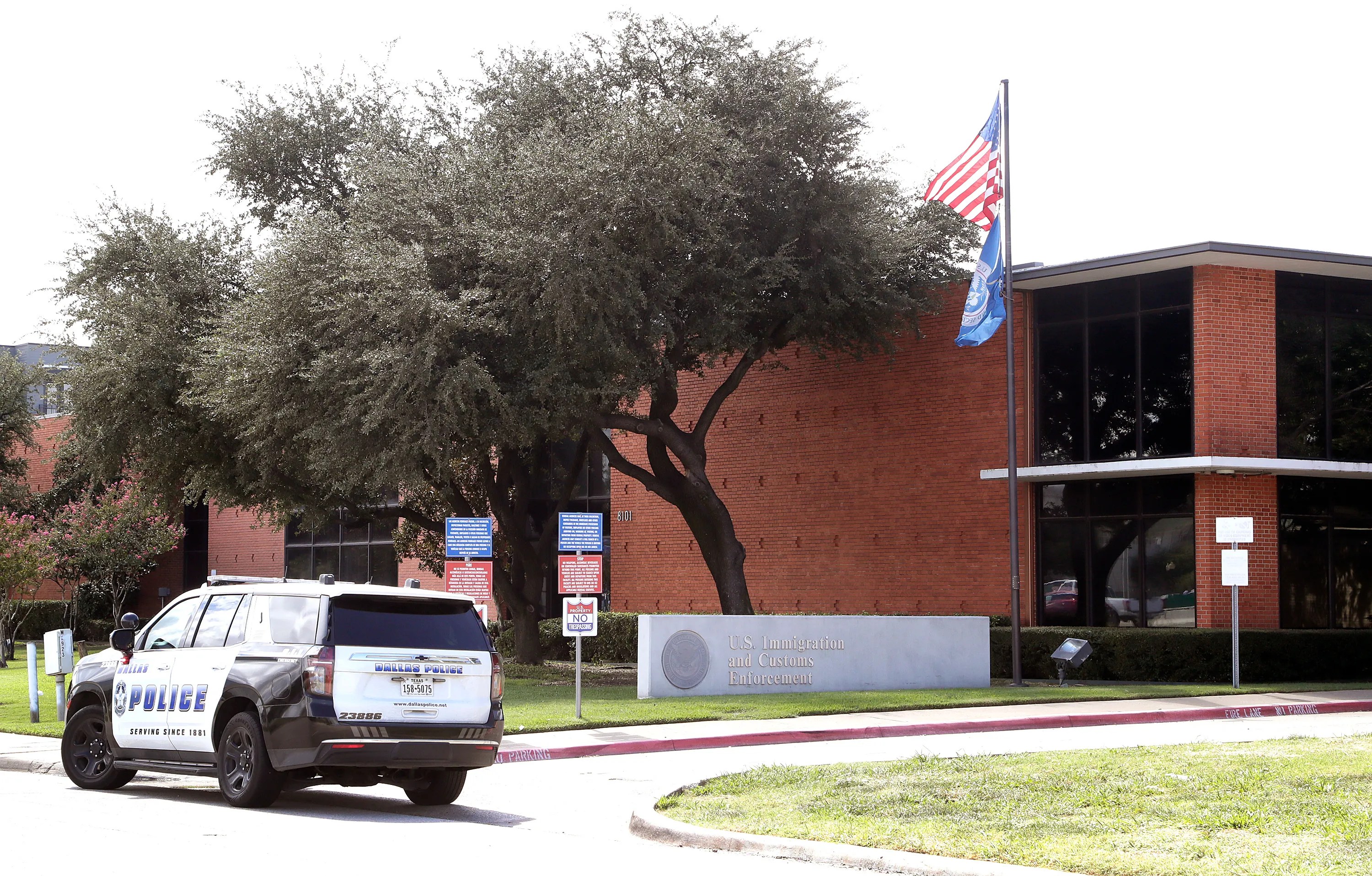
Stewart F. House/Getty Images
Unlike Santos Lloyd, Zoltan has long fielded his client’s fears of apprehension. But similar to the California lawyer, he is now confounded by the seemingly erratic tactics of ICE agents who target courtrooms.
“It is no surprise that people aren’t showing up to their hearings, because even I don’t understand how to predict who will and who won’t walk out of their hearing free,” he said. “We have masked ICE officers who take the law into their own hands and determine perfunctorily that folks shouldn’t have gotten the chance to see a judge in the first place, and [the agents] wrestle them to submission in the court corridors.”
For his clients’ sake, he tries to reassure them before hearings, stating that “so far” a certain type of case hasn’t been targeted, or “most likely” a person will be fine. Because if they fail to appear, their sentence is final. Still, he recognizes that those words are a “thin shield when so much is at stake.”
Having a deportation order issued means spending a lifetime avoiding traffic stops. It means limiting travel and not calling 911 in emergencies. It means the constant threat of being shipped away from one’s home. More immigrants than ever are choosing that over appearing in Dallas’ immigration court. Of the 10 U.S. cities with the most completed immigration cases in 2025, only two others, Atlanta and Charlotte, saw in absentia rates rise above 70%. Miami, in 10th place, orders deportations in only 34% of cases.
“It’s a puzzle. I don’t know why Dallas is leading. The only thing I can think of is that what guides no-shows is fear, and what generates the fear is ICE’s conduct,” Zoltan said. “Their intimidation, their presence, it makes such an impression on me every time I see them.”
Arrests at the Dallas courtroom are often violent. The person usually goes kicking and screaming, outnumbered and seized by masked agents. Family members look on in tears, and strangers try not to look at all. Eventually, the immigrant is swept behind a set of swinging double doors whose closing thump sounds like a death knell.
Zoltan has seen it. He still can’t believe it. And he understands why it would leave someone never wanting to set foot in an immigration court again.
“I’m not the least bit religious. But to me, attending services in a civil institution, I hold that in high esteem,” he said. “I think this violates something damn near sacred.”