
Kristin Bjornsen/Adobe Stock

Audio By Carbonatix
What does it take for a North Texas school district to break even on a $450,000 marketing campaign of grassroots outreach, newspaper ads and targeted digital advertising? Netting approximately 75 new students, Richardson ISD staff recently estimated.
The numbers came as RISD officials considered investing up to $500,000 on a dedicated marketing and advertising campaign after years of sustained enrollment declines and financial strain. Further enrollment, staff explained, would lead to additional revenue, as school funding in Texas is largely dictated by the per-student allotment. While trustees ultimately balked at the proposed budget item and called for a more phased approach, the board eventually approved $200,000 for marketing in June.
Set to roll out this fall, the campaign will see the district invest in targeted social media advertising, direct mail, events and community ambassadors. When asked by the Observer, Superintendent Tabitha Branum said an administrator in her position would have “never” had to consider search engine optimization or geofenced messaging 20 years ago. Those may be newer tools, but so are the circumstances that require public schools to use them, she added.
“It’s a new weight that we have around just understanding the breadth of choices and what we have to do to make sure that we are staying competitive with that breadth of choices,” Branum said.
Declining birth rates, housing shortages, and competition from private and charter schools have led school districts like Branum’s to lose students at an accelerating rate since pre-COVID highs. Richardson ISD’s enrollment has declined by more than 3,000 students since 2019, and those losses impact a district’s bottom line. Last year, RISD approved a $20.8 million deficit budget that required the district to transfer $9 million from its “rainy day fund.”
The constraints force school boards to make painful decisions. In 2024, RISD trustees voted to close four elementary schools and one pre-K campus amid a $28 million budget deficit. Districts have already closed or approved the closure of over 100 campuses since 2024, including 11 in North Texas, according to data analysis by Our Democracy Our Schools. Trustees for Fort Worth ISD, the tenth largest school district in the state by enrollment, approved plans to close 18 campuses over the next five years in 2025.
It is a bleak picture, and the rollout of school choice has made it competitive as North Texas school districts scramble to recapture students and, in turn, secure funding in what feels like an arms race. Marketing and advertising are obvious angles for some districts, while others are investing in early education programs, online learning and technical training. Four Texas districts have even applied to accept voucher funds for pre-K tuition. But they all point to the same thing: districts can no longer assume children zoned within their boundaries will enroll, and officials are trying to make their districts an easy sell in an era when choice matters more than ever and campuses continue to close.
Sustained declines
It may be an understatement to say public schools in North Texas have had a rough go of it. Despite regional growth, more school districts are facing sustained enrollment declines fueled by falling birth rates and built-out attendance zones, including RISD, which has seen total enrollment decline by 7% since 2019.
Significant post-COVID trends toward homeschooling and charter schools had an impact, as did housing costs. And with state funding—which many educators have long argued is inadequate—contingent on attendance, those factors painted an already worrisome financial outlook for administrators forced to consider mass layoffs and campus closures.
Then, in May 2025, Texas Gov. Greg Abbott finally got his wish. After the House of Representatives blocked five school choice bills from 2015 to 2024, both houses of the state legislature passed a $1 billion landmark bill to create Texas Education Freedom Accounts. Under the program, which will disburse funds for the first time this school year, families can use just over $10,000 toward private school tuition and other associated costs outside the public school system. That total rises to around $30,000 for special education students, although an analysis of state records by The Dallas Morning News found that fewer than 25 of 28,700 students with special needs received the full amount.
Over 100,000 students are expected to receive funding through the program in its inaugural year, Texas Comptroller Don Huffines announced earlier this month. Based on an earlier funded account total of 85,344 from the comptroller’s office, 43% of participating students previously attended public schools, roughly totaling 30,500 students. Homeschooling participation also hasn’t slowed since the end of COVID-era restrictions. With TEFA accounts, families can receive up to $2,000 annually for homeschool expenses.
“I think I’ve had to reconcile that at one time public ed was the monopoly, and we’re no longer a monopoly,” Branum said. “And so the work that we do around telling our story, marketing our identity, who we are, and what makes us special, we recognize we have to make some investments in that.”
The One
After an exploratory phase, RISD tapped a marketing firm to lead its marketing campaign: “RISD is the One.” The campaign will target three goals: student recruitment, retention, and recovery. All three matter at a time when choices are plentiful, Branum said. In March, CBS reported that 1,803 families zoned within the district’s boundaries have applied for TEFA accounts.
Recovery could mean connecting with a family to understand why they left and what it would take to bring them back, while retention requires effort to ensure families understand why they chose it in the first place, she said.
“Marketing also means really making sure our parents who have chosen us know why we need to continue to be their choice. If they’re an elementary student, how are we making sure that we are just feeding them, ‘Hey, when your kids get to secondary, these are all the things that will be available to them. Like greatness is ahead, so stay with us.”
Districts can struggle to reach families who live in the district but haven’t enrolled because they chose private or charter school alternatives, Branum said, which is why geofencing and targeted marketing represent such an opportunity for the district in recruitment.
Richardson is also one of a growing number of ISDs that have opened enrollment to a limited number of out-of-district students in recent years as budgets have shrunk and campuses have closed. Frisco ISD, McKinney ISD, Garland ISD, Arlington ISD and Grand Prairie ISD all offer options for students to transfer from outside their zones. All five have closed or consolidated at least one campus in the last two years. It is a competitive environment, but Branum said they won’t pursue those students “at all costs.”
“I very much value the relationships that we have with our surrounding districts, and I very much have mad respect for what they do for their kids every day, and I’m not going to go out and try to poach kids. We’re focused on creating and telling the best story we can of who we are.”
Lauren Drewes Daniels
Connecting to new families
Azure Angelov, a former professor at the University of Indianapolis and CEO of the Paramount Health Data Project, has studied school marketing nationwide. She has written five books on the subject, and her research roughly began around the time Indiana implemented its own voucher system in 2011.
Not investing in messaging is no longer an option for most districts and will remain critical as long as school choice remains in place, she said. Needless to say, adding a massive new expense like marketing to any budget isn’t ideal when there’s less money to go around to begin with.
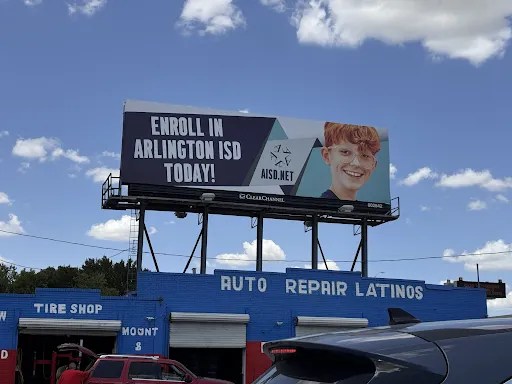
Other North Texas school districts have also leaned into marketing over the last five years, some with mixed results. In 2022, Fort Worth ISD invested $1.2 million in a campaign to combat charter school growth. Coppell ISD poured roughly $50,000 into its “Cowboys United” campaign last year, and this month, officials told NBC 5 it is working as the district recorded 100 new enrollments. Arlington ISD invested in its own marketing campaign in 2024 and 2025, but an audit by the National School Public Relations Association found that it failed to connect with its target audience and focused too heavily on parents and teachers rather than the wider community.
The transition into marketing can often come with hurdles, Angelov said, which is why consulting firms may make sense for districts with smaller budgets or those newer to the approach. She also said that while high-visibility marketing and advertising tools like billboards have their place, districts should remember where parents spend their time.
“We see a lot of places door-knocking and flyers. But I would say do not forget the grassroots places. Do not forget nail salons, barber shops, beauty salons, like places where people of childbearing years are going, because those are the places where they’re seen the most, so I think that I think that’s important.”
Instead of comparing themselves to others, she said, focusing on a district’s strengths and not overselling is crucial to designing an effective campaign. She added that listening to families is also key to effective marketing, and that outreach should take a more holistic format that goes beyond the standard survey. One school district improved the process by hiring people to call front desks and act as parents interested in enrolling their children at the school, Angelov said.
School districts are likely to hear that families want more bang for their buck and flexibility with their children’s education, she said, which is why school choice won’t just be about the strongest sales pitch. More than anything, setting themselves apart from charter schools or neighboring districts comes down to what they offer.
“I think a lot of times school choice gets defined as I have a public school over here, but I choose to go to a private school. When the reality is, I have a public school, but I like this other public school better because they have more resources.”
Programming and listening
One way districts can make themselves more attractive, especially in retaining students and attracting new families who have more options than ever, is by offering strong pre-K programming, Angelov said. In Texas, many districts offer free pre-K for students who meet certain eligibility requirements, such as being economically disadvantaged or being non-English speakers.
Dallas ISD, the largest school district in North Texas, is offering tuition-free pre-K to all families living within the district’s boundaries for the first time this year. Since 2019, the district’s enrollment has declined by over 20,000 students. The program’s cost is minimal because it fills empty seats in classrooms that are already sufficiently staffed. Previously, the district had roughly 270 students paying tuition for 3- and 4-year-old pre-K.
Debbie Ramos, the district’s assistant superintendent for early learning and centralized enrollment, said the decision was a no-brainer as families decide where to enroll their children.
“There are so many options out there; we wanted to make sure that families had access, and so that was our decision to go with universal pre-K because we know it’s so important for students to start early on, and we just wanted to remove any barriers that may stop a family from enrolling their child.”
Another initiative designed to give families more options for their children’s education is the pre-primer initiative. Unveiled alongside universal pre-K, the optional program adds a gap year between kindergarten and first grade, targeting students who need additional support or who did not attend DISD before grade school.
Dallas ISD designed pre-primer, Ramos said, after studying competing non-public options in the area.
“We were out visiting our neighboring private schools and looking at what they have that we can offer, and the thing that bubbled up was this pre-primer program, and it’s a bridge between kindergarten and first grade, and so it’s a mix of students who may want the academic advantage and students who may need additional time.”
Students enrolled in the program continue with standard subjects such as language arts and social studies, with a specialized curriculum that minimizes repetition from their previous grade level through hands-on experiences. Character building is a part of the curriculum, Ramos said, with book clubs and leadership exercises built in.
The program is being launched at select pilot campuses across the district, but will expand in the future. Around 100 students have already enrolled. The district will continue to invest in early education programs and push to increase pre-K enrollment, she said.
“I think families are just learning more about how critical it is to have an early start for their child, and that’s the message we continue to push,” Ramos said. “Because we know that there are students that we’re not tapping into, or they just don’t know about pre-K, or that they have options right down the street, and so we continue to make sure that parents are informed.”
Growing pains
While urban districts like Dallas ISD are grappling with a more immediate need to bolster enrollment, outer-ring suburban districts are also reevaluating their approach. These districts have seen record growth in their student populations, mirroring broader demographic shifts away from urban centers, with families seeking lower housing costs, better schools and a smaller-town feel. Located about 20 miles east of Dallas, Forney ISD has more than doubled its enrollment from roughly 9,000 students a decade ago to more than 20,000 today.
It’s a fast-growth school district, but Superintendent Justin Terry said he hasn’t been immune to the pressures facing other districts. Last year, enrollment was expected to grow by 1,000 students, down from a projected increase of 1,500.
“I think whether it’s a declining enrollment district or a district that’s really hit the peak and is beginning to fall,” Terry said. “We’re in the same boat.”
The district has focused on innovation amid its rapid growth, but Terry said it has also been careful to monitor the changing ecosystem as more students enrolled. Starting at the height of the growth surge, Forney ISD led focus groups with homeschool families to understand why they weren’t choosing local public schools. More than any other factor, staff heard families wanted flexibility and options when choosing how to educate their children, Terry said.
With their input in mind, the district began offering the Forney ISD Online Academy in 2022, following a 2019 pilot. The program allows students in grades 5-12 to complete coursework through an online curriculum while still accessing campus instruction, resources and extracurricular activities like athletics.
“It allows kids to have some flexibility for some of their core courses and come up and be a part of an athletic team, and still be a part of a Friday night football game, which is a great community event,” he said. “So I think that that’s something that we’ve got to begin to do, really, is just listen.”
Between the hybrid enrollment program and online dual credit offerings, Terry estimated that 1,500 to 2,000 students participate at the high school level, accounting for roughly a quarter of upper secondary students. Other school districts, including Dallas ISD and Arlington ISD, have also begun offering similar enrollment models.
Growth at Forney ISD has also allowed the district to invest in innovative facilities, which are a selling point by themselves. New property revenue has funded the completion of an animal science center, while Forney voters have approved $1.9 billion in bond funding since 2019 to build newer campuses equipped with cutting-edge amenities. The 2019 bond funded the construction of Opportunity Central, a $150 million blend of a career education facility and shopping mall with a florist, body shop, salon and dining options, all staffed by students. Student experiences offered by the center, along with its openness to the community as a resource and event space, make it a tool for changing residents’ perceptions of public education, Terry said.
“When you can create facilities that not only serve our kids but also serve our community outside of the hours, it adds value,” Terry said. “That really goes a long way, I think, when they see a school district in a light that is not just every day focused on eight to four, but really embracing the community as a whole and what the needs are there.”
Hopefully, a payoff
Last year, Richardson ISD’s enrollment fell by over 700 students. Branum’s expenses, such as transportation and food, keep rising, and she said she’s not confident that state lawmakers will increase the basic allotment when they convene in January.
But she’s still an optimist. RISD’s marketing campaign is launching over the next few weeks with a targeted enrollment push. The “One” is also an acronym: opportunities, neighborhood schools and experiences. Branum said those three things make the district unique and will remain central to its messaging.
“We’re going to provide opportunities and choices if that’s what meets your family’s needs,” Branum said. “We’re going to have amazing neighborhood schools, and then we’re going to provide experiences that I think are going to help shape our kids as humans.
RISD plans to evaluate the campaign’s success in the spring, so it remains to be seen whether it will pay off. In the meantime, Branum said she knows what long-term success will look like when she sees it.
“I hope… that there will be a moment in which their love and respect for the school district is so strong that word of mouth is just so infectious that before we’ve even reached out to a prospective parent, they’ve heard from 10 other parents,” she said.