
Illustration by Sarah Schumacher

Audio By Carbonatix
Keep Dallas Observer Free
We’re aiming to raise $10,000 by April 26. Your support ensures Dallas Observer can continue watching out for you and our community. No paywall. Always accessible. Daily online and weekly in print.
Texas might be heading into the psychedelic business alone after failing to find a drug company to partner with on clinical trials.
State lawmakers approved $50 million in funding for clinical trials with ibogaine, a psychoactive drug derived from a shrub native to Central Africa, with the passage of Senate Bill 2308 in June. The bill’s text calls for the creation of a “consortium to conduct United States Food and Drug Administration ’s drug development clinical trials.” While state funding was supposed to be matched by a drug company, no viable proposals have come forward, Lt. Gov. Dan Patrick and Texas House of Representatives Speaker Dustin Burrows announced last week.
Instead, the state will “fully fund” a two-year clinical trial, according to a joint statement from the two senior state Republicans. UTHealth Houston, in collaboration with The University of Texas Medical Branch at Galveston, has been tapped by the state’s health and human services commission to lead the trials.
Ibogaine is currently listed as a Schedule I drug by the Drug Enforcement Administration. Despite its federal status and the Texas GOP’s hardline stance on drug policy, Republican lawmakers have largely rallied to advocate for research into ibogaine’s therapeutic potential. The drug has been used with some success in treating opiate addiction, PTSD and traumatic brain injury.
“Texas is home to more veterans than any other state,” Texas Gov. Greg Abbott wrote in a statement after SB 2308 was signed into law. “Many of those veterans suffer from injuries both seen and unseen. A therapy that has shown great promise in treating those conditions is ibogaine. This law authorizes a Food and Drug Administration-approved clinical drug trial that will seek approval of ibogaine as a medication for the treatment of opioid use disorder and other behavioral health conditions.”
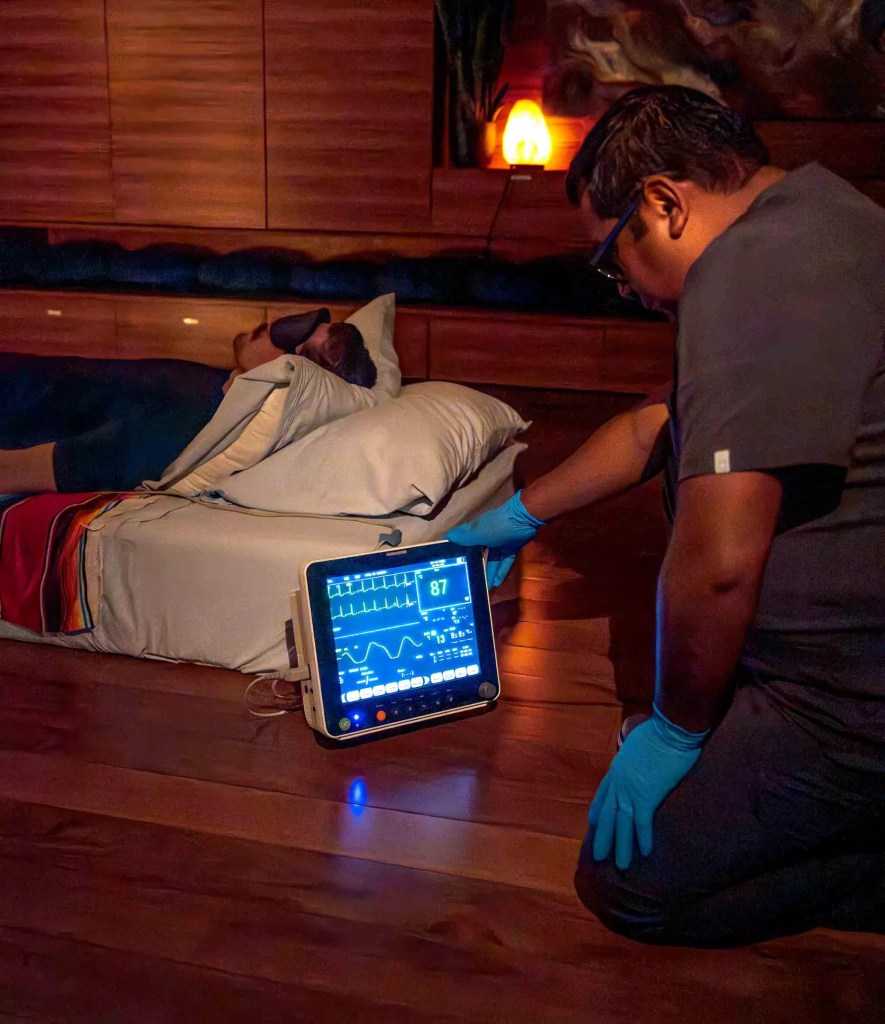
U.S. citizens, including former Texas Gov. Rick Perry, have traveled to Mexico for years to take the drug in upscale clinics and off-the-beaten path sweat lodges. In an interview with The New York Times, Perry said ibogaine therapy helped treat his anxiety and insomnia, leaving him “happy as I’d been in memory.”
Magda Stuglik
Not a Short-Term Fix
The road to getting the drug federally approved for treatment and publicly available will be long, Katharine Neill Harris, a fellow at Rice University’s Drug Policy Research Institute, said.
“I would say 10 years, really. Maybe I’m being pessimistic, but the drug development process takes a very long time,” Harris said.
The latest publicly released figure from the FDA, dating back to 2015, puts the average time to study a new drug and bring it to market at 8.5 years. Other groups, like the Nationwide Children’s Hospital, say the timeline is now closer to the decade mark. And that’s just the average; the approval process for an experimental psychedelic — especially one potentially posing cardiac risks for users — could take even longer.
Barring any new developments, researchers at state institutions will launch that process without a private industry partner. SB 2308 requires an approved drug company to have a physical corporate presence in Texas, disclose key financial information and agree to the state collecting 20% of future revenue. Along with the $50 million match, the requirements may have been “a tough pill to swallow,” Harris said.
“I would really like to see what companies were considered for this process and why, specifically, they were denied,” Harris said. “Because I think it’s helpful to understand that and to understand if the state’s bar is too high, or is there a lack of interest with these requirements? How many companies are even capable of meeting these requirements?”
The Tuesday joint statement did not contain information on the companies involved; rather, Patrick simply wrote that “no drug company, including the most recent applicant, has yet submitted a proposal that meets the law’s requirements and standards to receive state funds and begin clinical trial.”
Harris said the state could look to donors or other private sources to help match the state’s $50 million contribution. And the state needs a matching partner to disburse its own funds under the adopted text of SB 2306, Harris said.
“They’re supposed to have that private matching contribution of 50 million to move forward… As a statutory thing, something is going to have to change for the compliance to be there,” Harris said.
She added that, if needed, lawmakers could amend the bill’s language in a special session. Burrows and Paxton’s joint statement did not specify a timeline for launching the trials.
But even then, she said the $100 million total may not be enough to fully fund the trials.
“There’s questions about how this is going to work. $50 million will not be enough to get the clinical trials to the FDA approval stage,” Harris said. “I don’t know that $100 million will be. So more money is going to be needed, and maybe there are already identified private donors, right? So maybe they don’t have a drug developer partner, but maybe they can help. Maybe they’re still intending to raise money from the private sector.”
Legislators in other states have joined Texas in advancing bills to fund research. On March 30, Mississippi Gov. Tate Reeves signed a bill authorizing the state’s own ibogaine consortium and allowing for collaboration with other states’ research programs. Lawmakers in Oklahoma and West Virginia have also filed bills modeled after SB 2308.
The would-be miracle drug is still years away from approval for use, however, and a rubber stamp from the FDA is far from guaranteed, said Harris, who pointed to the agency’s decision to deny MDMA for therapeutic use after decades of trials in 2024. And it remains to be seen whether Texas officials will have the stomach for a years-long process with an uncertain outcome.
“Without the private partner, I don’t know that they actually have the appetite to spend what needs to be spent on this,” Harris said. “Because, again, I think $100 million is a kind of low-ball for what it would take to get to the FDA approval process. They wanted to spend $50 million.”