Texas Department of Corrections

Audio By Carbonatix
Scholar and author, Dr. Michael Phillips, SMU Professor Dr. Rick Halperin and Hadi Jawad, co-founder and president of Human Rights Dallas submitted the op-ed below on Texas’ death penalty.
If all goes according to the Texas Department of Corrections’ plans, the state will reach a shameful milestone on May 14 with the execution of Edward Busby.
Pending a court stay, Texas will first put James Broadnax to death on April 30. A Dallas County jury sentenced Broadnax to death row in 2009 for fatally shooting two men during a robbery outside a Garland recording studio the previous year. At his trial, prosecutors presented as evidence to an all-white jury forty handwritten pages of rap lyrics written by Broadnax. This move, Howard University liberal arts Professor Erik Nielson said in a legal brief, aimed at exploiting white fears of Black men as irredeemable super predators.
In a March 11 written declaration submitted to the court, Broadnax’s cousin, Demarius Cummings, now says that he killed Stephen Swan, 26, and Matthew Butler, 28. Cummings is now serving a life term for the murders, which took place when Broadnax was 19. Cummings’ DNA, and not that of Broadnax, was found on the murder weapon.
If the TDC still carries out that state killing on schedule, then the next month Busby will become the 600th person to die by lethal injection since Texas pioneered this method of capital punishment on December 7, 1982.
In 2005, a jury convicted Busby of a terrible crime. With a co-conspirator, in 2004 he abducted Laura Lee Crane, a 77-year-old retired Texas Christian University professor, from a grocery store parking lot. Using her credit cards, the pair robbed her of more than $775. They threw her in the trunk of a car, asphyxiated her, and then dumped her body near a highway in Oklahoma.
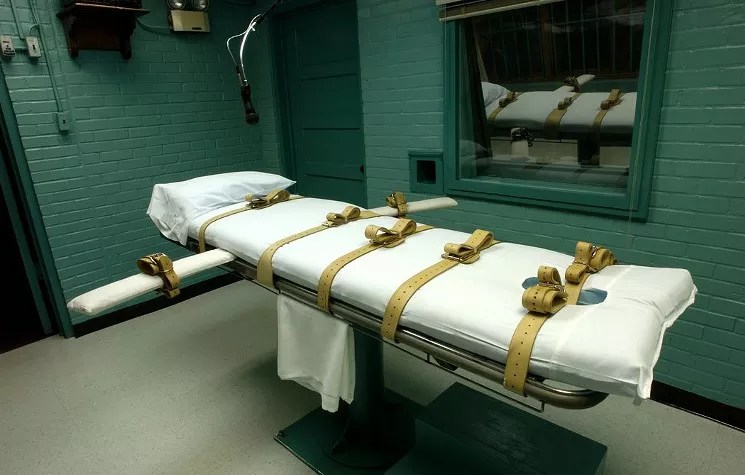
It’s impossible to ignore the brutality of Busby’s worst deed. However, the state of Texas has done a brilliant job of concealing the extreme violence that unfolds in its Huntsville death chamber with each execution. Throughout its history, lethal injection has served as a deceptively calm form of torture.
From 1924 until 1965, Texas executed 361 prisoners with the electric chair. However, in 1972 the Supreme Court ruled in Furman v. Georgia that the death penalty was so racist and randomly applied that it violated the Eighth Amendment’s ban on cruel and unusual punishment. The decision temporarily halted executions nationwide but the court restored capital punishment in its 1976 Gregg v. Georgia decision. Yet, as Texas prepared to resume executions, local politicians quickly faced a dilemma.
On January 9, 1977, Tony Garrett, a reporter for KERA in Dallas, persuaded Federal District Judge William M. Taylor Jr. that the television station had the First Amendment right to film executions.
As law professor Corrina Lain explains in her book Secrets of the Killing State, although that decision was later overturned, Texas lawmakers feared how the public might react to witnessing prisoners electrocuted on prime-time television. They sought less grisly alternatives.
According to Lain, Texas turned to a three-drug lethal injection protocol designed by an Oklahoma coroner, Dr. Stephen Crawford. He stepped into the breach because most doctors shunned designing new execution methods for fear of violating the Hippocratic Oath. Crawford joked that although he was an expert in dead bodies, he didn’t know how to get them that way. He didn’t realize that the three drugs he recommended worked at cross-purposes, prolonging prisoners’ agony.
Because they resemble harmless medical procedures and render victims unable to cry out, lethal injections proved politically successful. In 2012, Texas switched to a one-drug lethal injection protocol when European pharmaceutical companies objecting to the death penalty cut off the state from its poison supply. Texas now uses pentobarbital alone, but regardless of the change, the state’s death house remains a chamber of horrors.
Autopsies reveal that the lethally injected die through acute pulmonary edema, meaning they drown, often slowly, while paralyzed. Prisoners facing execution tend to be older than the population as a whole and to have a history of intravenous drug use, which makes finding usable veins for infusing the deadly drugs difficult. Professional ethics prohibit medical personnel from participating in executions. Prison guards lacking appropriate training step into the breach. This results in inmates being jabbed with needles repeatedly by inadequately trained personnel for excruciatingly long periods of time before an IV line can be established successfully.
In 1987, it took prison guards in Huntsville an hour to kill Elliot Rod Johnson, whose veins had collapsed because of his drug habit. Killing Genaro Ruiz Camacho took two hours in 1998 for similar reasons. During the 1988 execution of Raymond Landry, the needle popped out of his arm. A curtain was drawn around the execution scene and Landry could be heard moaning as guards found a new insertion point. By the time the Huntsville execution team strapped Stephen Barbee to the gurney in 2022, he had suffered severe degeneration of the joints in his arms that left him unable to lay his arms flat. Executioners attempted to open an IV line in both hands and finally in his neck before the lethal drugs successfully began to flow, an ordeal that lasted almost an hour and a half.
Because Texas has trouble buying lethal drugs, in the past it obtained pentobarbital from a compounding pharmacy in San Antonio cited for repeated safety violations. Executioners often administer the drug well past its recommended use date. This weakens the lethal dose, extending the process of death agonizingly longer.
Racism largely shapes who gets subjected to this cruelty. African Americans make up 12% of the state’s population, but 47.6 percent of Texas death row inmates.
Wrongful convictions also haunt the process. In the past 53 years, at least 202 sent to death row have been subsequently exonerated.
Dallas County has played an outsized role in this grim history. Sixty inmates subjected to lethal injection in Texas received their death sentences in Dallas County. Only Harris County, which includes Houston, has been more prolific in its use of the death chamber in the past 44 years.
This county also has a tragic history of executing the innocent. This January, the Dallas County district attorney’s office posthumously exonerated Tommy Lee Walker, a man railroaded into the electric chair in 1953 by Henry Wade, the ruthless late former D.A. who served from 1951-1988. Reportedly, Wade once bluntly expressed his win-at-all costs philosophy by declaring, “any prosecutor could convict a guilty man, but… it takes a real pro to convict an innocent man.”
The near execution of another intended victim of Wade’s reckless team, Randall Dale Evans, became the subject of an acclaimed 1988 documentary, The Thin Blue Line. One of Wade’s successors, Craig Watkins, later exonerated about two dozen who were wrongly imprisoned by his predecessor. Watkins revealed evidence of systemic prosecutorial misconduct and racism during those decades, including in capital cases. Yet, in spite of his misconduct, Dallas County still pays tribute to Henry Wade, with his name gracing the juvenile justice center.
Since he took office in 2019, current Dallas County District Attorney John Creuzot (recently defeated in his re-election bid) instituted a de facto moratorium on seeking the death penalty. It is hoped that the Democratic D.A. nominee Amber Givens, unchallenged this fall, makes this official policy. Dallas must move past this barbaric past and set an example for the rest of the state, long a world-leader in capital punishment, in ending the death penalty locally.
Have an opinion on this you’d like to share with us and the Dallas community? Email editorial@dallasobserver.com (and it might get published in our Opinion section).