
Nathan Hunsinger

Audio By Carbonatix
Today is Local News Day
A national day of action to support and celebrate the trusted local journalism that strengthens communities. If you believe local news matters — this is the day to show your support. Make a contribution today to help keep our reporting free and accessible to all.
Scholar and author, Dr. Michael Phillips, SMU Professor Dr. Rick Halperin and Hadi Jawad, co-founder and president of Human Rights Dallas, submitted the op-ed below regarding how former Dallas County District Attorney Henry Wade’s legacy should be viewed
A disturbing five-year New York Times investigation published on March 18 detailed accusations that civil rights icon Cesar Chavez molested two children and raped fellow farmworker activist Dolores Huerta. In response, Dallas politicians acted at lightning speed to erase the disgraced labor leader’s name from the landscape.
Hours after the Times published its exposé, six Dallas city council members recommended renaming Cesar Chavez Boulevard. On March 19, crews removed a statue of Chavez from Dallas Farmers Market. On April 8, the city removed Cesar Chavez Day on March 31 from the list of city holidays, and established a day in honor of Huerta to be observed on her birthday each April 10.
The nature of Chavez’s abuses justifies these moves. In Dallas, however, such historical reckonings have always proven separate and unequal. White people who are celebrated in the public square tend to get a special pass for their crimes. Such is the case with Henry Menasco Wade, Dallas County district attorney from 1951-1987.
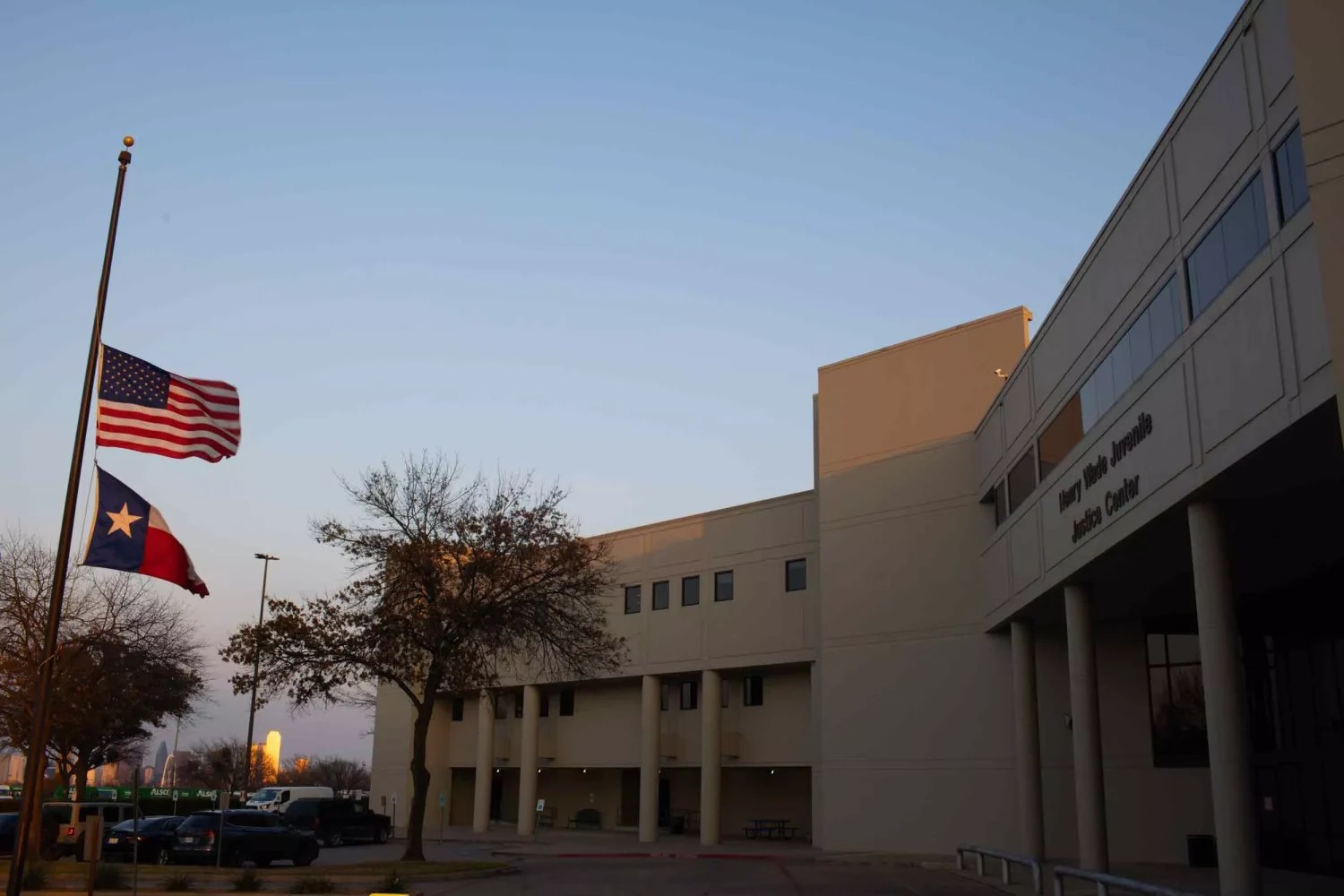
Racism, misogyny, homophobia and a careless disregard for the rights of the accused defined his career. Yet, in 1995, Dallas County named its juvenile justice center after Wade. It is past time for the Dallas County commissioners to remove Wade’s name and stop paying tribute to a man who showed so little regard for the Constitution.
Wade’s greatest talent might have been self-mythologizing, a skill that shaped how the press depicted him. In his 1994 book Big D: Triumphs and Troubles of an American Supercity in the 20th Century, longtime Dallas Times Herald reporter Darwin Payne promoted this legend, describing Wade as “one of the nation’s most famous and successful district attorneys, noted for a sensational record of courtroom triumphs and for developing a large number of aggressive prosecutors.”
That “sensational” record, however, rested on the racist exclusion of Black and brown jurors, threats and abuse of suspects outside the presence of defense attorneys and the repeated unethical suppression of exculpatory evidence.
The case of Tommy Lee Walker, an innocent 19-year-old Black man who died in the electric chair after being convicted of the murder of a white woman, captures all the horrors of Wade’s now-whitewashed career. Overwhelming evidence of misconduct by Wade’s office and the Dallas police in that more than 70-year-old case impelled the Dallas County Commissioners Court to posthumously proclaim Walker’s innocence on Jan. 21.
Venice Parker died after being stabbed on her way home from work on Sept. 30, 1953. One police officer later claimed that she said, “a Negro took me under the bridge and cut my throat,” although medical experts later testified that she would have been unable to speak because of her injuries. After hassling a multitude of Black men for four months, Dallas police arrested Walker, who became a father the night of Parker’s slaying. Police and Wade’s office ignored nine eyewitnesses who said that they were with Walker at the time of the crime.
Wade later tricked the terrified young man into signing a confession after he was threatened with a beating by homicide detective Will Fritz, who belonged to the Ku Klux Klan into the 1920s. Wade lied to Walker, saying that if he signed the confession, the district attorney wouldn’t seek the death penalty. Wade did not just ask the all-white jury for a death sentence, but he also said in his closing arguments that, “I’d be glad to walk the last mile with you, Walker. And I’d be glad to pull the switch on you.” Texas executed the 21-year-old on May 12, 1956.
The all-white jury in the Walker trial was the rule rather than the exception in the Wade era. Well into the 1980s, Wade’s office fought to exclude all but white men from juries. Before he became the Dallas County 283rd District’s presiding judge, Jack Hampton served on Wade’s team of prosecutors from 1957-1962. In a 1986 interview with The Dallas Morning News, Hampton recalled how, in a DWI case in the late 1950s, he failed to use a peremptory challenge to prevent an African American woman from serving on a jury.
The trial resulted in a hung jury partly because Hampton had failed to convince that woman of the defendant’s guilt. Wade warned Hampton, “If you ever put another [n—–] on a jury, you’re fired.” Hampton never allowed another African American to serve on a jury the rest of his time with Wade.
In 2005, defense attorneys persuaded the U.S. Supreme Court to reverse Thomas Joe Miller-El’s 1986 death sentence when they proved that Wade and his team had systematically excluded African Americans and other marginalized groups from Dallas County juries through the 1980s. Miller-El’s legal team discovered jury selection manuals that had been given to Dallas prosecutors for decades. One, authored in 1963 by one of Wade’s top deputies, warned prosecutors, “Do not take Jews, Negroes, Dagos, Mexicans or a member of any minority race on a jury, no matter how rich or how well educated.”
In 1969, Dallas Assistant District Attorney John Sparling wrote an equally offensive sequel to that manual, a memorandum to DA office attorneys he called “Jury Selection in a Criminal Case.” The memo opened with this instruction: “You are not looking for a fair juror, but rather a strong, biased and sometimes hypocritical individual who believes that Defendants are different from them in kind, rather than degree.”
The memo further instructed Wade’s team to, if possible, block “any member of a minority group which may subject him to oppression — they almost always empathize with the accused” as well as those with “physical afflictions.” Sparling further declared, “I don’t like women jurors because I can’t trust them.” The U.S. Supreme Court, in the 1986 Batson v. Kentucky case, cited the Sparling Memo when it ruled it was unconstitutional to strike jurors based on their race or ethnicity.
Wade and his associates made life miserable for the Dallas LGBTQ+ community in the days before the state’s vague sodomy law was overturned in the 2003 Lawrence v. Texas case. As a judge, in 1988, Jack Hampton gave a lighter sentence than the law allowed to Richard Bednarski, convicted of murdering two gay men in a Dallas park. In an interview, Hampton demeaned the victims, Tommy LeeTrimble, 34, and John Lloyd Griffin, 27, as “queers” who “wouldn’t have been killed if they hadn’t been cruising the streets picking up teenage boys.”
Hampton’s homophobia was widely shared among his former peers in the Dallas County DA’s office. As historian Wesley Phelps notes in his book Before Lawrence V. Texas: The Making of a Queer Social Movement, the Dallas Police Department arrested 451 people for sodomy between 1963 and1 969 and, according to Judge Sarah T. Hughes, Wade took “pride in the manner in which he enforced the law.”
Wade also valued winning over justice. He once infamously joked, “Any prosecutor could convict a guilty man, but … it takes a real pro to convict an innocent man.” In his ruthless drive to win at any cost, Wade and his team convicted many innocent defendants. The acclaimed 1988 documentary The Thin Blue Line centered on the wrongful capital murder conviction of Randall Dale Adams, charged with killing Dallas police officer Robert Wood during a traffic stop in 1976. The film’s director, Errol Morris, extracted a recorded confession from the real killer, David Harris. Wade apparently focused on convicting Adams instead of the actual gunman because Harris was a minor at the time he killed Wood and therefore couldn’t be sent to death row.
One of Wade’s successors, the late Craig Watkins, later established a Conviction Integrity Unit that exonerated 36 people wrongfully convicted of crimes by Wade’s office.
Wade’s reputation rests primarily on the high number of convictions his office won in district court. However, appeals courts subsequently overturned many of those convictions because of the DA office’s courtroom misbehavior. Back in 1977, Jack Onion, the presiding judge of the Court of Criminal Appeals, told D Magazine, “Dallas tends to have more reversals on the basis of improper jury arguments than any other county.” Among the improper tactics employed by Wade and company was claiming that the prosecution possessed additional evidence that proved the defendant’s guilt that was never presented in court. Under Wade, prosecutors often emphasized to the juries that defendants had chosen not to testify, a right guaranteed by the Fifth Amendment to the U.S. Constitution and which does not imply guilt when exercised.
Wade’s sloppiness as an attorney led to him blowing his two most famous cases.
Dallas nightclub owner Jack Ruby murdered the alleged assassin of President John F. Kennedy, Lee Harvey Oswald, on live television. Ruby’s conviction should have been an open-and-shut case, but on October 5, 1966, the Texas Court of Criminal Appeals overturned the guilty verdict in part because Wade introduced as evidence an improperly gathered statement Ruby made to Dallas police that suggested he killed Oswald with premeditation. Ruby’s case was on appeal when he died from cancer-related causes at Parkland Hospital on January 3, 1967.
Law Professor David Garrow suggested in his book Liberty and Sexuality: The Right to Privacy and the Making of Roe v. Wade that Wade had little interest in enforcing the Texas abortion ban in the days before the legal battle that will forever be linked to his name. Garrow portrays the Dallas County DA’s office as being vastly outsmarted and outworked by plaintiff Norma McCorvey’s attorneys, Sarah Weddington and Linda Coffee. Garrow quotes Wade as saying that he never bothered to read the Supreme Court’s 1973 decision that for almost a half century maintained a woman’s right to an abortion, with some limitations.
While his loss in that case had the unintended positive consequence of granting women a degree of bodily autonomy until Roe was overturned by the 2022 Dobbs v. Jackson Women’s Health Organization, his lack of attention to a case that so deeply affected the lives of women in Dallas County and beyond hints at his indifference to the seriousness of his job. This approach had tragic consequences in criminal cases under his jurisdiction.
Henry Wade’s career repeatedly harmed people of color, the LGBTQ+ community and women and represented an assault on the Bill of Rights. The Dallas County Commissioners Court should remove his name from the juvenile justice center, perhaps as an important symbolic step toward addressing the well-documented abuses of inmates at that facility. The removal of Wade’s name might be only a small measure of justice, but that’s more than many of the accused who fell in Wade’s ruthless grasp during nearly four decades ever received.