
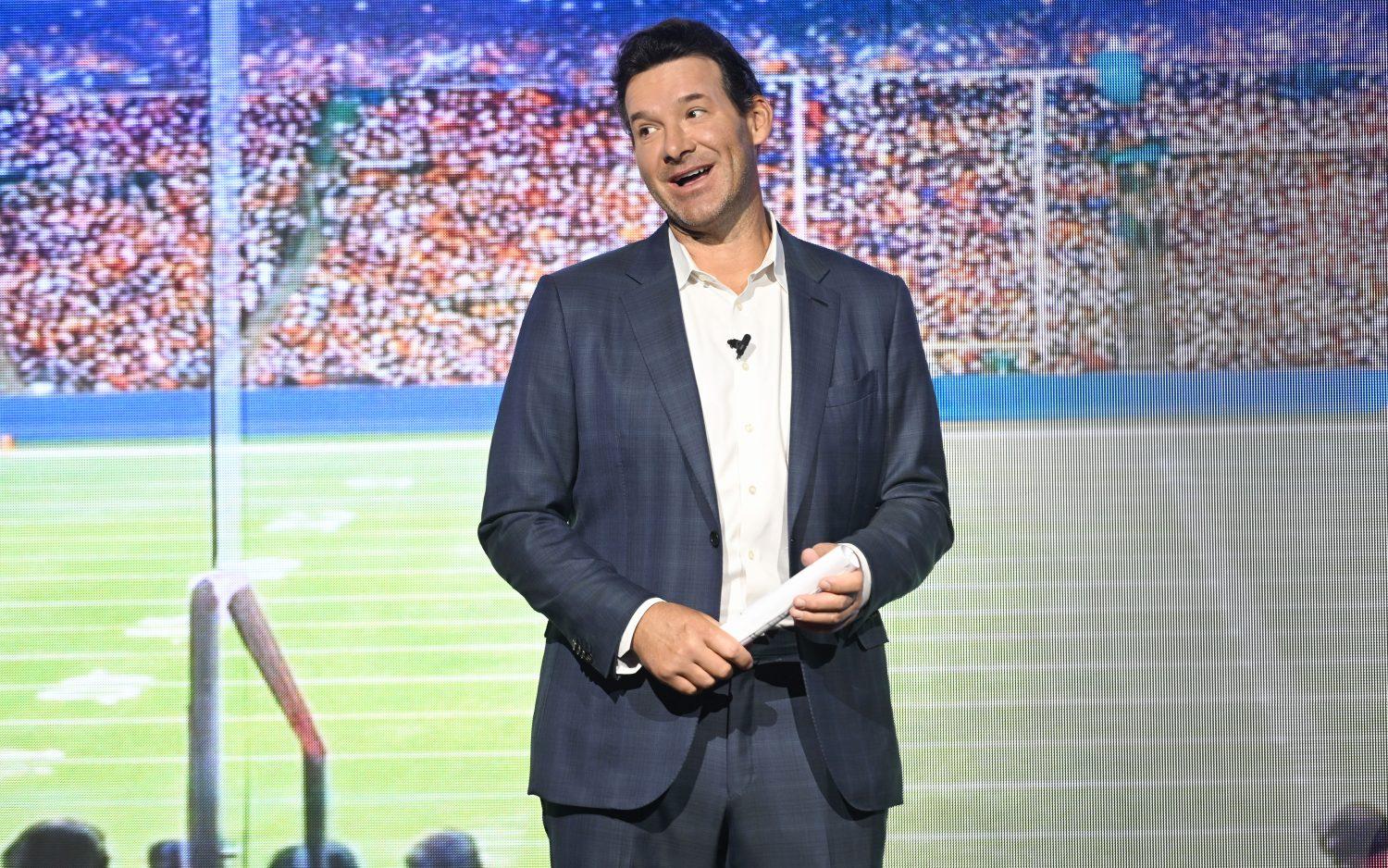
Photo by Noam Galai/Getty Images for Paramount

Audio By Carbonatix
Reader support matters more than ever
We're in the final stretch of our summer campaign. Our goal is to raise $12,500 by August 9 to support the journalism our community relies on. Reader support is helping shape the future of local news.
In North Texas, Tony Romo’s name has cachet up the yin-yang (this joke would work a lot better if he were number 7 instead of number 9, but alas.)
Cowboys fans remember Romo for a great many things (from getting America’s Team to the playoffs on multiple occasions to dating Jessica Simpson), but the world of late seems to only know him for one unfortunate thing. On July 23, Romo was pulled over by Milwaukee police for unlawful passing of a vehicle. During the traffic stop, the responding officer suspected Romo of driving while intoxicated, leading to a highly publicized arrest and the later release of bodycam footage by TMZ, which showed Romo, according to police, exhibiting signs of impairment.
The CBS football color analyst, who was placed on indefinite leave by the network following his arrest, was issued a citation for refusing a breathalyzer test. He was also separately cited for operating a motor vehicle while under the influence and “possessing open intoxicants.”
Of course, driving while drunk or while drinking are no-nos. But from a legal perspective, we can only go on what he was arrested for and what the reporting and footage allow. With that, here are some key legal takeaways from this case.
If a police officer asks you to step out of the vehicle during a traffic stop, you must do it.
Instead, Romo tried to do the right thing for himself, but unfortunately for him, the law was not entirely on his side.
When the responding officer asked if Romo would submit to any field sobriety tests, he initially declined to answer and instead said, “I’m going to call my lawyer.” When he repeated this, the officer asked him to step out of the vehicle.
At that juncture, Romo should have just stepped out of the vehicle without saying anything. The U.S. Supreme Court ruled in Pennsylvania v. Mimms that officers can order occupants out of the vehicle in the name of officer safety, so long as there is enough reasonable and articulable suspicion to support the underlying traffic stop. Failure to obey such orders can result in an obstruction charge, and legally justify officers using more force to get you out of the vehicle.
You don’t necessarily have the right to a lawyer during a traffic stop.
The Fifth Amendment states in pertinent part that the accused has a right against self-incrimination. The Sixth Amendment states in similarly pertinent part that “[i]n all criminal prosecutions, the accused shall enjoy the right…to have the Assistance of Counsel for his defence” [sic].
The right to have an attorney is a benchmark of the American legal tradition, but people also overestimate the precise scope of these protections. For one, there is an operative phrase in the Sixth Amendment: “In all criminal prosecutions…” Here, the Supreme Court has basically said, in true buzzkill fashion, “Erm, actually, you technically weren’t being prosecuted yet when the police detained you, so you didn’t have the right to an attorney under the Sixth Amendment when the police detained you.”
So does that mean that you don’t have the constitutional right to an attorney at all before you are prosecuted?
Not exactly, because the Fifth Amendment’s self-incrimination clause can require it. That’s part of what Miranda v. Arizona said: that if you’re being questioned during a custodial interrogation, you have the right to have an attorney present, and if you invoke that right, the police have a legal duty to stop questioning you post haste.
What does that have to do with Romo?
Well, he technically wasn’t in a custodial interrogation when he was first pulled over, so the right to counsel under Miranda didn’t apply when he first invoked it.
The law on this is a mess. But the main takeaway here is that police don’t have to honor your request to call your lawyer during a routine traffic stop. Romo’s responding officer was more than happy to exercise that discretion.
Romo probably should have been Mirandized.
Speaking of Miranda, remember that “custodial interrogation” thing we mentioned earlier? Turns out, the rookie officer may have actually put Romo in a custodial interrogation without Mirandizing him. After she first brought up the field sobriety test, she mentioned that she could not do it on the side of the road due to the uneven leveling of the road, the wind and debris. She announced his continued detention and cuffed a compliant Romo without incident, which likely means he was in custody for Miranda purposes.
What does that mean for Romo?
It’s possible that any questions law enforcement asked him from that moment forward (arguably) should have been preceded by the Miranda warning. And the bodycam footage did not show officers Mirandizing him. If the court were to rule that this was a custodial interrogation, it would render his statements inadmissible in these proceedings. That doesn’t necessarily mean the case would be dismissed (contrary to what movies like “21 Jump Street” and “Madea Goes to Jail” would have us believe). It just means that the prosecutors would have less rope to hang him with.
Romo had it backward
For the most part, it’s advisable to submit to the breath test and turn down the field sobriety test. In the bodycam video, there were two crucial moments that Romo handled poorly.
The first was when the responding officer said, “I’m going to run you through some fields.” When Romo asked what that meant, she responded, “Field sobriety tests. Are you willing to take any field sobriety tests?”
Putting aside everything he said about wanting his lawyer immediately after this, the Milwaukee County district attorney’s office is likely going to focus on this subsequent exchange:
Romo: “You want me to take your field sobriety test right now?”
Officer: “Yes. You’re denying to step out of the vehicle.”
Romo: “No.”
Officer: “… counting fields?”
This arguably sounded like he was consenting to the field sobriety test. If he was, that is the worst thing he could have done for himself. Every DWI attorney in the country would have advised him to say no to field sobriety tests, full stop. They possess great potential for scientific error, and are designed to give officers probable cause (if you stumble even once, police could theoretically use that to prove you were drunk – even if you pass the rest of the testing with flying colors).
In fairness to Romo, to us, it sounded like he said “no” to whether he’s “denying to step out of the vehicle,” not whether he’s “denying to” do so “counting fields.” And seeing as the officer started this correspondence with the declaration, “I’m going to run you through some fields,” Romo would have been reasonable in believing that he didn’t have a choice. It did not help that the officer continually blurred the lines between exiting the vehicle (which, as established, is not optional) and the fields (which are).
But he should have applied that belief to the breathalyzer test that came later. Instead, this exchange happened while Romo was being processed:
Officer: “You willing to submit to a BBT?”
Romo: “What is that?”
Officer: “It’s a machine that you blow in.”
Other Officer: “It’s a preliminary breath test.”
Officer: “It does not determine the results of [the blood] test.”
Romo: “Oh no, we’re not doing that.”
Officer: “OK.”
Romo: “I’ve heard from all the lawyers: don’t ever do that.”
If Romo actually did hear this from a lawyer, that lawyer gave Romo bad legal advice. Because in Wisconsin (and Texas), refusal to submit to a pre-arrest breath test could result in a revocation of driving privileges, and that refusal can be used to infer that you were intoxicated. There’s a corollary to that, however: if you drive drunk, that could also result in a revocation of driving privileges, and if you’re hammered, refusing could increase your chances of getting an occupational license so you can drive to work and school. That is why attorneys typically give far more nuanced advice on this matter than simply, “Don’t ever do that.”
But in Romo’s case, he refused to submit to a post-arrest breath test, which makes the potential consequences even steeper. That makes his actions even more mistaken.
The ‘head injuries’ question was a trap.
Footage of the officer asking Romo if he has had “any head injuries” went viral for obvious reasons. When police ask if you have had any injuries or take any medications that make you feel woozy, they are trying to deprive the criminal defense attorney of any possible line of defense for their clients failing the field sobriety test.
The Fifth Amendment protects a person’s right not to answer those questions. That could’ve been the good news, but for Romo, the bad news is he either did not know that or believed that invoking that right would have made him look guilty. Perhaps he wasn’t thinking clearly for some reason.
Romo has a preliminary hearing scheduled on Sept. 21 for his citations in Milwaukee County.