John Moore/Getty Images

Audio By Carbonatix
Scholar and author Michael Phillips, SMU Professor Rick Halperin and Hadi Jawad, co-founder and president of Human Rights Dallas, submitted the op-ed below on how the Trump administration’s border plans may destroy a precious Texas historic site.
Back in 2018, Texas led the nation in removing Confederate monuments. Critics of that movement, like former state Rep. Brandon Creighton, often complained about activists “erasing history.”
Creighton and other defenders of Confederate monuments, however, have remained silent as the Trump administration is on the verge of literally bulldozing history along the Rio Grande. (Editor’s note: Although bulldozing for a patrol road in Big Bend had begun, U.S. Customs and Border Protection Commissioner Rodney Scott announced on Monday that construction would be paused, pending further evaluation.)
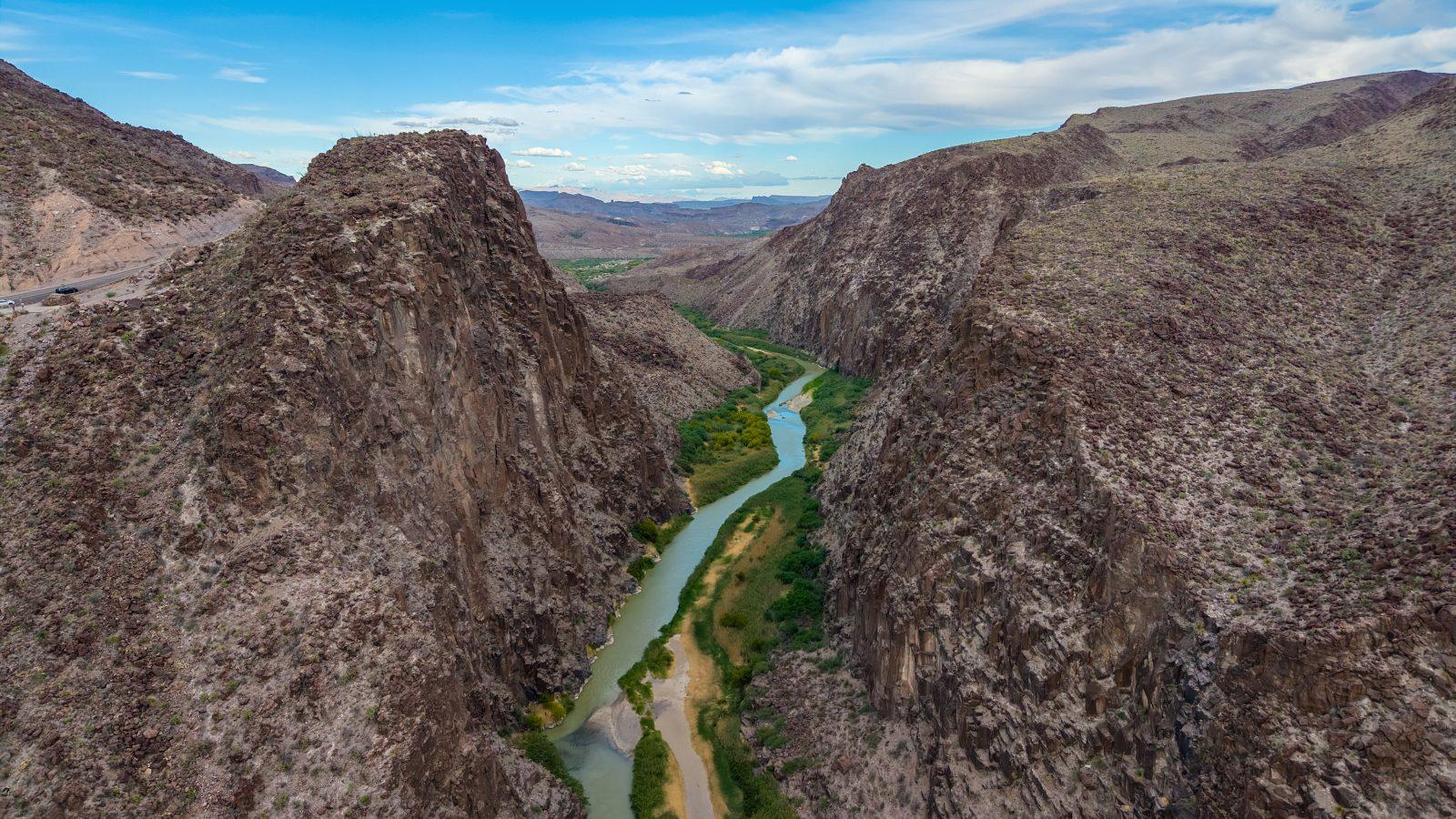
According to the U.S. Customs and Border Protection “Smart Wall Map” website, an extension of the border wall dividing the United States and Mexico might soon cut off public access to the site of the January 28, 1918, Porvenir Massacre, one of the most infamous human rights atrocities to ever unfold in this state.
Early on the morning of that grim day 108 years ago, Company B of the Texas Rangers went hunting for armed Mexicans in Porvenir, an inconspicuous farming village on the banks of the Rio Grande in the Big Bend region. Local cattlemen and the 8th U.S. Army Cavalry Regiment joined the Rangers, who later claimed that they were looking for “thieves, informers, spies, and murderers” they accused of participating in the raid of a nearby ranch.
According to historian Dr. Monica Muñoz Martinez in her groundbreaking book “The Injustice Never Leaves You: Anti-Mexican Violence in Texas,” this armed force roughly awakened residents and “separated . . . fifteen able-bodied men and boys” from women, small children and others the authorities deemed too old to pose a physical threat. No evidence ever linked them to the raid. The posse ransacked homes, searching for weapons. They uncovered a pistol and an antique rifle owned by the only Anglo living in Porvenir.
Regardless of this meager haul, the Rangers and their accomplices tied up their 15 captives, lined them up and shot them, firing their weapons until they ran out of bullets. The victims were aged 15 to 72.
Robert Keil, a cavalry private, later described the horrors he witnessed.
“For perhaps ten seconds we couldn’t hear anything, and then it seemed that every woman down there screamed at the same time,” Keil said. “It was an awful thing to hear in the dead of night. We could also hear . . . the small children screaming with fright. Then we heard shots, rapid shots, echoing and blending in the dark.”
After the mayhem, the approximately 140 residents remaining in Porvenir fled. Soldiers and lawmen burned the village to the ground. The state disbanded the Rangers unit responsible for the crime, but the murderers evaded responsibility for their deeds. J.M. Fox, the captain who ordered the Porvenir raid, was later rehired by the Rangers.
For decades, descendants of the massacre victims sought to bring this injustice to public consciousness and fought to get the state to erect an historical marker at the site of the mass murder.
Starting in 2014, they were joined by scholars who formed an organization called Refusing to Forget, dedicated to increasing public awareness of the relentless violence against Mexicans and Mexican Americans in South Texas that unfolded between 1915 and 1920, a tragic era that Tejanos call La Matanza (“the Massacre”).
After years of lobbying, this coalition convinced the Texas Historical Commission in 2018 to erect a marker at the massacre site. Some local Anglos decried the effort as agitation by “militant Hispanics” and demanded similar markers “commemorating violence by Mexicans against white settlers,” according to NBC News.
The marker has provided the public rare exposure to a sinister but defining chapter in Tejano history, one that has been almost entirely erased in Texas schools. “The big problem is that the experiences of people of Mexican origin are . . . left out of curriculums,” historian Emilio Zamora told NBC in 2018
The Trump administration, however, seems determined to erase this part of the Texas past with its 30-foot steel wall and, in the process, reopen the wounds inflicted by the 1918 mass murder.
Building a wall at what Arlinda Valencia, a descendant of a Porvenir victim, calls a “100-year-old crime scene” represents not just an attack on Tejano history. The construction “would bulldoze what remains of the sensitive archaeological zone, which is still being studied,” as Texas Monthly recently reported. Indigenous people regard the location as culturally important. The wall will furthermore block breathtaking views at Big Bend.
As work crews plow under natural beauty, they have placed already endangered species in greater peril, disrupted natural habitats, and threatened to forever damage “fragile soils and vegetation,” according to a lawsuit filed by the Center for Biological Diversity and other groups.
Customs and Border Patrol plan this assault on history and nature at a site that accounts for a mere 1.3% of illegal border crossings. “I support border security 100%,” Terrell County Sheriff Thaddeus Cleveland told The Texan news site, “but this isn’t border security. [It’s] a boondoggle.”
Valencia believes that the Trump administration’s actions stem directly from racism. “Do you think if you started bulldozing Gettysburg that people would accept it?” she asked a Texas Monthly reporter.
The threat to the Porvenir historical site reflects the degree to which the Texas political establishment chooses to forget and refuses to learn from its past. Porvenir is part of a much larger history of anti-Latinx violence in the Lone Star State that has largely been consigned to oblivion.
Between 1910-1920, the violence of the Mexican Revolution claimed more than a million lives south of the border. Mexican rebels sometimes crossed into Texas seeking arms and cash to support their cause. According to Dr. Trinidad Gonzalez, Anglo racial violence in South Texas, committed by the Texas Rangers, local law enforcement, and vigilante gangs, accelerated in 1915 after Tejano and Mexican radicals in San Diego, Texas, issued the “Plan de San Diego.” That manifesto called for the creation of a new nation made up of lands seized by the United States during its war with Mexico from 1846-1848, including Texas. Anglo backlash to the “Plan de San Diego” and the fear that Mexico might side with Germany in World War I triggered a bloodbath.
Former Southern Methodist University historian Benjamin Heber Johnson (now at Loyola University Chicago) noted in his 2005 book “Revolution in Texas: How a Forgotten Rebellion and Its Bloody Suppression Turned Mexicans Into Americans” that Anglo mayhem against Mexican and Mexican American civilians in South Texas from 1915-1920 resulted in “the killings of hundreds, possibly thousands.”
In response to this terrorism, the only Tejano member of the state House of Representatives, J.T. Canales, filed a bill in 1919 that sought to reduce the number of Texas Rangers. More importantly, the bill would have required all Rangers to be placed under bond, which would expose them to civil liability if they abused their authority. One Ranger physically threatened Canales. Outraged, the Texas Rangers demanded a legislative investigation they believed would clear them of wrongdoing. They got more than they asked for.
Seven white members of the state House and Senate made up the special investigative committee, with Canales playing the informal role of prosecutor according to the transcripts. The evidence of Rangers’ lawlessness galvanized the state. As “Mother Jones” reporter Tim Murphy summarized some of the horror stories Canales exposed:
“Toribio Rodriguez was taken from his home and shot in the back by a deputy sheriff working with a Ranger captain, then left in a jail cell to die . . . A judge recalled discovering the decomposing bodies of 11 men off a country road. Canales displayed a photograph for sale around Brownsville: It showed three men on horseback—one a Ranger captain – mugging for the camera above four bound corpses.”
Even if these stories captured the public’s attention, the investigative committee had little interest in reining in Texas’s rogue statewide law enforcement agency. The final version of Canales’s law did not require agents to post bond. The force still enjoyed an early version of qualified immunity and could engage in violence against unarmed citizens with little likelihood of being sued, much less arrested. The committee also promised to publish the transcripts of what came to be known as the Canales Hearings, but didn’t keep its word.
This whitewash carried terrible consequences. The Rangers continued to terrorize Tejanos and immigrants as well as Black civil rights activists, enforcing segregation and beating and arresting striking farmworkers in Roma, Texas, in 1966.
United Press/Wikimedicommons/Public Domain
The history of the Texas Rangers had become so thoroughly whitewashed that when the Washington Senators Major League Baseball Franchise moved to Arlington in 1972, it felt no discomfort, despite Tejano protests, in naming itself after the agency that terrorized Porvenir.
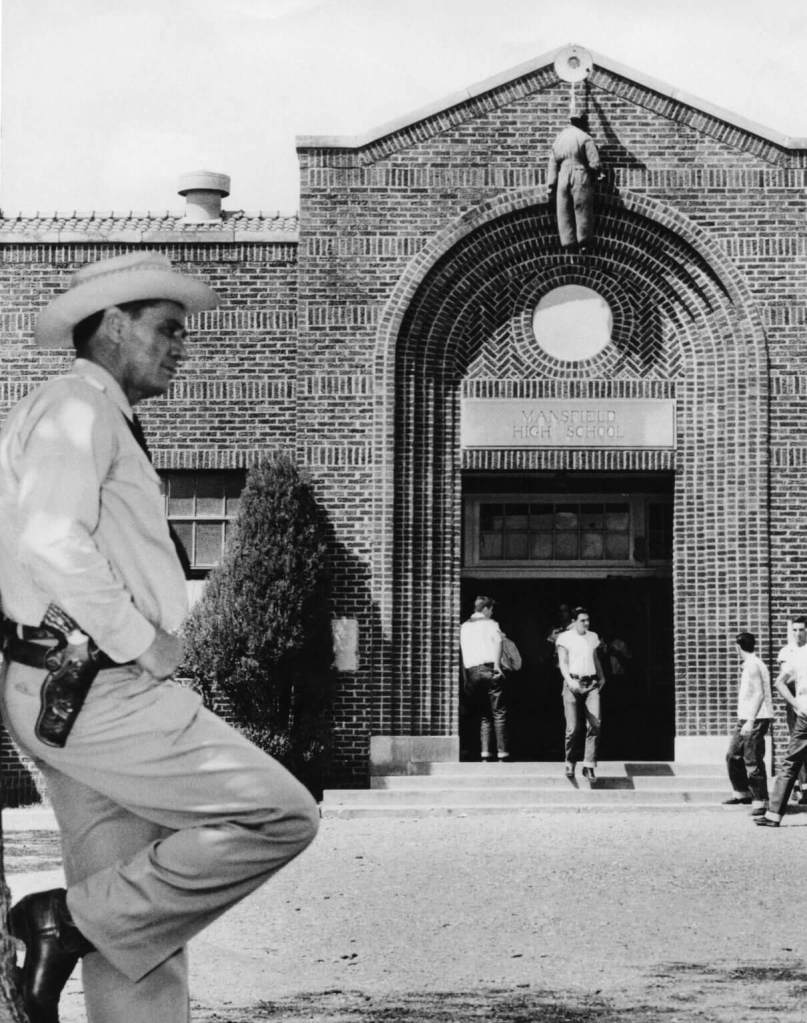
On March 2 of this year, the Texas Rangers baseball franchise doubled down on the racism, installing a bronze statue in the stadium concourse titled “One Riot, One Ranger” that had been removed from Love Field during the George Floyd protests. The statue was modeled on a Texas Rangers agent, E.J. “Jay” Banks, who did nothing to protect African American teenagers from a raging white mob when they attempted to integrate Mansfield High School in 1956. Banks shortly afterward also refused to help two Black students assaulted by a mob that chanted “Go North, [N-word]” when they tried to enroll at Texarkana College.
In 1968 a celebratory Texas Rangers Museum opened in Waco. The museum’s website offers a whitewashed account of the Porvenir Massacre and largely glosses over the horrors of La Matanza. “Accounts are conflicting, but it is certain that fifteen residents are executed without due process . . . The act is condemned on both sides of the Border . . . Justifiably stronger action is not taken in the inflammatory climate of the ‘Plan de San Diego’ . . .” the website says.
The bloodshed in Porvenir was a crime. The repeated efforts to whitewash the depravity that unfolded there have been as well. “The denial of past atrocities undermines our collective attempt to prevent similar crimes today,” as Dr. Simon Adams, the executive director of the Global Centre for the Responsibility to Protect, put it.
Texas owes it to the massacre victims’ descendants to demand that the Porvenir historic site be preserved. Our state must also stop celebrating the perpetrators of the crime by naming its sports teams after them. And Texas’ school curricula must bring the lessons of Porvenir to the classroom so such an atrocity never happens again.