
Photo by Enrique “Ricky” Oropeza

Audio By Carbonatix
The following is sponsored content by Texas Card House.
Texas Hold’em was popularized in the Lone Star State, but ambiguous gambling laws have kept poker games in somewhat of a legal limbo.
Some Texas poker club owners, like Texas Card House’s Ryan Crow, are testing the boundaries of those gambling laws in an attempt to provide clarity and prompt reform. Now, TCH is being featured in The Battle for Texas Poker, a docuseries following the history of poker and its deep, sometimes gnarly Texas roots.
A Legal Poker Club in Texas
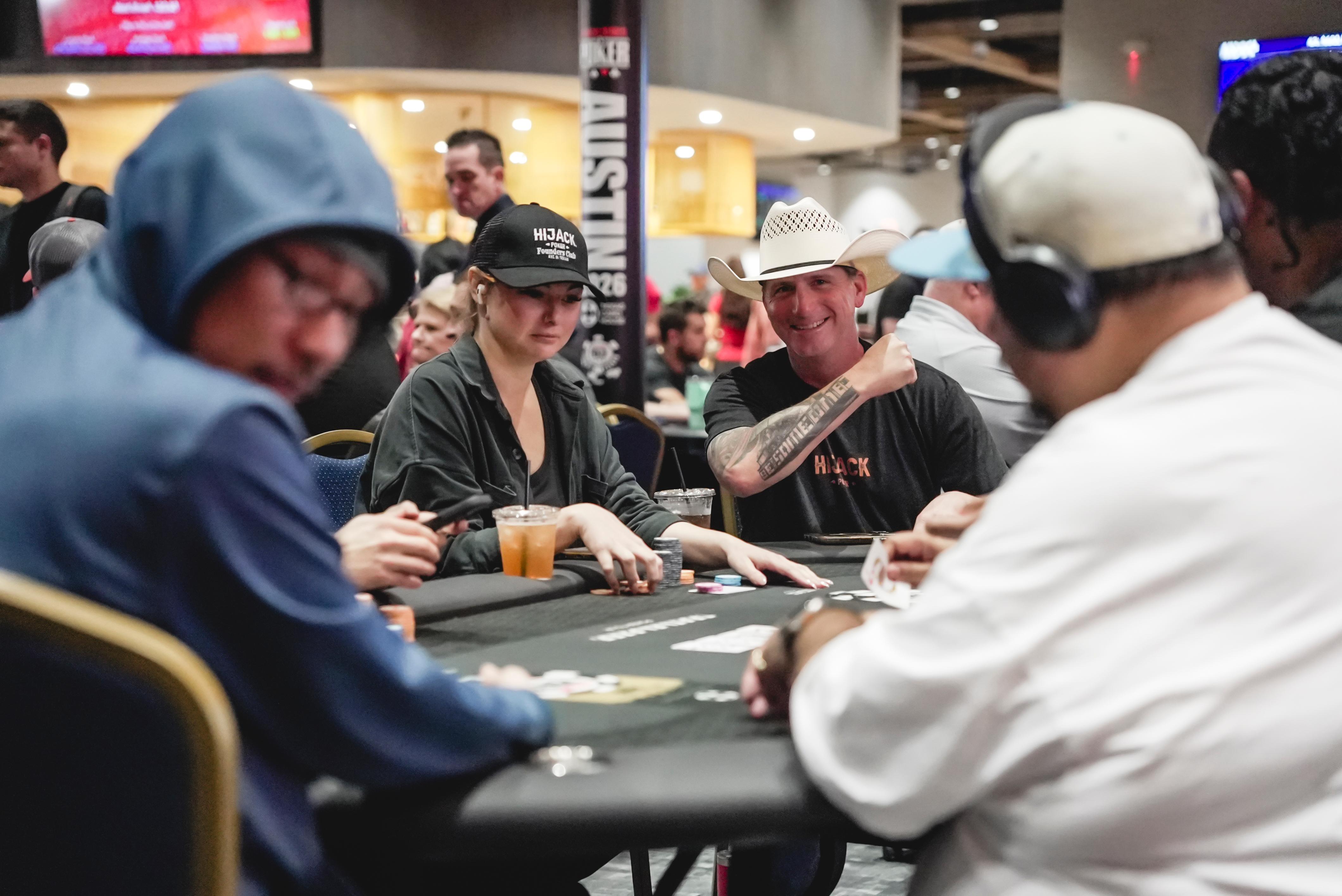
After run-ins with local government in Dallas and legal battles to legitimize their business model, known as the “Texas model,” Crow and his associates celebrated a major win. On April 23, the World Series of Poker kicked off its annual tournament in Texas for the first time ever. TCH hosted it despite the state’s unclear laws, and it generated the largest prize pool in the history of Texas poker at $2,589,135.
To avoid the deep end of the murky legal waters, TCH functions under the Texas model, which charges patrons by their time played rather than through rake. A raked game means that the house takes a percentage of the winnings of each game, which is not legal under Texas’s gambling laws.
“Most things, if you prohibit them, they don’t just go away,” Crow notes. “They get driven underground, and then that allows for more seedy activity to happen.”
Illegal “underground” games, also known as home games, proliferated before the rise of membership-based card houses like his, Crow explains, because of the lack of legal places to play a hand. Because of this, house games often served as dens for other illegal activity, such as prostitution and dealing or consuming drugs. The early Texas poker circuits became tangled in mob ties, and proximity to other illegal activity tainted the game’s reputation.
“We’ve pretty much killed that industry, and I would say that 80 to 90% of those types of games are gone,” Crow says. According to him, the rise of legal spaces to play a hand of poker has been pivotal to keeping debauchery separate from the game.
Photo by Enrique “Ricky” Oropeza
Poker’s Tangled Texas History
While gambling has been illegal in Texas since the early 20th century, according to TXK Today, the state is still deeply aligned with multiple forms of gambling, but none more so than poker.
In 2007, a resolution by the Texas Legislature formally recognized Robstown, Texas, as the birthplace of Texas Hold’em. To make this all a bit more digestible, it’s pertinent to understand that not all poker games are Texas Hold’em, but all Texas Hold’em games are poker.
As with most card games, Texas Hold’em has evolved over the years. According to The History Channel, poker itself has far-reaching roots from ancient Chinese, Persian and European games, among others.
In the United States, variations of poker became popular in saloons and among soldiers during the 19th century, according to Poker News. The Civil War, in particular, was a hot spot for fighting not just the opposing forces, but also boredom — the latter by playing card games. Although its origins are hazy, poker runs deep through American culture.
But as stated by the Texas Legislature, Robstown is the home of Texas Hold’em, a very specific type of poker. In the 1970s, the current iteration of the game really took off.
“Texas Hold’em…began its rise to dominance in the 1970s, when it became the game featured in the World Series of Poker, the game’s leading annual competition,” the History Channel reported.
That was soon after a professional poker player from Texas, Felton “Corky” McCorquodale, took the game to Las Vegas. According to The Bend, McCorquodale took Texas Hold’em to the California Club, and from there it bounced around a few other clubs and casinos, sometimes even going by different names.
But Texas Hold’em is what stuck, thanks largely in part to the professional players that came from underground gambling rooms in the Lone Star State.
Before the World Series of Poker existed, there was the Texas Gamblers Reunion, which was held outside of Texas, in Reno, Nevada. Texas poker has a long history of being played everywhere else but back home — not just because of the laws surrounding gambling in the state, but also because of the mob ties, corruption and crime that followed the game.
Mob ties in Texas poker are no secret. One mobster in particular, Benny Binion, was a Las Vegas casino operator from Texas. According to the Mob Museum, he was a convicted killer, bootlegger and gambler in North Texas who fled the state and arrived in Nevada in true mobster style: in a Cadillac with $1 million stashed in the trunk and two Thompson submachine guns, also known as Tommy guns.
This larger-than-life Wild West character is just one of many who came out of the Texas poker scene, giving the game a less-than-desirable reputation here. Now, though, poker is experiencing a rebrand with the help of legal poker clubs like Texas Card House.

Photo by Enrique “Ricky” Oropeza
Hold ’em or Fold ’em?
Gambling is still illegal in Texas, but there are ways that a card house can get by without being squashed under the government’s heavy hammer.
While public poker games and other forms of public gambling are not legal, private poker clubs are able to function under three defenses to prosecution.
This means that they may still be prosecuted for running games, but there are three defenses that a card house may use to prove that its business is not illegal. The burden of proving that no crimes have been committed is on the card house.
“The first [defense] is pretty straightforward,” Crow says. “It has to be in a private place.”
But what is private? All of the card houses that are operating legally in the state are able to keep their doors open because of membership policies and requirements.
“We go to great lengths to make sure that if you’re coming in, you have to be a member,” Crow says. “You have to sign our member agreement, we scan your ID, we take a pic[ture] of who you are.”
Membership also allows the card houses to remove people who do not comply with their rules. Members can be banned for things like excessive drinking, being disruptive or charging back on credit cards. For TCH, maintaining a private club with strict rules keeps the business, the patrons and the game safe.
The second defense, which Crow says is the easiest to comply with, stands against game rigging. Games must offer an equal chance of winning to everyone playing, with the exception of skill or luck. Also, the house can’t play. TCH provides dealers for each game, but the dealers don’t play.
“If you’ve ever gone to Vegas and you play Blackjack, you’re playing against the house,” Crow explains. “The house has a statistical edge against you. So you play 10,000 hands. Statistically, they’re going to win over the long run because the odds are stacked in their favor. In our club, we only allow games where the players play each other.”
The final defense is the most ambiguous.
“Except from your winnings, no one can gain an economic benefit from the game,” Crow says. “This could be interpreted a lot of ways.”
What constitutes economic benefit? Depending on how far the rule is stretched, it could mean that buying groceries at the store with your winnings violates this defense because the grocery store gains that money thereafter.
“There are ways that people can take this rule and extend it to infinity,” Crow says.

Photo by P&R Creative
The legal language surrounding the do’s and don’ts of gambling is vague, but Crow and other poker club owners are working to change that. Hosting the World Series of Poker for the first time in Texas and being featured in the docuseries is just the beginning.