

Courtesy of Warner Bros. Pictures

Audio By Carbonatix
When the trailer dropped for Emerald Fennell’s “Wuthering Heights,” the collective internet had one thought, particularly after the beautiful depravity of her previous work with Saltburn: Valentine’s Day weekend was about to get messy. Jokes about needing to laminate theater seats have been abound since, and audiences have been bracing for a period piece that would make Jane Austen blush. The good news? Fennell’s latest is indeed a ravishing, hot-blooded affair. The better news? It’s also one of the most exquisitely crafted and emotionally arresting films you’ll see all year.
Fennell, who previously gave us the candy-coated revenge of Promising Young Woman and the aristocratic hedonism of Saltburn, completes her thematic trilogy with a film that feels both startlingly new and timeless. “Wuthering Heights” pulses with the same raw energy as her other work, defined by committed performances and visuals that could hang in a museum. This time, however, she trades neon-lit bars and sprawling English estates for the windswept moors of the English countryside, creating her most beautiful film to date.
The production design is a living, breathing character in its own right. Some shots, like one of Jacob Elordi’s Heathcliff silhouetted on horseback against a painted sky, feel ripped from the Golden Age of Hollywood epics like Gone With the Wind. Others employ a bold, painterly palette of striking reds and earthy tones that recall the passionate canvases of Pedro Almodóvar blended with the strange precision of Yorgos Lanthimos. At times, the wallpaper itself seems to sweat and pulse — designed to evoke the characters’ very skin and muscle, blurring the line between the house and its inhabitants. We’re a long way from those walls tasting like snozberries, however. Here, the walls practically breathe desire and dread. The world is both hyper-real and dreamlike, a perfect stage for a love story that blurs the lines between passion, possession and madness.
Fennell wisely dedicates the film’s first act to the younger versions of main characters Catherine “Cathy” Earnshaw and Heathcliff, played with astonishing maturity by newcomers Charlotte Mellington and Adolescence’s Owen Cooper. Their early bond established between them anchors the entire story as we see them navigate a harsh world, finding solace and a fierce, protective love in each other. There’s a strikingly tender moment when Heathcliff gently grabs Cathy’s ankles — a gesture both intimate and innocent — which lingers in the memory and returns later in the film with bittersweet resonance. Young Cathy calls Heathcliff her “pet,” promising to be kind unless he’s bad, then she’ll pinch him. This isn’t a story of innocent puppy love. It’s a foundational pact, a promise Catherine makes to a boy the world has already discarded: “I will never leave you, no matter what you do.” This section establishes a rich, sometimes painful history, complete with a recurring motif involving broken eggs that pays off with a gasp-inducing, full-circle moment later on.
When Margot Robbie and Elordi take the reins as the adult versions of Cathy and Heathcliff, the simmering connection explodes into a full-blown inferno. The way they look at each other across a crowded room is pure cinematic dynamite — a mixture of teenage longing, adult resentment and a magnetic pull that feels both sacred and profane.
Elordi’s Heathcliff, complete with a roguish ‘80s pirate earring, is more than just a handsome brooder. He carries the weight of a boy who was told he was only a servant, unworthy of the girl who is his entire world. Robbie’s Cathy is a force of nature, luminous and dangerous, torn between the wild freedom Heathcliff represents and the comfort offered by the wealthy Mr. Linton (Shazad Latif). Her infamous declaration that marrying Heathcliff would “degrade her” lands with the force of a physical blow, setting their destinies in motion.
Courtesy of Warner Bros. Pictures
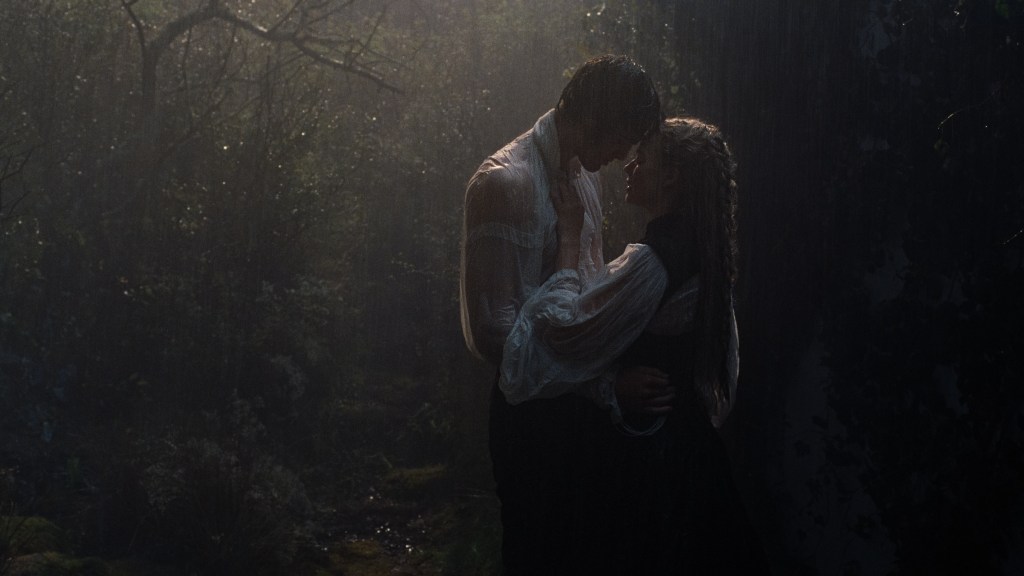
So, is it the horn-fest everyone anticipated? Yes and no. The film is undeniably sensual, filled with moments of intense intimacy — fingers lingering in mouths, the provocative use of chains and collars, and one particular scene in the fog that rivals the hand-flex from Pride & Prejudice for sheer erotic tension. But this isn’t Saltburn. Fennell is less interested in shock value and more in exploring the intoxicating, almost violent nature of obsession. The film is wilder and has more horsepower than your standard costume drama, but its provocations serve a deeper, more poetic purpose. A soundtrack performed entirely by pop purveyor Charli XCX evokes this, too, adding a modern, juxtaposed layer to the film’s mostly 18th-century-set story.
This is “Wuthering Heights” as seen through Fennell’s unique lens — the quotation marks she intentionally places around the title feel like a wink to the audience. She isn’t just adapting Emily Brontë’s novel. She’s exploring its darkest corners and unearthing the radical, non-judgmental core that made it so shocking in the 19th century. This is a story where love is not polite. It is a consuming fire, and Cathy says it best: “Whatever souls are made of, his and mine are the same.”
Fennell has crafted a sumptuous, thrilling and heartbreaking visual poem that captures that sentiment perfectly. It’s a beautiful, messy and unforgettable cinematic experience.
“Wuthering Heights” is now playing in theaters nationwide.