
Photo by Lauren Drewes Daniels

Audio By Carbonatix
At this point, Dallasites are used to orange traffic cones popping up like spring daisies, but it’s rare for the construction scenes to disappear all that quickly.
Which is why, sometimes, we get so used to seeing a construction site that it completely fades into the background. That’s what happened to us when it came to the Sylvan Avenue Bridge, which crosses the Trinity to connect West Dallas and the Design District. Cones have been on that bridge for more than a year, which inspired one of our readers, Jeff from Oak Cliff, to finally ask, “What’s up with that?”
So, for the latest addition of our Weekly WTF series, we decided to find out.
Bridge in Progress
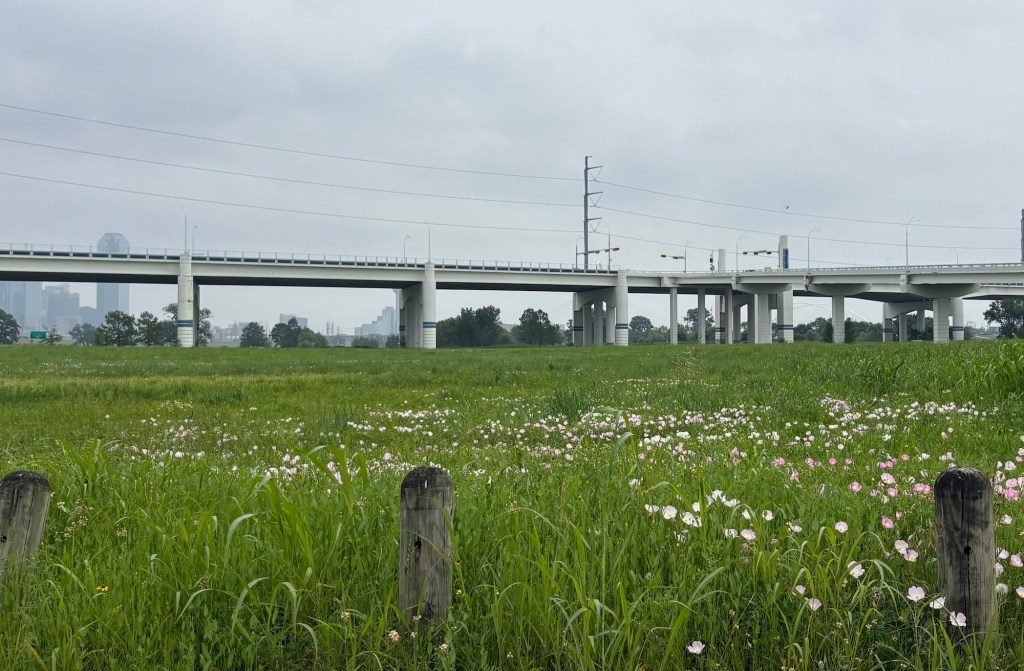
The Sylvan Avenue Bridge spans approximately 3,500 feet and was originally built to carry six lanes of traffic across the Trinity. The bridge replaced an older roadway that sat at a lower elevation and often flooded, and, in an effort to encourage pedestrian traffic, protected sidewalks were installed on each shoulder.
The bridge also has an unprotected bike lane, and an access ramp midway across the bridge allows pedestrian and car traffic to access the floodway’s Trammel Crow Park. Because pedestrian and bike traffic are already accounted for in the bridge’s design, our reader Jeff was confused about why cones had suddenly appeared over a year ago, blocking a lane on each side of the bridge.
Emma Ruby
“At first, they poured what looked like concrete plant boxes that sat empty for a year, and cars occasionally were stuck on, but now they are filling them with bricks. There is already a pedestrian walkway and a bike lane, so why would they need to narrow the road for only the bridge portion?” Jeff asked.
As it turns out, the construction on the Sylvan Avenue Bridge is part of The Loop, the $135 million plan that will connect 50 miles of contiguous trail around Dallas. The Sylvan Avenue bridge is set to become the Discovery Gateway, connecting the Trinity Strand and Skyline Trails. The connection will also allow cyclists to access the Discovery Trail, which leads to Fort Worth.
According to a spokesperson for The Loop, the eliminated traffic lane on each side of the bridge will be converted into a protected trail for walkers, runners and cyclists. While the bridge’s original design included a hint of this infrastructure, the Oak Cliff Advocate noted in 2015 that the bridge’s unprotected bike lanes didn’t exactly feel safe.
When The Loop began tinkering with the bridge’s design in 2021, the group said that eliminating two lanes of traffic on the bridge would slow vehicle speeds, creating a safer environment for pedestrian traffic.
“But why did things sit there for so long without anyone working on them?” Jeff is surely asking now.
Last year, The Loop and the city found themselves at odds after the city attempted to contract out its own design firm for the development, a right that was explicitly reserved for The Loop in its contract. According to reporting by The Dallas Morning News, the dispute was enough for The Loop to threaten to back out of funding and project management obligations. Which is why, for a time, things were at a standstill.
But as of just a few weeks ago, it appears that dirt is once again moving on the bridge.
According to a city of Dallas statement, the original design had to be recalibrated because it would have included parking for vehicles on the overpass. Dallas’ Transportation and Public Works Department flagged that as a safety issue, per the Office of Homeland Security, but the problem has been resolved. There is no dispute, says Dallas, and work is back underway.
The Loop declined to comment on last year’s squabble. The Observer called Simon Engineering and Consulting, Inc., The Loop’s chosen contractor, and a spokesperson said the firm remains “partially” involved in the bridge’s development.
The construction is expected to be completed in the first quarter of 2027, The Loop said.