
Provided by Deep Vellum Publishing

Audio By Carbonatix
Mark Lamster still remembers the first time Dallas entered his imagination. It wasn’t a skyline. It wasn’t a building. It was a helicopter shot from the opening credits of the iconic TV show “Dallas,” the camera pushing into the mirrored glass of the Hyatt Regency.
That was long before he arrived here in 2013. Now, more than a decade later and freshly crowned with the 2026 Pulitzer Prize for Criticism, the Dallas Morning News architecture critic has written the book that a city as strange as this one deserves. It’s called “Welcome to Paradox City: A Critical History of Dallas as Told Through Its Architecture,” and it landed Aug. 4 through Deep Vellum Publishing.
The title is not an accident. Lamster has spent years trying to understand a place that seems designed to resist understanding.
“So much of what it does sort of defies logic or even basic rational common sense,” he says to the Observer, and you can hear the affection curling around the frustration. “It’s always interesting to write about.” He has a favorite metaphor for the job. “Over the years, I’ve come to think of writing about Dallas as going to the circus every day, because there’s always something crazy, or weird, or entertaining happening.”
A city of glorious contradictions
Ask Lamster to define the paradox in his title, and the examples pour out like they’ve been waiting.
“It’s both incredibly rich and incredibly poor,” he says. “It’s got places that are beautiful and places that are just mind-bogglingly ugly.”
The city he describes is not a single thing but a collision of things — “heterogeneous people and spaces and ideas all jammed into one.” White, Black, Latino, new immigrant communities, congregations of every faith, all elbowing for room inside one restless metropolis.
Dallas, in his telling, is a place perpetually at war with its own better instincts. He describes its planning ethos as a willful tendency to “take two steps forward and two steps back at the same time.” His favorite illustration is almost too perfect: the city built “an amazing park between the Trinity levees and then we’ll run a highway through it.”
You laugh. Then you realize he isn’t joking.
Reading a city through its buildings
Most of us treat architecture the way we treat air. “Architecture and urban design are kind of like oxygen to most people,” Lamster explains. “You need them, but you tend to not notice it and take it for granted.” His book is an invitation to finally look up and see the invisible forces shaping the streets we drive without thinking.
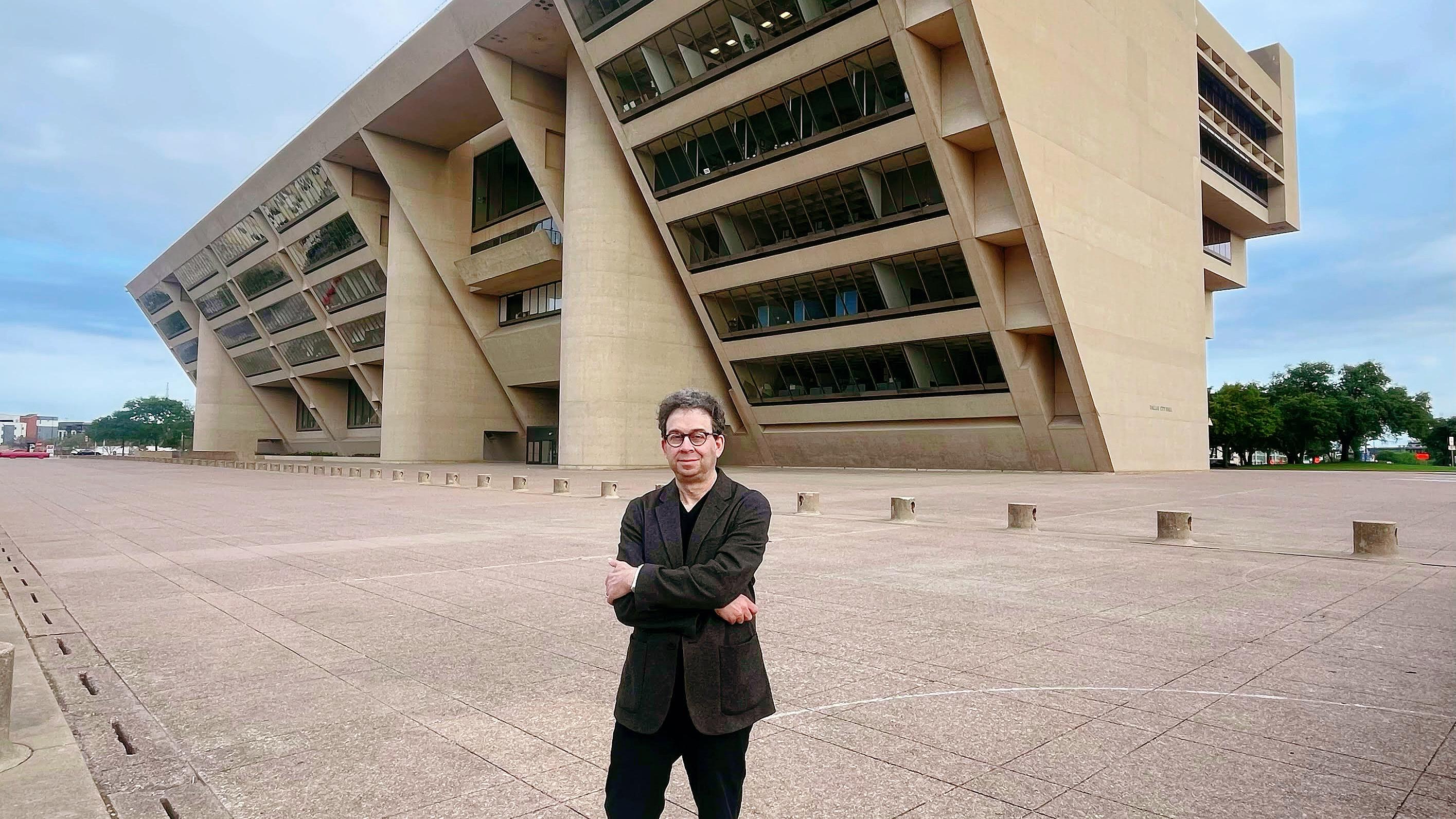
And there’s plenty worth looking at. Lamster reserves real reverence for Dallas City Hall, I.M. Pei’s dramatic inverted wedge. “As purely as an object, it is an amazing, amazing work of architecture,” he says. “Extraordinary.” It was, he notes, “designed to define what Dallas is and what it should be and what it could become” — which makes its current uncertain fate all the more poignant.
Then there are the towers that first seduced him from the television screen. “Dallas has beautiful mirror glass buildings, whether it’s the Hyatt or Fountain Place or Campbell Center,” he says. “Gold, green, silver, every hue of glass.” A city that dressed itself in reflection, forever showing us the sky instead of itself.
His most delightful obsession, though, is the “Woofus,” the peculiar fountain-sculpture born for the 1936 Centennial Exposition. “To me, it’s the perfect metaphor for Dallas,” he says, “because it’s incredibly weird looking, it’s not especially beautiful, but it has this charm, and it’s made up of all these different things.”
Follow the money
Lamster is not content to simply admire. He is, after all, a critic — the kind Dallas both needs and occasionally wishes would move away. His book traces the machinery behind the buildings, and that machinery runs on capital.
The city’s habit of bulldozing its own past, he argues, comes down to one thing. “It’s about money, it’s about developers and what powerful interests have always been able to mobilize the government power in their own interests.”
Nothing crystallizes this for him quite like Klyde Warren Park. He genuinely admires it — “It gave the city a front lawn,” he says, calling it “an extraordinary success” and proof that Dallas can think progressively about repairing “the damage from the way it turned itself over to the car.” And yet. He finds it “stunning” that the city’s central green space is named for a 9-year-old whose sole qualification was being “born into a very, very wealthy family.” That single fact, he says, “speaks a lot about the way money works in Dallas.”
The car, of course, is his great antagonist. The city’s worst habit, he insists, is “designing for the car instead of for the person.” His verdict is blunt and unimprovable: “You can’t make great public spaces that are great public spaces for cars.”
A partnership born in 2013
There’s a lovely symmetry to who is publishing this book. Lamster and Deep Vellum founder Will Evans both landed in Dallas the same year, 2013, and struck up a friendship. Lamster credits Evans with almost single-handedly reviving a literary culture he found “dormant or nascent.” A book about a city coming into its cultural own, published by the man helping it do exactly that — even a skeptic has to smile at that one.
The two will share a stage on Aug. 27 from 7:30 to 9:00 p.m. at the Dallas Museum of Art’s Horchow Auditorium, as part of the museum’s beloved “Arts & Letters Live” series. Expect the wit, the reverence and the righteous exasperation to be out in full force.
Tickets are $30 for members and $35 for the public, available now through the DMA’s event page.