City of Dallas

Audio By Carbonatix
Back in 2016, the British government was preparing to launch a brand new, $287 million polar research ship when some wise chap suggested that the general public might be interested in naming the vessel.
Within days, one suggestion had garnered more than 124,000 votes, with the online traffic enough to crash the Natural Environment Research Council’s website. The New York Times observed that the chosen name was “What You Get When You Let the Internet Decide.” The people had spoken, and they demanded that the scientific cruiser be called “Boaty McBoatface.”
(In the end, the British government named the boat after Sir David Attenborough, and gave the McBoatface moniker to one of the submersibles aboard the ship.)
Perhaps Dallas’ leaders had never heard the tale of Boaty McBoatface when, earlier this spring, they asked everyday Dallasites to submit their ideas for the future of City Hall. But having now combed through the 418 submissions received, we aren’t quite sure what they expected to get.
Until this point, the conversation at City Hall has revolved around two options: pay up to $1 billion for repairs and restore the I.M. Pei-designed building, or sell the land to the highest bidder. Many speculate that said bidder would likely have a name that starts with a “D” and ends with an “allas Mavericks.”
For the most part, the hundreds of resident submissions fall into those two categories. Overwhelmingly, respondents want to restore the building; 321 of the 418 submissions advocate for this option, with dozens stating simply, “save City Hall.” Another 85 pitches advocate for our government to find somewhere new to govern, opening the space up for development enticing enough to keep Dallas’ professional basketball team squarely downtown.
But a few brave Dallasites had the tenacity and vision to think bigger than just one of those two solutions. They asked themselves what it truly means to be a world-class city, stepping up to the challenge of embracing the spirit of Boaty McBoatface when reimagining our city’s epicenter.
The power of pickleball
Early in the open-submission process, the pickleball lobby made its interest in the Dallas City Hall site known. Rather than continue Marilla Street’s legacy of civic engagement, and rather than sell out to the local basketball overlords (whom one respondent referred to as “literally Satan”), one Dallasite asked us to imagine the sheer number of pickleball courts that could fit on the city hall plaza.
“Rather than restoring City Hall to what it once was, this is a chance to redefine what it can become,” the proposal states. It goes on to emphasize that pickleball is the fastest-growing sport in the world and that Dallas has an opportunity to get in now.
The suggestion outlines the need for indoor and outdoor courts, the opportunity for events such as pickleball lessons and tournaments and vendor opportunities, all funded through a public-private partnership. Of all the submissions, this one is not nearly the longest shot. Still, we have our doubts as to whether Dallas is ready to get its pickle on.
The City of Dallas
Submissions of slop
In this day and age, why would a person spend time on a proposal for City Hall when they could ask ChatGPT to do it for them? Around a half-dozen respondents outsourced their city hall hypotheticals to generative AI, and they were kind enough to include images that force us to wonder, as the Observer’s arts and culture editor, Alec Spicer, put it, what it would mean for Dallas to turn into Dubai.
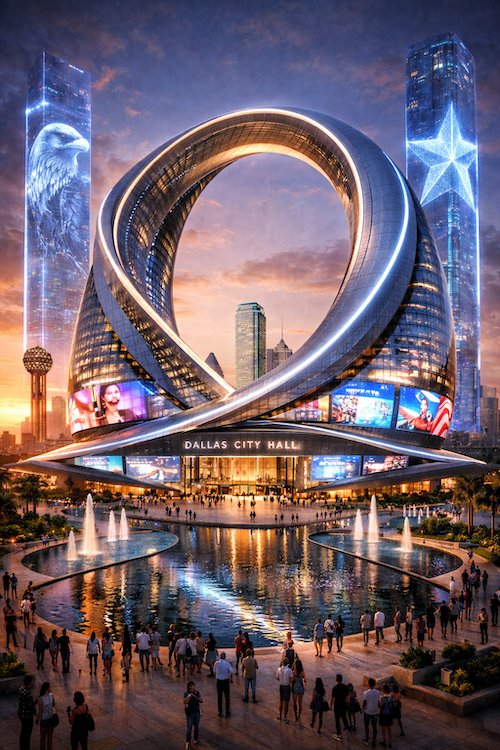
One rendering resurrects City Hall from its current brutalist form, casting it as an architectural knockoff of Disney World’s TRON rollercoaster. Behind the loop-de-loop are what can only be described as twin towers, decorated with neon-blue projections of a bald eagle and a lone star. Because ‘Merica, that’s why.
Another AI-generated plan argues that the financial power of water parks could solve Dallas’ budget woes. “Year-round fun for all ages” could be had at the corner of Marilla Street (which, in this mockup, has been rerouted to flow parallel to South Akard) if only we allow ourselves to dream big enough.
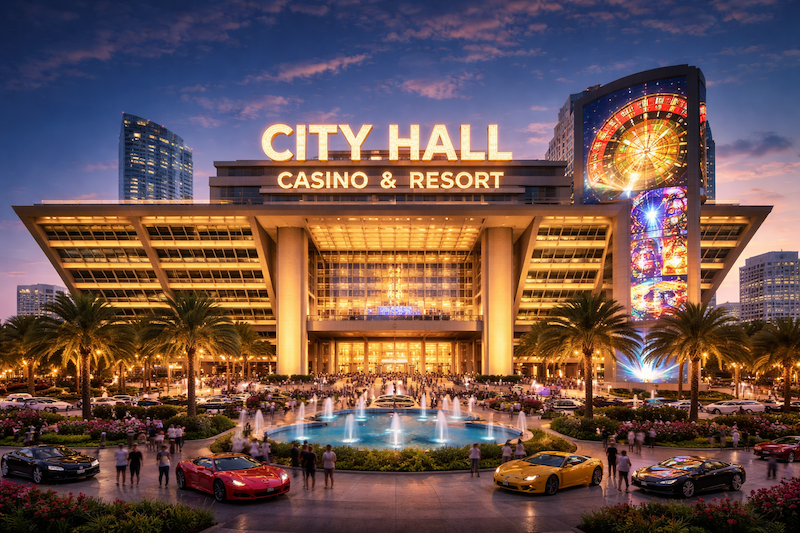
City attorneys will likely shoot down our personal favorite suggestion on account of the fact that casinos are not legal in Texas, but the rendering is hard to argue with. Let’s preserve the historic building, this proposal urges, but not for city government purposes. Instead, the building should be a home for gambling addicts, blackjack enthusiasts and the kind of Dallasites who spend way too much money on their monthly luxury car payment (of which there are many).
A happy medium
Some respondents have encouraged preservationists and sports fans to come together on the future of City Hall. These peace makers ask whether it would be possible to preserve the building’s upside-down facade while using its unique architecture as a starting point for a new arena.
If you’re a visual person, don’t worry. This suggestion also came with AI-generated images.
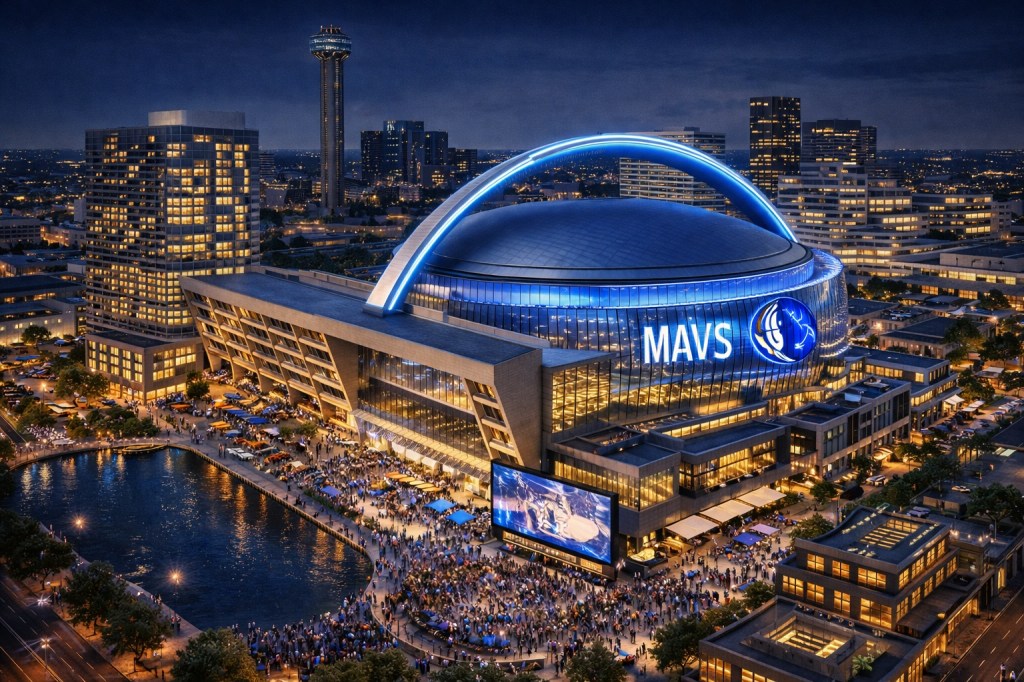
City of Dallas
Legacy matters
Many proponents on the “save City Hall” side have argued that the building’s architect, I.M. Pei, the same designer of the Louvre Museum pyramid, gives the structure sufficient historical significance that it must be preserved.
But focusing solely on the Pei of it all would be a mistake, says Robocop’s biggest fan. There is no greater spot to honor Paul Verhoeven’s 1987 cinematic masterpiece than Marilla Street, this proposal says. Just think of the branding opportunities!
We could open a Robocop museum and Robocop-themed restaurants. A Robocop hotel would be necessary, of course, to accommodate all of the tourists who “would come from all around to see and stay in the building.” Not only should Dallas pay the $1 billion in deferred maintenance on the building, this superfan states, but the city should throw in a little bit more to “make it bigger and better by paying homage and building it exactly the same as the OCP Tower.”
Honorable mentions
President Donald Trump himself may have written one submission, but we’ll let you decide. The suggestion is to replace Dallas City Hall with our “next huge beautiful hotel” that absolutely must be “massive,” “beautiful,” and “huge.”
Another respondent is torn between two ideas: the facility should be either a casino or a homeless shelter. (Not, we emphasize, a combination of the two.) We can only imagine that this is the kind of person who has somehow squared the logic of voting for both Ken Paxton and Gina Hinojosa in the November election.
A negotiator suggested that Dallas Mavericks owner Miriam Adelson be allowed to purchase the land on which city hall sits, but only if she agrees to pay an additional $250 million per year in taxes to the city of Dallas through 2047. Otherwise, the Mavericks can “GET REKT.”