
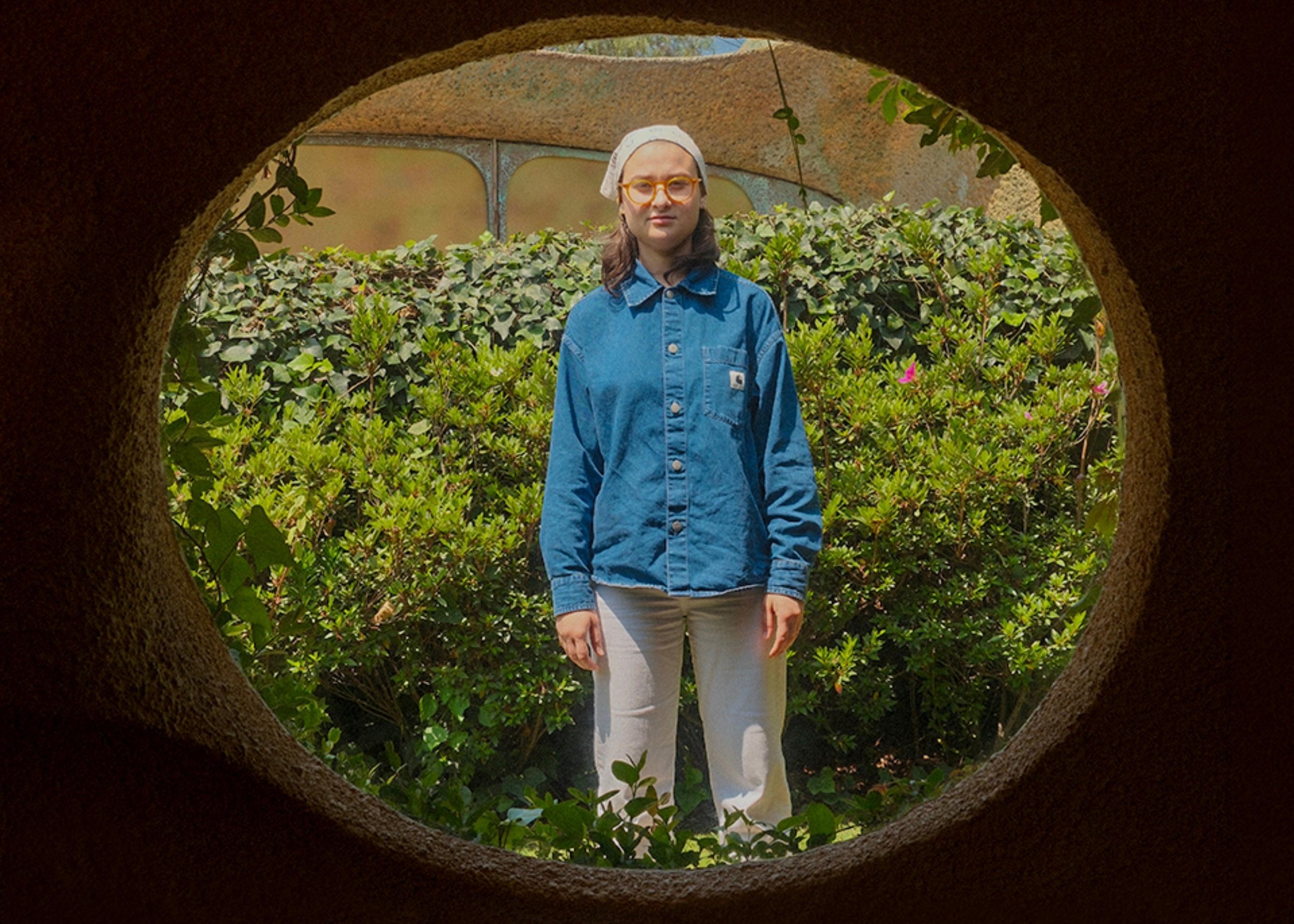
Photo by Ashley Maldonado

Audio By Carbonatix
Some songs arrive like a door slamming. “La Burbuja” arrives like one quietly closing behind you and the strange relief of realizing you’re already on the other side.
That’s the feeling Ceci Ceci chases across her new song. It’s the lead single from her debut album — also titled “La Burbuja” — arriving this October, and it’s the closest the Nicaraguan-born, Dallas-based singer-songwriter has come to putting her whole chest on record. “La Burbuja,” or “The Bubble,” is a song about going home and discovering that home has quietly stopped fitting, like a favorite jacket from another life.
“I titled it that to reclaim something painful,” she tells the Observer.
The song grew out of a trip back to Nicaragua, where she found herself standing in familiar rooms, but feeling like a guest. And that gap — between a place frozen in memory and a person who kept growing — became the whole record’s beating heart.
The clarity that hurts a little
You hear it in the opening lines, sung with the calm of someone stating a fact they’ve made peace with: “Volví al mismo lugar con la misma gente.” (I came back to the same place, with the same people.) Then the quiet gut-punch: “Todo sigue igual/No soy la de siempre. (Everything’s the same/I’m not who I used to be.)
There’s no villain here, no dramatic falling-out. That’s what makes it ache. Ceci writes toward a softer, harder truth: that you can love a place completely and still no longer belong to it.
“It’s the most complex song on the album,” she says. “It touches these deep human things that come from being an immigrant, living away from home. But I didn’t want it to be a purely negative thing. I wanted it to be poetic. Digestible. Beautiful, even.”
That instinct — to hold pain and beauty in the same hand — is what separates “La Burbuja” from a simple homesick ballad. The chorus doesn’t wallow. It observes. “Cuánta apatía hay en este lugar/Lo veo tan claro.” (So much apathy in this place/I see it so clearly.)
In Ceci’s writing, carity isn’t triumphant. It’s just raw honesty, which has its own kind of sting.
The bubble, reclaimed
Here’s the twist that keeps the song from tipping into melancholy: For Ceci, the bubble isn’t a trap to escape, but rather something she’s decided to own.
“The bubble can be a good thing if you want it to be,” she says. “It can be a place in your mind that you go back to sometimes, for inspiration of sorts.”
That’s a generous reading of an experience that could easily curdle into bitterness. The bubble is the insulated world of a hometown, sure — the comfortable sameness that starts to feel like stagnation once you’ve outgrown it. But it’s also a refuge, a memory you can visit on purpose. Ceci refuses to pick just one meaning, as she lets the word carry both, which is exactly how memory actually works: tender and suffocating at once.
By the time the second verse lands, though, the decision is made as she sings, “No pertenezco a la burbuja/Llévame lejos de esta ciudad.” (I don’t belong to the bubble/Take me far from this city.)
It’s not a tantrum. It’s a person finally naming what she already knew.
How a bubble learns to float
The single’s most quietly brilliant move happens in its final seconds — and it almost didn’t happen at all.
The original demo ended with a literal pop, like the sound of a bubble bursting. In the finished version, produced by Argentinian producer Sir Hope during sessions in Mexico City, that burst was traded for something far more poetic. The song simply drifts as Ceci’s voice pulls back from the mic, thinning into distance, until the bubble seems to lift off and float away.
“It’s the feeling of increasing distance,” she says of the fade. “Like you’re physically disappearing from the frame.”
It’s a small production decision that rewrites the whole ending. A burst is violent, final and a thing done to you, while a drift is gentle, chosen and a thing you do for yourself. As she repeats “Salí de la burbuja” (I got out of the bubble), the sound itself feels like a release rather than an escape. Sir Hope understood that the truest goodbyes rarely slam; they recede.
That’s the kind of collaboration this record runs on. Sir Hope’s organic, unfussy approach — warm acoustic guitars, understated arrangements, room for a voice to simply be — lets the emotion sit at the front where it belongs. The result is dreamy without being vague, nostalgic without being sleepy. The production feels like memory itself: soft at the edges, precise at the center.
Growing up in North Texas
Ceci first turned heads around Dallas and North Texas as an emerging voice in the region’s Latin alternative scene — folk, bolero, reggae and contemporary Latin songwriting braided into intimate indie-pop. What’s changed since then isn’t in the ingredients; it’s in the confidence.
Where earlier work introduced her, “La Burbuja” trusts you to keep up with her. It’s less about proving she belongs and more about interrogating what belonging even means. The North Texas scene gave her room to build an audience and sharpen her instincts; this new chapter is her using that footing to reach for something riskier and more personal.
What hasn’t budged is the compass. Identity, migration, belonging, the ache of the in-between — these remain non-negotiable in her writing. She’s an artist who keeps asking the same enormous question from new angles: what do you do when home no longer looks the way you remember it?
A debut built on searching
That question is the thesis of the album to come. “La Burbuja” opens it as a kind of overture by introducing the themes of memory, distance and self-recognition that the rest of the record will complicate and stretch.
It’s her most personal project to date, and it doesn’t pretend to have tidy answers. Instead, it sits in the honest, uncomfortable, weirdly hopeful space of searching for home after realizing the old one has changed shape.
For anyone who’s ever left somewhere and come back as a stranger, “La Burbuja” will feel less like a song and more like a mirror. Ceci isn’t singing solely about drifting away from the bubble. She’s inviting the rest of us to float with her.