
Christine Odwesso

Audio By Carbonatix
Olive Okoro has always questioned everything. Like much of Gen Z, she was raised on the internet as a child of the Tumblr era. Similarly, like many Nigerians, she was also raised in church. Despite her religious upbringing, her queerness was never a question for her. At the age of 8, she’d already found a home in a digital world where queerness was celebrated. To her, homophobia was bizarre.
For some, a journey toward self-acceptance is wrought with a desire to adhere to social norms, but Okoro has never cared much for convention. She says her irreverence for the status quo might be due to her upbringing. While some families adopt a patriarchal structure, Okoro’s mother was the breadwinner. Being raised in a family with mostly women, and being feminine presenting herself, meant that no one ever seemed to consider that Okoro might be queer. Regardless, her coming out was met with curiosity.
“My family is so deeply matriarchal,” Okoro says. “It’s not so ‘traditional’ that I feel constrained. When I started doing more queer stuff online and more advocacy work, my parents just told me to be safe.”
As immigrants, Okoro’s family prioritized working to build a prosperous life. They didn’t have time to fret over who she was dating. Okoro laughs as she recalls on the conversation.
“They said, ‘OK, you want to date a woman. Are you gonna be rich? Are you still going to school,’” she remembers.
Christine Odwesso
Three years ago, in her junior year of college, Okoro decided she would be rich. She’s always been a social media person; when she started making TikToks in 2022, she quickly built a following discussing anything from human rights to financial literacy. Now she has over 600k followers across all her social media accounts.
Okoro has used her TikTok platform to land brand deals, book jobs and speak at conferences. This year, she was invited to speak at a nonprofit conference about liberation for the LGBTQ+ community. She chose to speak about queer Africans, and her months of research for the topic led her to create her own organization, Queer Motherland.
When launching her organization, Okoro leveraged her social media platforms to build an international team. Queer Motherland has board members in Ghana, Houston, Chicago and Dallas. It formally launched in March of last year and has since amassed more than 14,000 followers on Instagram.
“It’s just spiraled,” Okoro says. “Bet on yourself a little bit, and you’ll be surprised.”
Advocacy has always been important to Okoro. One of her primary goals for the organization is to dispel the myth that Africans can’t be queer. The organization is founded on the African philosophy of Ubuntu: “I am because we are.”
“Queer Africans have always existed,” Okoro said. “There are always gonna be queer Africans, because Africa is the foundation of humanity.”
Okoro says generalizing all Africans by monolithic notions is a disservice to the diversity that lives throughout the continent.
“A lot of people think of Africa as a monolith,” Okoro says. “There are different countries, and tribes upon tribes with different languages and different traditions.”
Walking Away From Shame
Zewd Azeb, who uses they/them pronouns, began to reckon with their identity after moving from Ethiopia to the United States. Leaving home at 18 granted them the space to deconstruct their long-held belief system. Although they were deeply involved in their Lutheran church in Ethiopia, they always harbored doubts and nagging questions. In their community, queerness was publicly demonized, forcing them to swallow their questions in fear of shame.
After hearing similar messaging in American churches, Azeb walked away from the church altogether. Releasing their shame allowed them to embrace their identity. They initially came out as bisexual and non-binary before ultimately coming out as transgender.
At the height of the Black Lives Matter Movement, Azeb learned what it meant to be Black in America and considered how their Black and queer identities intersect.
Earlier this year, as a newly licensed therapist, Azeb was seeking resources to create mental health programs for queer Africans. Then they found Okoro’s TikTok. Now, Azeb serves on Queer Motherland’s board by organizing events and coordinating mental health and immigration programming.
“We’re trying to create a community for people to process some of the hardships of experiencing the intersectionality of being queer and African,” Azeb says. “There’s a lot of isolation and a lot of harm people are experiencing today. We’re trying to find programs that could link them to immigration resources and provide mental health resources through different languages.”
Delving deeper into queer African history helped Azeb realize that homophobia in Africa is not traditional; it’s a colonial construct.
When Azeb was in seventh grade, former President Barack Obama visited Ethiopia. They remember chaos erupting as people wagged their fists about Obama “bringing queerness to the country.” But Azeb insists that queerness has always been there. They referenced the Maale people’s broad gender expression. In southern Ethiopia, the Maale people have a term called “ashtime.”
“In modern day, we would describe them as non-binary, or trans — specifically trans women,” Azeb says. “This group was perceived as closer to God. They were spiritually pure, so they were the only ones who were able to go into the high courts. Historically, Africa is the birthplace of queerness. There’s so much queer culture in every single country, but that part of history gets erased, it gets hidden, it gets whitewashed. So there’s this belief — even amongst Africans — that queerness is a Western import.”
A Gathering Place
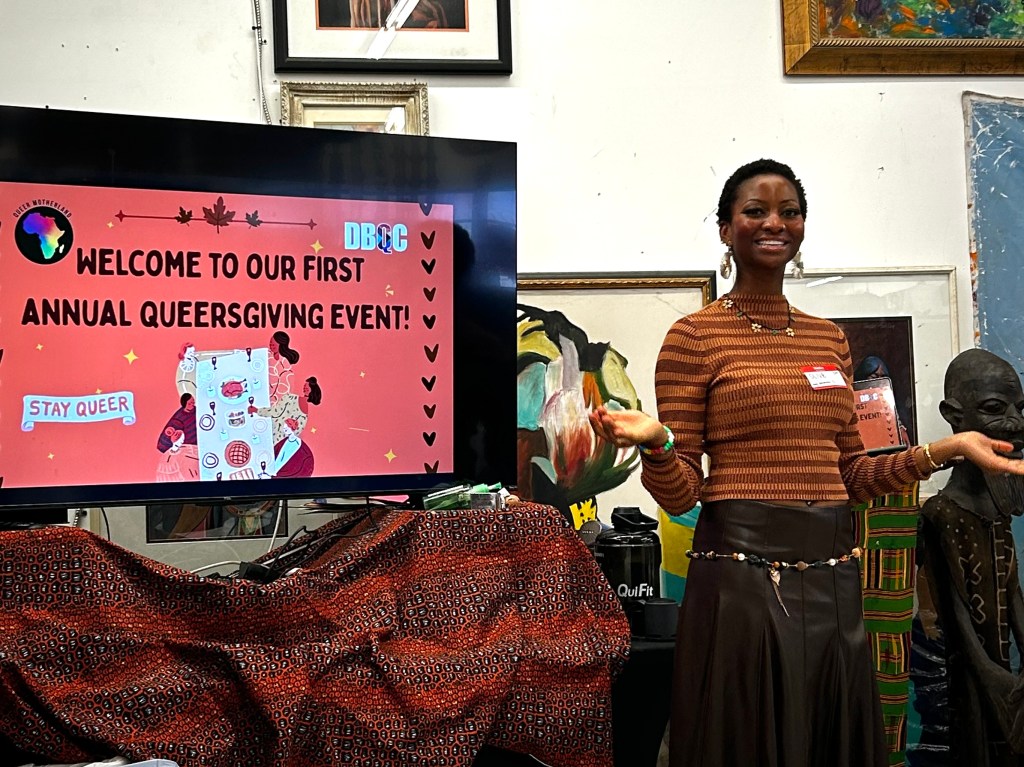
Queer Motherland is working to illuminate similarly hidden aspects of African history. The group regularly posts informative content across social media, shares posts celebrating African queerness and plans events for the community. Recently, about 30 people convened at Pan-African Connection with plates of jollof rice, a traditional West African dish, in celebration of Queer Motherland’s first Queersgiving event.
Hosted in collaboration with Dallas Black Queer Collective, Queersgiving offered Dallas’ Black queer community a space to gather and celebrate chosen family. Attendees participated in queer trivia, engaged in discussion about Queer Motherland’s chosen book of the month and deliberated about the experience of being both Black and queer.
Late last month, the organization hosted its first digitally global event, Queer African Vision Board Circle, to plan for the new year. Eventually, Okoro aims to establish Queer Motherland chapters worldwide.
“Our goals center around our three pillars: education, advocacy and community,” Okoro tells us. “I want to build more chapters across the U.S. and in different parts of Africa and make sure we’re having events every single month. We also want to make a Queer Motherland Scholarship fund. I know a lot of queer people in African and Black families can be ostracized from their homes, and I want people to be able to continue their education.”
Queer Motherland also plans to partner with more African organizations doing advocacy work on the ground.
“South Africa has the biggest queer African conference in the world,” Okoro says. “I want to partner with them, maybe be a vendor at their event next year, and make sure that we are actually advocating for the people in Africa so their voices are heard as well.”
For Azeb, joining Queer Motherland has given them the opportunity to understand that, much like the African community, the queer community is vibrantly diverse. This has allowed Azeb a lifeline for their own identity and has connected them with others from Ethiopia who have reached out to discuss their own personal journeys.
“Access is so important,” Azeb says. “There is so much fear for people — specifically in African countries, to access this kind of space. To see representation of someone that looks exactly like them, living the lives that they could live, shows them it’s possible. We’re here, we’re queer and we’re gonna be there for them.”