
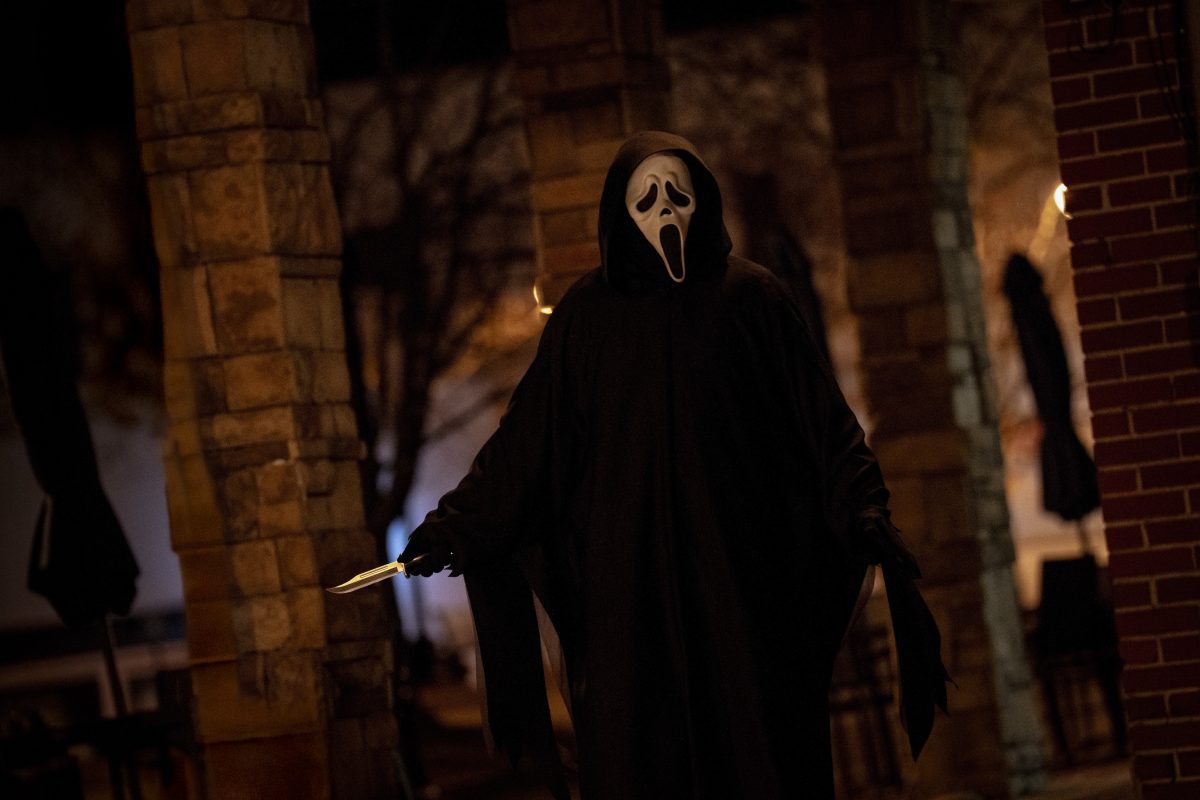
Courtesy of Paramount Pictures and Spyglass Media Group

Audio By Carbonatix
The Scream franchise has always been the smartest kid in the horror class. It’s the honors student who dissects the syllabus while the other slashers are busy sharpening their machetes in shop class. For decades, it has stood tall, perhaps taller than any other series with this much mileage on its odometer. Even the long-maligned Scream 3 has its defenders in the court of public opinion these days. But watch out, Woodsboro apologists, because there’s a new runt in town.
Scream 7 isn’t a disaster. It’s something far more damning for a franchise built on meta-commentary and razor-sharp wit. It is remarkably and painfully ordinary.
To understand the film’s uneven heartbeat, we have to look at the surgery required to get it onto the table. This production didn’t just have hiccups, it had a full cardiac arrest. The studio lost its “Core Four” momentum when rising star Melissa Barrera was fired for speaking out about the Israel-Palestine conflict and expressing solidarity with Palestinians — comments that quickly polarized audiences and ignited heated debate online. In response, a vocal contingent of fans called for and organized boycotts of the film, putting an even brighter headlight on the controversy. Barrera’s ouster was swiftly followed by the exit of Jenna Ortega. Director Christopher Landon (Happy Death Day), who was poised to inject the fresh blood this aging beast desperately needed, also walked away. Left with a gaping wound where their plot used to be, the studio scrambled, threw a vault of money — reportedly $500,000 — at a rewrite and tapped the franchise’s original architect, Kevin Williamson, to direct.
The result feels less like a triumphant return and more like a stabilizing maneuver. It’s competent, sure, but it lacks the fire. It lacks the consistent electricity that makes a Scream movie feel like a Scream movie.
That isn’t to say there aren’t sparks. The opening sequence is a clever, modern riff on our cultural obsession with true crime tourism. We watch a couple staying at an Airbnb that just happens to be the “Macher House” — the site of the original bloodbath. The film winks at us here, filling the screen with memorabilia and photo ops, turning Stu Macher’s legacy into a grim roadside attraction. There are effective scares here, some “out of the shadows” moments that pay lovely homage to Wes Craven’s A Nightmare on Elm Street, proving Williamson still knows his roots.
Speaking of roots, we have to talk about the local ties that bind this production. Grapevine-native Mckenna Grace is having quite the moment, contributing not just her acting chops but to the soundtrack as well. It’s always a treat to see a local talent thrive in the big leagues.
Oddly enough, the production itself has a “Dallas” connection, just not the one you think. Filmed in Dallas, Georgia, the movie features a blink-and-you’ll-miss-it shot of the fictional Pine Grove’s movie theater. Look closely, and you’ll see the “Dallas Theater” marquee screening the original The Texas Chain Saw Massacre. It’s a nice Easter egg for the horror heads.
But Easter eggs can’t feed a hungry audience forever. The film attempts to pivot towards something more emotional, anchoring the chaos in a mother-daughter dynamic. Neve Campbell returns as Sidney Prescott-Evans, delivering perhaps her best performance yet. She is a mother protecting her daughter (1883‘s Isabel May), sometimes fiercely, sometimes suffocatingly.
There is genuine emotion here, a heaviness that feels like a change of pace. But in doing so, the film sometimes forgets to be fun. It plays with concepts of artificial intelligence — blurring lines of reality — but never commits to the bit hard enough to truly unsettle us. We hear characters mention that the franchise’s fictional Stab movies were based on Sidney’s true-crime bestseller, and discussions of podcasts covering the New York murders, but the meta-commentary feels tired. We know the pattern. We know the signs. The guessing game just isn’t as fun when the rules haven’t changed in 30 years.
Williamson directs with a steady hand, but one can’t help but miss the chaos that Landon might have brought. The film feels tapped out on ideas, a ghost that keeps haunting the same hallway because it doesn’t know where else to go. It’s a sequel that exists because it has to, not because it has something urgent to say.
Scream 7 leaves us with a lingering question scarier than any Ghostface call: How many times can you stab a legacy before it finally bleeds out? The film is just okay, and for a series that redefined the genre, “just okay” is the unkindest cut of all.
Scream 7 is now playing in theaters nationwide.