
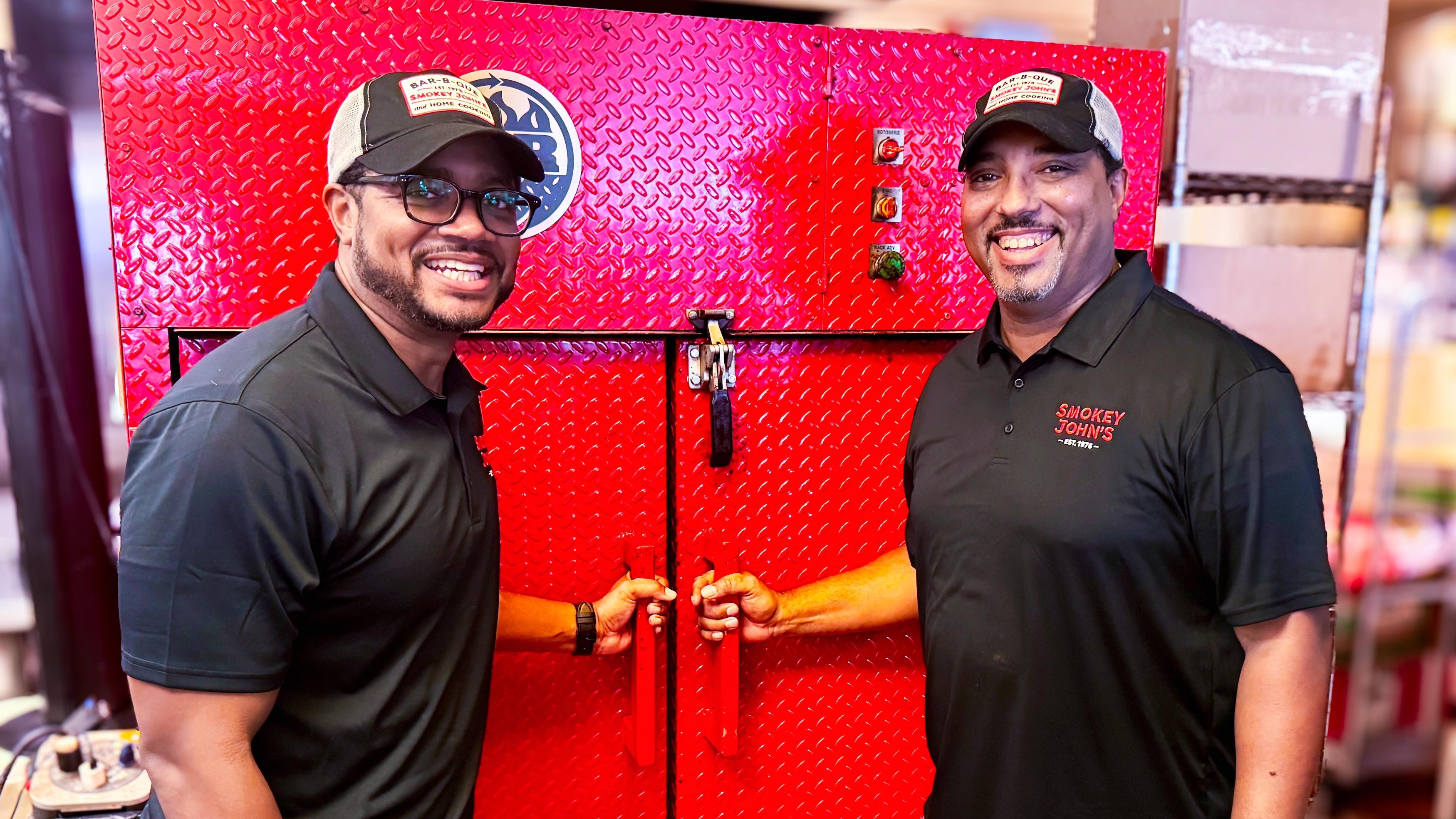
Photo by Lauren Drewes Daniels

Audio By Carbonatix
This week, Smokey John’s is celebrating a half century in the Dallas restaurant scene. And while the same family owns the space, and for the most part they’ve continued serving the home-cooked staples they always have, one major change has taken place recently.
Brisket is in a new era at Smokey John’s.
We caught up with the two sons of John “Smokey” Reaves, Brent and Juan Reaves, who have been running the restaurant since 2013. I peppered them with questions about how their beef program has evolved. Here’s our chat:
Dallas Observer: What are you doing about the price of meat, which is at a record high?
Brent: Oh my God. Crying at night sometimes.
Juan: We’re being creative. We’re actually making our meatloaf out of our brisket trimmings. WE’re making burgers out brisket trimmings. We’re maximizing. We’re getting every ounce out of that brisket we can.
DO: You’ve recently revamped your barbecue program. Tell me about that and why you decided to change things after so long.
Brent: Well, this year we turned 50, and our dad had done barbecue a certain way. And at that time, it was a big innovation to get a Southern Pride smoker, something that was gas-burning and wood-burning.
Juan: He moved from an offset backyard smoker to a commercial smoker, and that was a big deal. It was cutting-edge technology. You’re using wood, but you’re supplementing with gas; set it and forget it. That was a big deal.
Brent: However, at this point, barbecue has changed. And Dallas barbecue is nothing like it was 20 years ago. Of course, the birth of the craft barbecue that you see in Central Texas with Aaron Franklin and all these different guys. You’re seeing a completely different style of barbecue. And now what’s happening is the customer’s palate has completely elevated.
Juan: So what’s happening is, they’ve learned how things are supposed to go or how things can go. And so now they’re expecting that at every barbecue place. They’re looking for that. They know to look for the bar, They know to look for the smokers. There’s just more education about barbecue. So now the challenge is, you can have a good style and be doing it well, but there’s a new standard.
Brent: We want to go from good to great; we want to get on that Top 50 list. We want to be talked about. And we think that over the years we had just been forgotten because we’re not using the kind of equipment.
Juan: Now since we’ve been involved [in running the business], we’ve done a lot of changes, but in order to continue that, Brent was really the driving force behind doing the work about figuring it out. And he came to me at one point and said, ‘We’re going to have to buy a new smoker,’ and it’s the first time we bought a smoker since we’ve been in the business, almost 30 years. The [old] smoker had been at the original location; here it survived a fire. It was the only thing left. It never left the building; the only thing we did was some restoration. And so when we decided we’re buying a new one and then having to move it out, it was truly emotional.
DO: What did you do with the old smoker?
Juan: A catering company bought it. It’s still working.
DO. What’s the biggest difference with the new one?
Brent: The new one is a wood-fired smoker [they got it in March]. We worked with the guys over at J&R Manufacturing, who are probably one of the longest-standing wood-fired rotisserie companies. They created this really incredible piece of equipment that gives you some of that same field that you get on the offset smoker, but gives you a little bit of the convenience that you had with the old Southern Prides and some of the set-it-and-forget-it styles.
Juan: The biggest difference is there’s no gas involved.
DO: What kind of wood are you using?
Brent: We’re hickory, which is a little different from some of the guys like in Central Texas that use post oak; some use red oak. Our dad was from East Texas and so hickory is huge in that area.
Juan: Also, hickory’s economical.
Brent: It burns a little bit longer, so you don’t go through it quite as fast.
DO: What’s changed with the actual brisket?
Brent: So we’re focusing on how we trim the brisket and that’s now creating a lot of scraps that we use to make hamburger meat, Salisbury steak and meatloaf. And then we also have bigger chunks that we’re able to make beef tips; we were already doing beef tips, and we’d actually taken them off the menu because it wasn’t cost-effective well, now because of the trimmings — we’re able to do the beef tips.
DO: Then you’ve also done something with the seasoning?
Brent: We have our seasoning that we created and we increased the black pepper a little bit, creating more color that we’re wanting to see. And it created a better flavor as well.
Juan: Also, the way we trim the brisket now is way more aerodynamic. And we’re getting a little more of a uniform cut of brisket, so it allows us to be more consistent on how we plate, which obviously helps us with the food costs.
Brent: And then the presentation. Now the cuts are looking really nice. so when you lay them on the plate, everybody’s like ‘Oooh, that looks good.’
DO: What’s the hardest part of running a restaurant right now?
Both: Food costs.
Brent: It’s crazy, and it fluctuates every day. And all the recalls right now, just on regular food, are affecting us because when you start pulling away volume, you just make your price go up. And so now if people aren’t producing it, now the supply is low. And if supply is low, demand’s high and price goes up.
Juan: And if we changed our menu every time we got hit, we’d change it weekly. And we can’t do that. So that’s where you have to be really strategic in setting your price. And then we have to be really good about negotiating and finding the best deals so that we can stay within a margin that allows us to be successful.