
Emma Ruby

Audio By Carbonatix
Dallas City Council members initiated what one called the “nuclear option” on plans to reroute major thoroughfares over the Trinity River on Tuesday.
City staff first presented plans to reconfigure the Jefferson and Houston Street Viaducts at an April meeting of the council’s Transportation Committee. Unsurprisingly, committee members highlighted the importance of each route in connecting southern Dallas with the urban core, criticized the recommendations and asked staff for a less disruptive scheme at a later date.
The updated plan was presented to the committee on Tuesday, and, once again, council members were unimpressed with the proposal from staff.
Originally, the routes coming off the bridges were intended to run beneath the rebuilt Kay Bailey Hutchison Convention Center. Reconfiguring the connections from the Jefferson and Houston Street Viaducts has become necessary, staff said, due to the lowering of the future convention center’s footprint to save $597 million. Council members were the ones who originally asked the project’s leaders to cut spending, but on Tuesday, they said the decision was made without understanding the impact on traffic entering and exiting downtown.
Out of the 15-person council, 12 council members were present for the committee meeting, including five of the six members representing parts of southern Dallas. Non-committee members may attend meetings, make comments and question staff, but are unable to vote on motions.
Paula Blackmon, who conceded her district in Lakewood would largely be unaffected by the changes, said the city was jeopardizing residents’ access for the wrong reasons at the meeting.
“We cannot cut off half of our city for a customer experience,” Blackmon said. “I mean, they are our customers too.”
The updated plans presented Tuesday called for added ramps and a connecting bridge to help offset the impact to the two roadways. Committee members still felt the changes failed to fully reflect council input and community priorities, ultimately passing a motion by District 12 Council member Cara Mendelsohn recommending the original convention center plan to the full council.
“We’ve got so many opportunities we’ve missed in southern Dallas. Again, we’ve been talking about this whole transportation thing,” Zarin Gracey, who represents parts of southern Oak Cliff, said. “This is yet another opportunity … and we’re missing that opportunity too.”
Second time’s not the charm
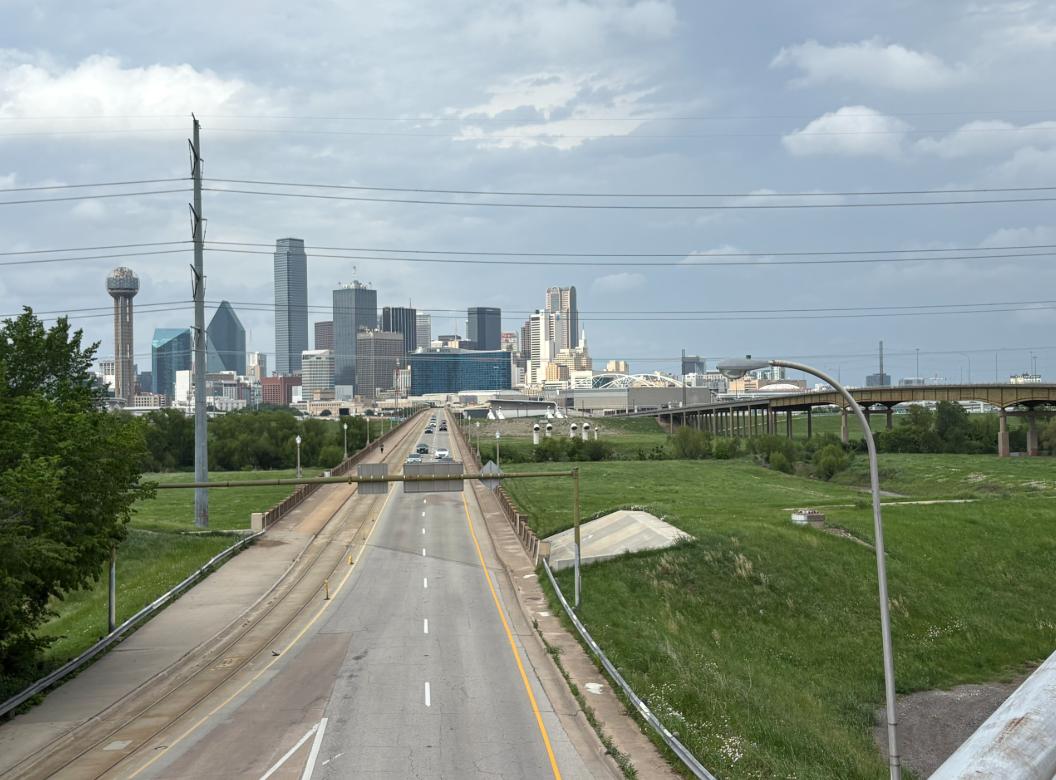
The Jefferson Bridge currently carries three lanes of traffic into downtown from Oak Cliff, while the Houston Bridge serves as an exit into the neighborhood via two lanes. In April, staff presented plans to divert all vehicular traffic onto the Jefferson Bridge and create a greenbelt for pedestrian, cyclist and streetcar traffic on the Houston Street Viaduct.
One lane of traffic would have been lost overall, which alarmed Oak Cliff residents concerned with their commutes. The more immediately pressing issue, however, centered on the routes’ immediate connections to downtown.
At present, traffic reaching the end of the Jefferson Viaduct flows relatively unimpeded onto South Market Street, which then carries it directly to major downtown streets such as Elm and Commerce. The section of Jefferson Boulevard connecting to Market Street will be severed, staff told council members, regardless of any changes to the convention center design due to planned demolition and construction projects.
With a lowered convention center, that disruption would become permanent. The first proposal required dead-ending traffic with a traffic light on Hotel Street, a relatively minor road straddling the southern end of the center.
“I feel like you’re cutting something that’s really essential to the future of our entire city and how that traffic moves,” Mendelsohn said at the April meeting.
The recommendation put forward by staff Tuesday notably called for both bridges to remain open to vehicular traffic and for the Houston bridge to become a two-way thoroughfare during construction, a change from the earlier proposals. Traffic from Jefferson Boulevard would be routed to and merge with lanes on the Houston bridge via a connector ramp.
Tuesday’s proposal also provided for the construction of an exit ramp off Jefferson Boulevard to connect it with Hotel Street and the convention center’s planned mobility hub.
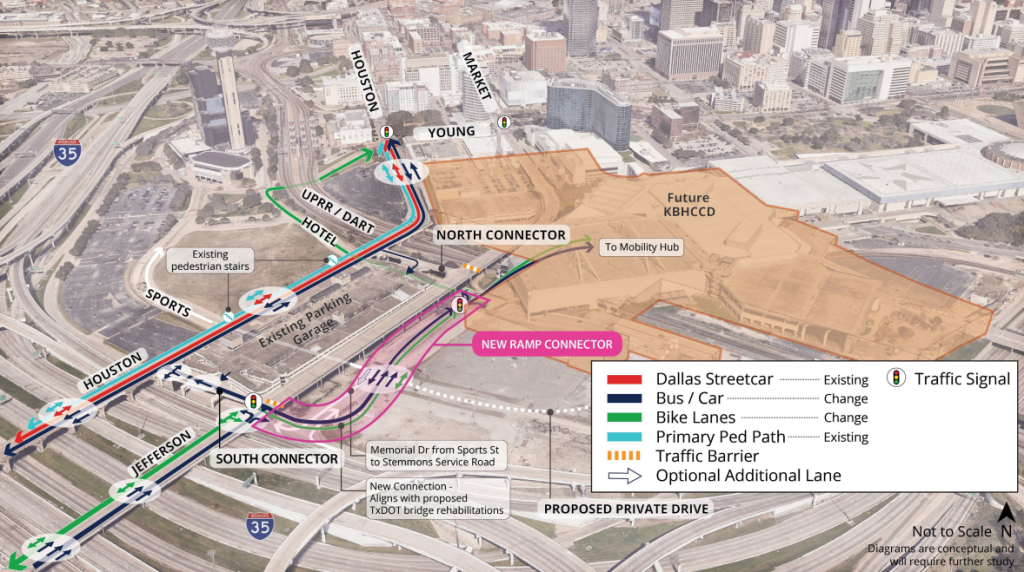
Rendering of staff’s proposed configuration at the time of the convention center’s completion.
City of Dallas.
“Staff continues to talk about the new connection to Hotel Street and the Convention Center’s mobility hub, but that’s not where Oak Cliff residents are asking to go,” Chad West, North Oak Cliff Council member, said at the committee meeting. “They’re asking to maintain their direct access to downtown.”
Speaking after the meeting, West said he supported the motion to recommend reevaluating the convention center’s footprint, calling it the “nuclear option,” and criticized how staff have engaged with stakeholders.
“If I was any given resident who watched that meeting, my takeaway would be that staff has really missed the ball in communicating with residents and with failing to take community input seriously, and that council has now given them a directive that needs to change today,” West said.
West asked staff to tell the committee exactly how the changes would benefit Oak Cliff residents. James Fry, a representative of a firm hired to consult on the Jefferson Viaduct realignment, said the changes could possibly improve conditions for bicyclists. West said he was “stretching a bit” in response.
‘We’re being excluded from decisions’
During the construction of the convention center, which is expected to finish in 2029, commutes would be lengthened by up to 10 minutes during morning rush hour periods, according to traffic data presented Tuesday.
To account for commuters finding other routes to avoid congestion, traffic data factored in a “conservative” 25% decrease in total traffic over the bridges, which amounts to around 7,800 vehicles a day, Fry said. Committee members questioned the figure and asked which routes could be used as detours, to which Fry said South Beckley Avenue was a possible alternative.
“We want equity on the Oak Cliff side… It just seems to be an afterthought, and I would like the same amount of funds, equity investment on our Oak Cliff side, and this does impact my district,” West Dallas council member Laura Cadena said. “I think somebody mentioned that traffic would be routed to Beckley. Beckley and Commerce is already a mess. Beckley people take it to go to Commerce.”
Based on committee data, traffic delays are expected to fall to under seven minutes following the opening of the construction center, before decreasing to two minutes during peak morning periods with further upgrades. However, that’s assuming the construction of staff’s recommended $66 million bridge connecting the end of Jefferson Boulevard onto Houston Street. The planned bridge would run over DART and Union Pacific Railroad tracks, requiring consultation with both entities, Director of Transportation and Public Works Gus Khankarli told the committee.
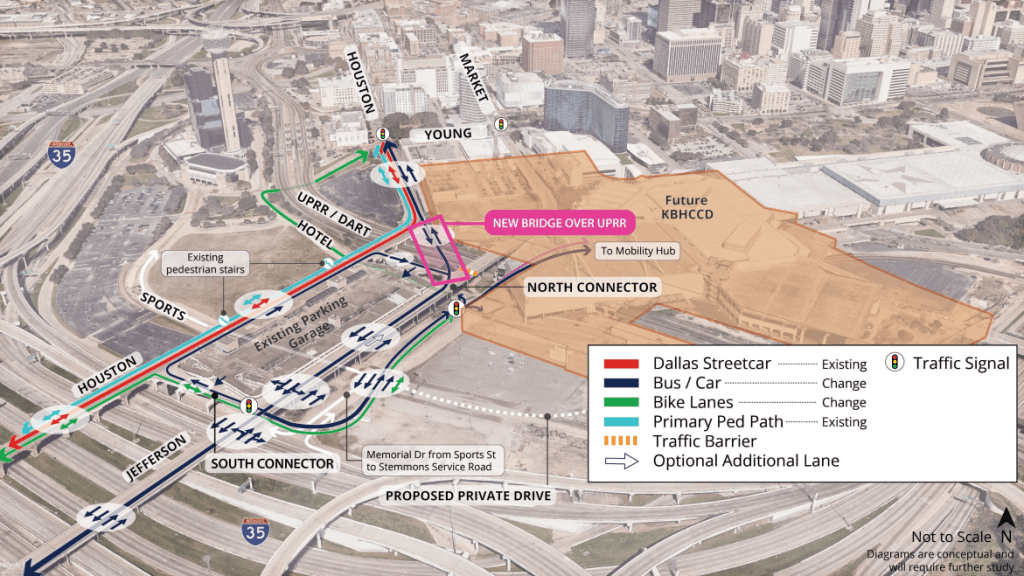
Council members questioned whether Dallas — the same city that recently enacted a hiring freeze due to financial constraints — would be able to find funding for the planned bridge. Assistant City Manager Dev Rastogi said it could begin construction after 2030, aligning with a planned TxDOT repair of the viaducts. West said the $66 million figure would likely grow with inflation by the time construction begins.
Maxie Johnson, a non-committee member representing District 4 in southern Dallas, attended the meeting and said council members needed more information before moving forward.
“We’re getting ready to make a decision based off assumptions,” Johnson said. “What you’re doing is asking this council to do this based off assumptions, and I’ve seen it very clearly. I can’t support anything that doesn’t give access to southern Dallas, and it seemed like we’re being excluded from decisions in the process that have been made in my district.”
What about the convention center?
City of Dallas
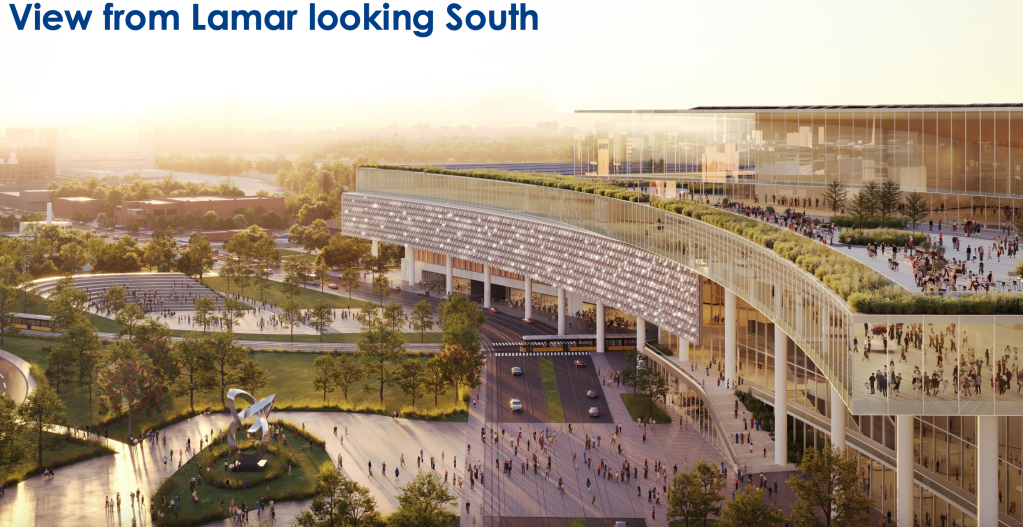
At the heart of the issue lies the planned convention center, which is expected to cost at least $3.2 billion in total. Mendelsohn said she had repeatedly asked for a firmer budget on the project, but has not yet received satisfactory reports from the city. At a January meeting, Dallas Convention Services Director Rosa Fleming said the ceiling for the project is currently estimated at $3.5 billion.
Mendelsohn also pressed staff for a comprehensive cost breakdown of the savings provided by lowering the convention center and disrupting the viaducts. The committee was then presented with a three-page analysis of the savings.
“We were handed a three-page document with a lot of numbers on it,” Mendelsohn said. “We never even discussed it. I mean, obviously, we’ve not spent very much time on it. I don’t understand how this was passed out — not even at the beginning of the meeting, like two hours into the meeting.”
In response to questions about potentially reverting to the convention center’s original height, Fleming said reverting to the original plan would lengthen the completion timeline, force the city to cancel contracts and potentially lose money on purchase orders for materials like steel. She said elevators, storage and other amenities have already been planned and would need to be reconfigured.
“Put the building back,” Mendelsohn said. Stop disconnecting the South and West Dallas from downtown. Literally, this is what people keep talking about. For seven years, I’ve been on city council. We’ve got to connect down to the southern side, and then this is disconnecting it.”
Mendelsohn’s ultimately approved motion will bring a third debate over the connections and convention center design to a full council discussion in two weeks. Staff could present options more attractive to council members to avoid the nearly $600 million price tag reportedly associated with re-elevating the structure.
“A disservice to citizens”
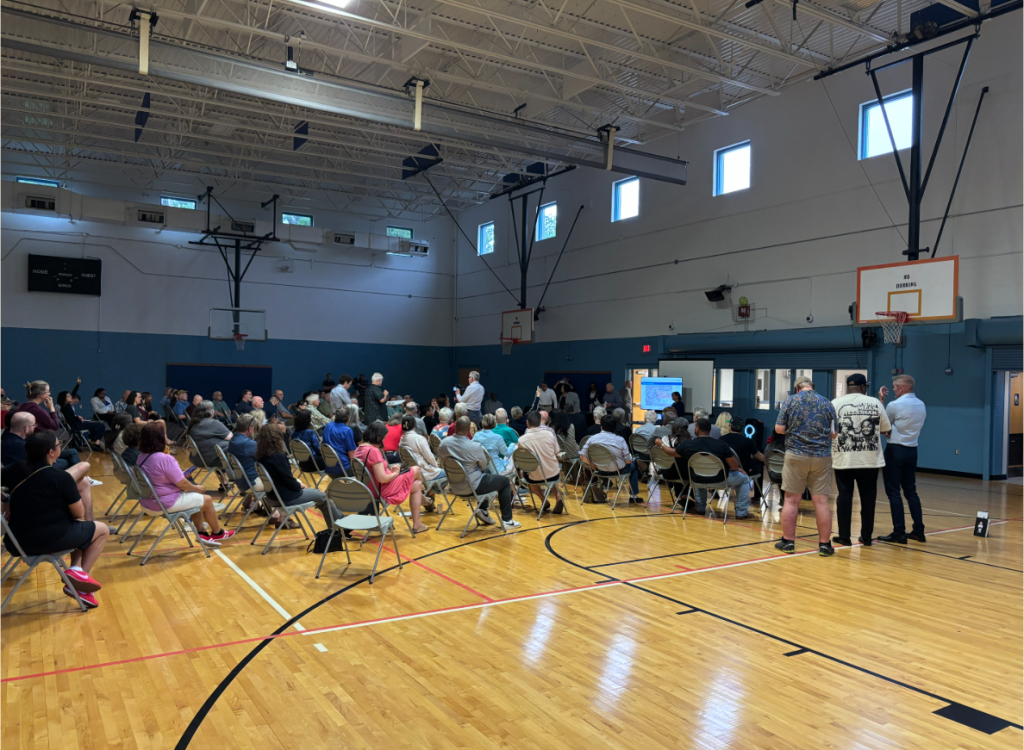
Oak Cliff and southern Dallas residents have strongly opposed the plans, which they say will effectively cut off their access into downtown. Over 100 residents packed into the Eloise Lundy Recreation Center Friday night for an admittedly hard-to-follow meeting on the plans, with a vocal majority criticizing the city’s proposal.
Following the meeting, resident Martha Truby said the crowded gymnasium made it difficult to hear the city’s presentation, which was shown on a single TV screen.
“I could only hear probably 50% of what was being said, and I have really good hearing. I do not have hearing aids, but this is a poor building to have a meeting in, and the microphones were bad,” Truby said. “The presentation was not big enough. I just can’t say enough how that was so frustrating.”
Some residents criticized the massive expense, while Truby and others said they weren’t sure why it should harm their access to downtown.
“The convention center should not take priority over traffic and cyclists, and I know the convention center makes a lot of money,” Truby said. “I think it’s beautiful, all that good stuff, but that’s a disservice to citizens, because we pay taxes, and we also bring income to the city of Dallas.”