Emma Ruby

Audio By Carbonatix
For a few years now, the marine life artist who goes only by his last name, Wyland, has intended to return to Dallas to touch up the eight-story mural he painted downtown in 1999. The iconic oceanscape depicted life-sized humpback whales, dolphins and a coral reef, and stood out as one drove down the Woodall Rodgers Freeway as a bit of ocean smack dab in the middle of Dallas’ concrete.
It could have used a light power wash and some fresh paint here and there, where old billboards had scratched the artwork. But overall, the mural called Ocean Life or Whaling Wall 82 had held strong for 27 years.
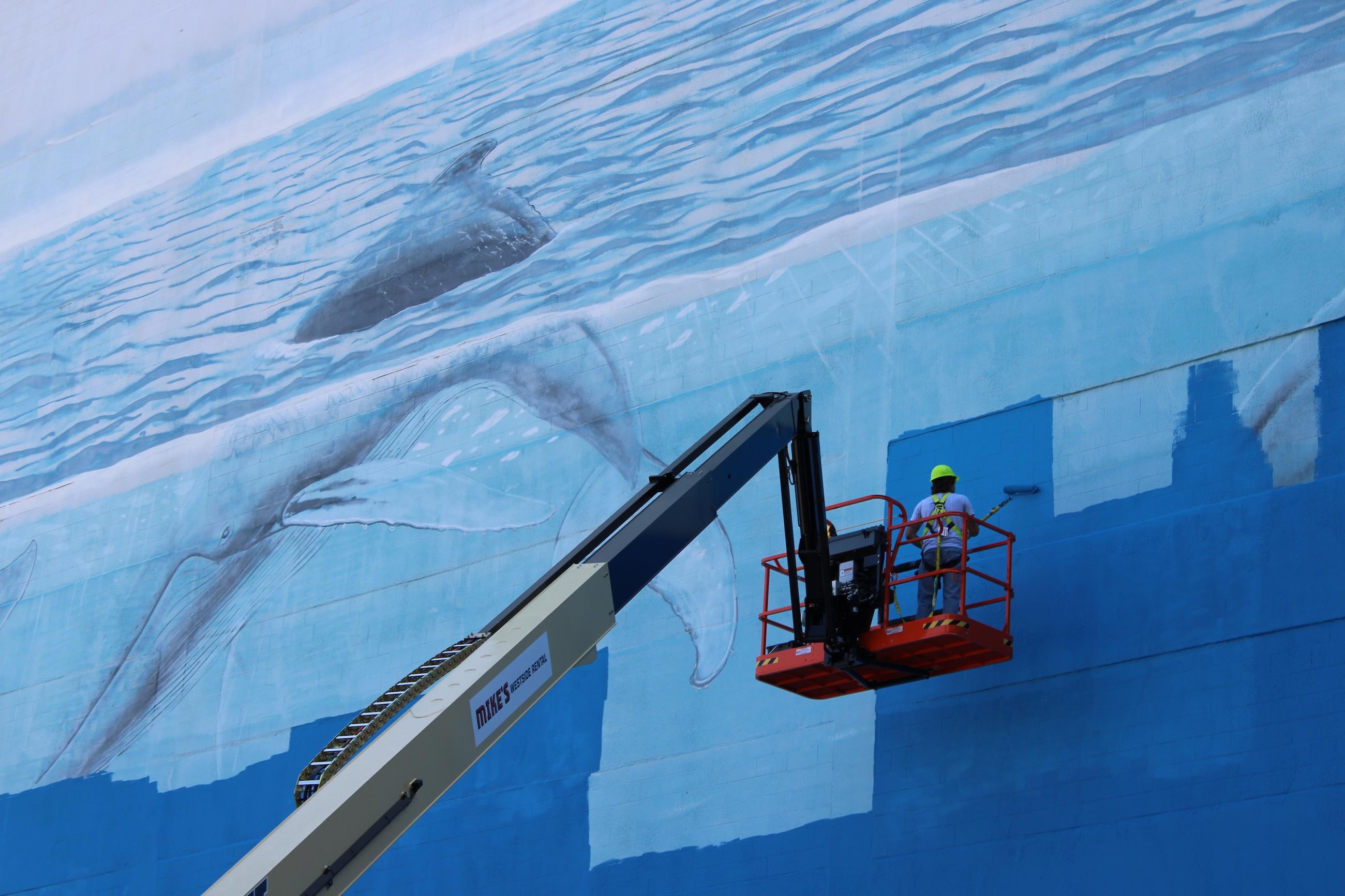
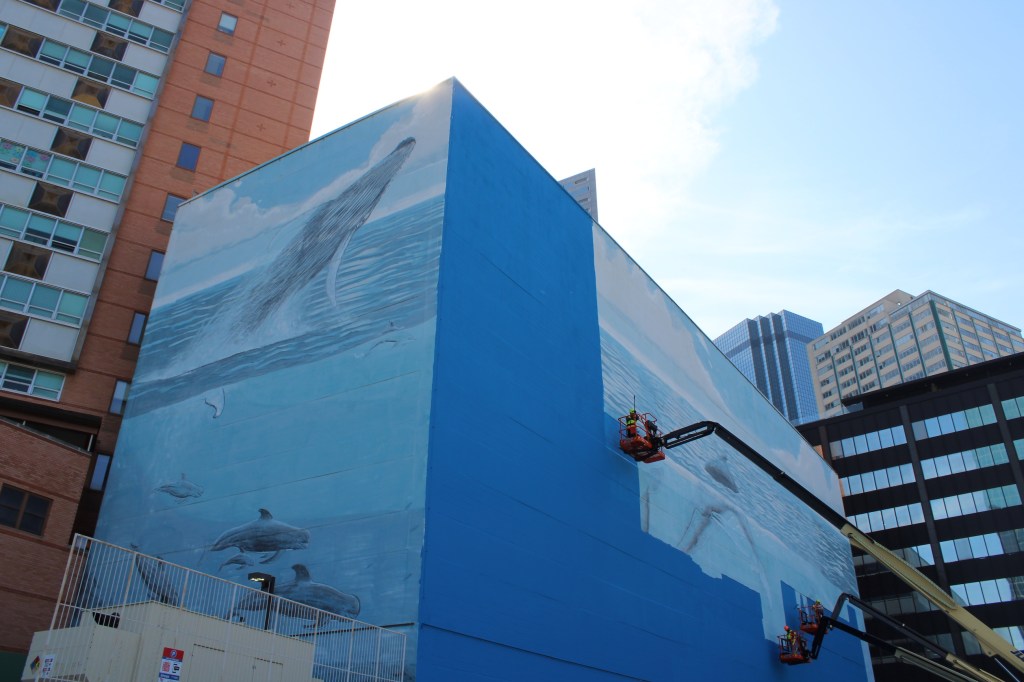
Then, on May 13, Wyland received photos from a Dallas local asking whether he knew anything about the dark blue paint blooming across the landmark. He didn’t.
“We were pretty upset. We still are. This mural is iconic, and public art is for the community. This was a gift to the city of Dallas,” Wyland told the Observer on Thursday. “This is permanent. They’ve destroyed it.”
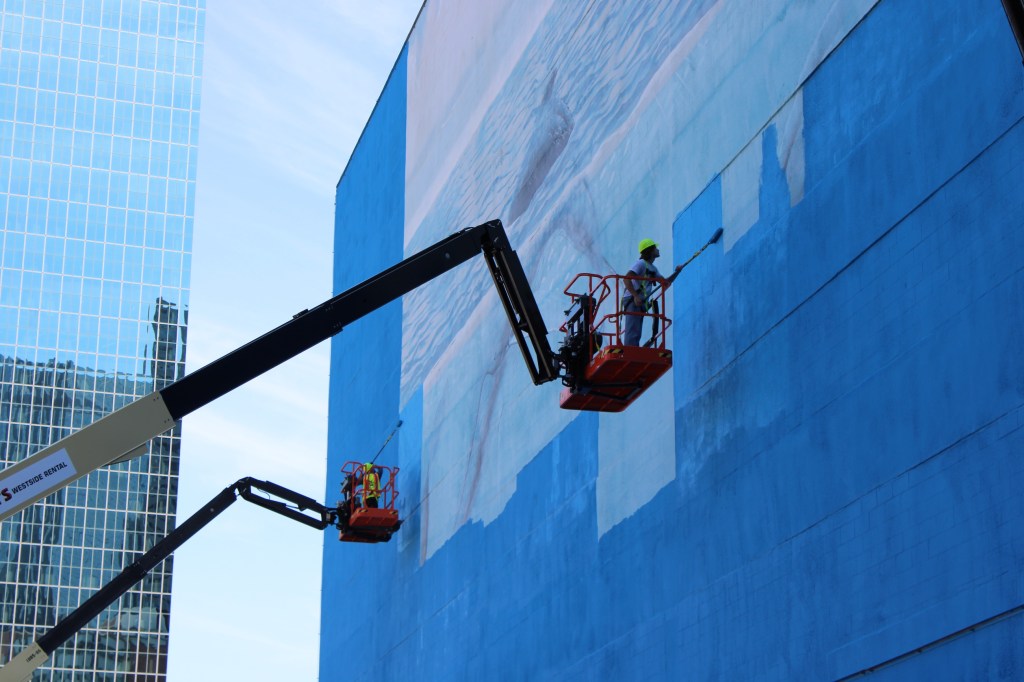
The western-facing facade at 505 N. Akard St. will be transformed into a mural for the FIFA World Cup, which begins on June 11. According to a spokesperson with the North Texas FIFA World Cup Organizing Committee, the new mural will not be an advertisement. Still, the committee has not yet unveiled what the new image will be or who will be commissioned to paint it.
The FIFA mural is expected to be completed within the next few weeks. It is being completed in partnership between the local organizing committee and Slate Asset Management, the building’s owner.
“We recognize the cultural and historical significance of Robert Wyland’s Whaling Wall 82. With great respect for Wyland’s legacy, a portion of the original mural will remain preserved as a tribute to its lasting impact on the city,” a spokesperson for the North Texas FWC Organizing Committee told the Observer in a statement. “We look forward to unveiling a new piece that captures this current historical moment and reflects the energy, unity and global spirit surrounding the World Cup 2026 this summer.”
The building’s northern corner, which will remain intact, depicts a cresting humpback whale and several dolphins.
Emma Ruby
Wyland’s Whales
Dallas’ whale wall was the 82nd installation of a 100-mural project that Wyland painted over three decades. Dallas Cowboy-turned-politician Herschel Walker dedicated the piece, and Wyland recalls the unveiling party as one of the largest held for the murals.
His oceanscapes span across the United States and multiple continents, including Europe, Asia and South America, and the images are meant to inspire a love of the ocean and encourage ocean conservation efforts.
For several years in the 2010s, the whale wall was covered by massive advertisements. Then, during COVID-19, when the pandemic dried up funding for outdoor advertising, it reemerged. At the time, city leaders celebrated the art’s unveiling. Former Dallas city council member Veletta Lill told the Dallas Morning News that the whale installation, and public art in general, “speaks to our humanity, and I feel strongly that it’s important to have that downtown.” Former Mayor Mike Rawlings said he “always thought they were beautiful.”
Finding out that the bulk of the mural is now gone was “heartbreaking,” said Wyland. The artwork was donated to the city at no cost. And as he remembers it from the last time he was in town, Dallas has “plenty of empty walls.” He doesn’t understand why this one had to be selected for a FIFA-inspired installation.
Emma Ruby
Steve Creech, president of the Wyland Foundation, which promotes environmental stewardship and clean water education, said the organization was “blindsided” by the decision to cover the whale wall. Both Creech and Wyland say the FIFA organizing committee did not notify them that the mural was under threat.
At a time when environmental protections are under threat, Creech said it is especially painful to watch a symbol of conservation be replaced by a major corporation. Since taking office, President Donald Trump has rolled back air pollution protections, eliminated regulations on forever chemicals in water, gutted the EPA and ended hunting restrictions on federal lands and national parks.
“We work so hard to spread this message about the conservation of our oceans, and it’s a fight. It is very hard, especially these days,” Creech said. “Now the community loses, the art loses, the environment loses.”
“It’s a slap in the face,” he added.
Perhaps even more upsetting is Wyland’s legacy of celebrating major sporting events through his art. In 2008, he served as the official artist for Team USA during the Beijing Olympics. To commemorate the games, he led children from around the world in painting a mile-long marine mural in China.
“It was beautiful to watch us all come together,” Wyland said.
Over the years, the whale walls have begun to disappear. The mural in Portsmouth, New Hampshire, was demolished in 2021; in Detroit, the 76th wall is often covered by advertisements, as Dallas’ once was. But this desecration has been especially hard to grapple with; it “feels personal,” he said.
Wyland said he intends to explore legal action against the new mural’s sponsors under the Visual Artists Rights Act of 1990, which protects artists against the demolition or modification of legally placed artwork. It can be a hard statute to enforce, especially when artists don’t have the resources to take on building owners or corporations.
But Wyland feels that if he doesn’t try, “all other public art [will be] exposed.”
“They need to be taken down a couple notches. How arrogant can you get?” Wyland said. “We just can’t let them get away with it.”