
Photo-illustration by Sarah Schumacher; Photography by Dylan Hollingsworth; Getty Images

Audio By Carbonatix
Independent Journalism in Dallas Needs You
We need to raise $12,500 by August 9 to support the reporting our community depends on. Reader support keeps us independent and is playing a larger role in funding local journalism and shaping what comes next. If you believe independent local journalism matters, make a contribution today.
The map on Hannah Sims’ phone divides the blocks surrounding Fair Park into four quadrants. Her colleagues hover around the device, holding clipboards and water bottles to their chests, and listen to her terse morning debrief as they divide themselves into teams.
“You guys are going to take this side,” she instructs one group, her finger tracing the veiny roads that circle the South Dallas hub. “Let’s get an idea of who’s here.”
Sims, a crisis-system senior manager at the nonprofit Housing Forward, is taking inventory. She wants to know the name and needs of every person sleeping outside within a quarter-block radius of Fair Park, where, in just a few weeks, hundreds of thousands of soccer fans will coalesce in celebration of the FIFA World Cup. She wants to warn them that what they’re doing — camping outside — is against the law and can get them into trouble with local law enforcement. She wants to tell them that help is available if they’re willing to accept it.
It is a warm May morning as Sims begins driving at a crawl through the streets of South Dallas; she acknowledges that she and her team of street outreach workers aren’t always welcome at the encampments they aim to serve. Admittedly, she was “pretty grouchy” for the couple of days last summer that her air conditioning went out; imagine how you’d feel if you could never get out of the heat.
She pulls over at an empty lot, having somehow spotted a camouflaged pile of belongings on the back corner of the land. A chair, a tarp and a shopping cart holding bric-a-brac are tucked away, overgrown vines shrouding the proof of life. Sims has noticed the collection before, and she thinks someone may be living here.
“Hello!” She calls out as a trio of social workers tramps across the tall grass ahead of her. No one emerges from the shaded alcove, but the team agrees the site looks lived in. After a few more calls, Sims makes a note in her phone and vows to come back later.
“The whole population of our [unhoused] neighbors is becoming more transient,” Sims says, which makes it hard to know who is living where or to find a person who may already be working with one of the organizations that Housing Forward oversees.
Around Fair Park, specifically, the encampments that have formed are “less traditional” than the tent villages that pop up under overpasses or in wooded areas in other parts of the city. You’re more likely to find one or two people looking for shade. Most hope to be left alone.
“They’re just trying to find a space to stay safe and survive out here,” Sims says.
If history is any indication, these homeless community members are the most likely to be affected when the FIFA World Cup lands in Dallas. For decades, major events like the World Cup or the Super Bowl have inspired cities to handle the homeless with temporary off-site shelters or bulldozers. It was the latter that disrupted an encampment in Dallas when the World Cup came to town in 1994.
But those strategies don’t work in permanently reducing street homelessness, said Sarah Kahn, president and CEO of Housing Forward. Instead, they result in millions of dollars spent to move homeless people out of sight for a few weeks, only to throw them back onto the streets when the games are over.
That’s the kind of short-term problem-solving that Housing Forward wants to avoid. So it’s operating like business-as-usual-ish, building by-name inventory lists and working to move one person at a time into housing while accelerating outreach in areas like Fair Park, which will be especially relevant during the month of matches.
“We have a system that’s built for this moment,” Kahn said. “We don’t need to invest in temporary fixes. … Our community made a commitment to invest in long-term solutions that actually reduce street homelessness, that allow us to see results even after the games are finished. And that was really important to us.”
Dylan Hollingsworth
Temporary fixes
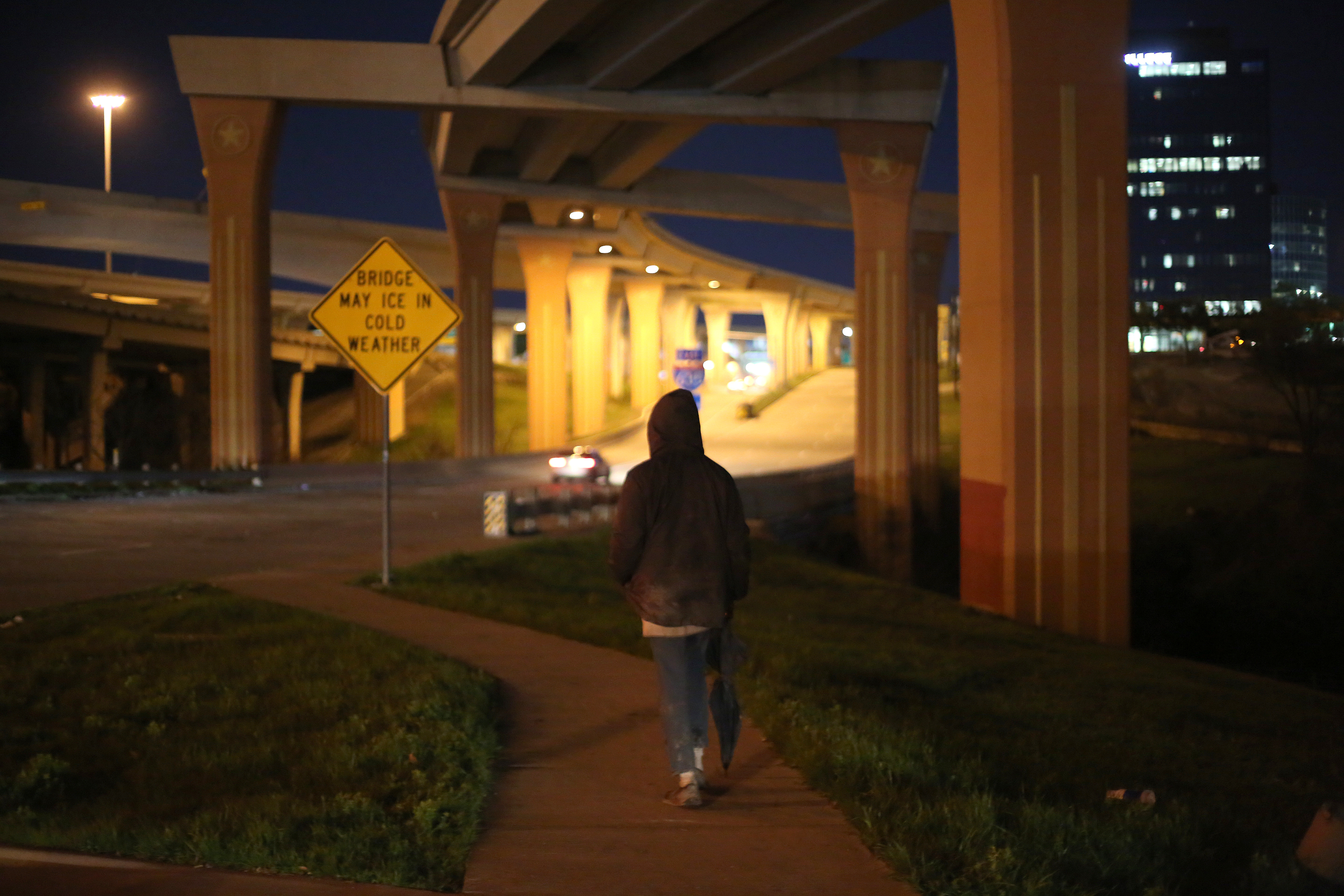
It was May 1994 when Dallas turned to bulldozers to prepare for the World Cup matches to be played at the Cotton Bowl. Around 200 people were cleared out from under Interstate 45, The Dallas Morning News reported, and many were arrested for sleeping outdoors. The encampment site was less than a mile from where games would be played.
The American Civil Liberties Union sued the city for the clearing, but Dallas won on appeal. The playbook has been run time and again.
In 1996, Atlanta officials arrested 9,000 homeless people in the lead-up to the Olympics. In 2006, a Detroit homeless organization hosted a three-day Super Bowl-themed watch party that ended when the game clock hit zero as a way to get the homeless off the city’s streets. In 2022, Los Angeles aggressively cleared out tent cities that officials believed would pose a “safety issue” to tourists in town for the Super Bowl.
Perhaps most egregious was Louisiana’s handling of the 2025 Super Bowl. Before the game, Louisiana Gov. Jeff Landry allocated some $20 million to build a tent city 7 miles from the Superdome, where 200 homeless people living in the stadium’s vicinity were relocated. The pop-up shelter was surrounded by barbed wire, faced plumbing and heating issues and failed to offer the “support for your new start” that had been promised when relocation notices were first issued.
Those notices, which promised everything from three meals a day (plus snacks!), bedding, hygiene kits and laundry services, also warned that failing to comply with the relocation may result in “enforcement actions or legal proceedings.”
(Louisiana also sent state Wildlife and Fisheries and law enforcement officials in to clean up New Orleans encampments ahead of Taylor Swift’s three-night Era’s Tour stop in 2024.)
“If a community member really wants to reduce the visibility of homelessness, then dollars have to be invested in a particular way to get that outcome,” Kahn said. “Putting people in a temporary shelter for four months is not going to get community members the result that they want.”
The first phase of Housing Forward’s Street to Home initiative launched in summer 2024 and focused on assisting homeless people living in downtown Dallas. Over the course of 15 months, 2,070 homeless people living downtown were given medical care, partnered with addiction or mental health services as needed and given a permanent place to live. It’s an extensive safety net, but one that ensures people aren’t just moving back onto the streets after a few nights at a shelter. Housing Forward cites sustained reductions in violent crime downtown as evidence that the process worked.
Phase two began in March of this year, and outreach workers are aiming to replicate those results citywide for 1,200 homeless neighbors by the spring of 2027. (The 2026 point-in-time count, a federally mandated annual survey that inventories the number of people sleeping on a city’s streets on a given night, identified just over 3,513 unsheltered people in Dallas.)
Housing Forward knew that the launch of phase two would coincide with the start of the World Cup, but Kahn said that it has had little bearing on the organization’s approach to resolving homelessness.
“Cities all across the country are under immense pressure to address street homelessness, FIFA or no FIFA,” Kahn said. “At the end of the day, in the absence of creating permanent pathways off the street for individuals, we’re just moving them from block to block, from one neighborhood to the next neighborhood without bringing about any change.”
Still, politics is politics. Last December, City Council approved a $10 million contract to help support phase two, but not all the council members were convinced that the street-to-home initiative was working.
Council member Cara Mendelsohn accused city staff of encouraging the council to “throw more money” at a process that “has not yielded the kinds of results that we expected.” She added that the timing of the funds had reinforced the perception that major events lead to major homelessness crackdowns, even as Housing Forward officials disputed that conclusion.
“Business leaders all across town are saying this is FIFA cleanup money. It’s a kind of gross way to describe what’s happening, but that’s what they’re saying,” Mendelsohn said. “It’s the creation of a short-term illusion that an issue is solved or doesn’t exist. It’s about FIFA, that’s what this $10 million is really about.”
Coordinating enforcement
Last month, the Observer submitted public records requests to the city of Dallas and the Dallas Police Department asking for any documents, policies, email communications or memoranda that addressed homelessness outreach, enforcement or response related to the FIFA World Cup. No documents matched either search, we were told.
Kevin Oden, Dallas’ director of Emergency Management and Crisis Response, partners with Housing Forward to help coordinate encampment cleanups through the Dallas street response team. At the end of April, he told reporters that he had “not been asked to do anything related to the FIFA sites. … We’re not going to make decisions based on who should or shouldn’t be in a [World Cup event] location.”
Housing Forward, the street response team and the Dallas Police Department’s Homeless Outreach Team operate like the three legs of a stool. Just one department being off can cause things to topple over. And with the fluid nature of homelessness, it’s easy for things to get thrown off balance.
For instance, an outreach worker could spend months warming someone up to the idea of accepting a shelter bed, only for police to respond to a public hazard, such as a fire, and thwart that trust.
“Just coming in and arresting people really only results in people cycling in and out of jail and hospitals at a very high cost to both the individual and the community,” Kahn said. “It ultimately undermines our ability to get those folks off the street. And so that’s why we want to always pair enforcement with these strategies that support getting people off the street. When one is used without the other, that’s when we see problems.”
Dallas police have ramped up homeless enforcement over the last year under the leadership of Chief Daniel Comeaux, and city leaders have acknowledged that the crackdown has resulted in “coordination gaps” from time to time. Last month, police officers walked into a South Dallas encampment hours before a clearing of the site had been scheduled to take place, and without the Emergency Management and Crisis Response team that was expected to oversee the process.
Housing Forward had spent the six weeks prior pairing individuals living at the encampment known as “Coombs” with services, resulting in 47 getting placed into housing. Still, more than 20 people were at the encampment when DPD arrived, and they were arrested as bulldozers worked their way across the site.
In a statement to nonprofit news site The Lab Report, a police spokesperson said, “We value the partnership we have with Housing Forward and other stakeholders with the goal of sustainable pathways out of homelessness, but we also have a responsibility to respond when public safety concerns, criminal activity or legal violations happen.”
That’s a slippery slope; public safety and public health were the reasons officials gave for the bulldozing in 1994. And with as much work as Housing Forward has put in to make sure that history isn’t repeated, the stakes are especially high.
A statement from the Dallas Police Department confirmed that the HOT team will “not [be] focusing on special encampments due to FIFA,” but rather will “continue [its] daily efforts of getting the homeless population off the streets.”
Emma Ruby
Slow but steady outreach
At the second stop of the day, Sims finds success.
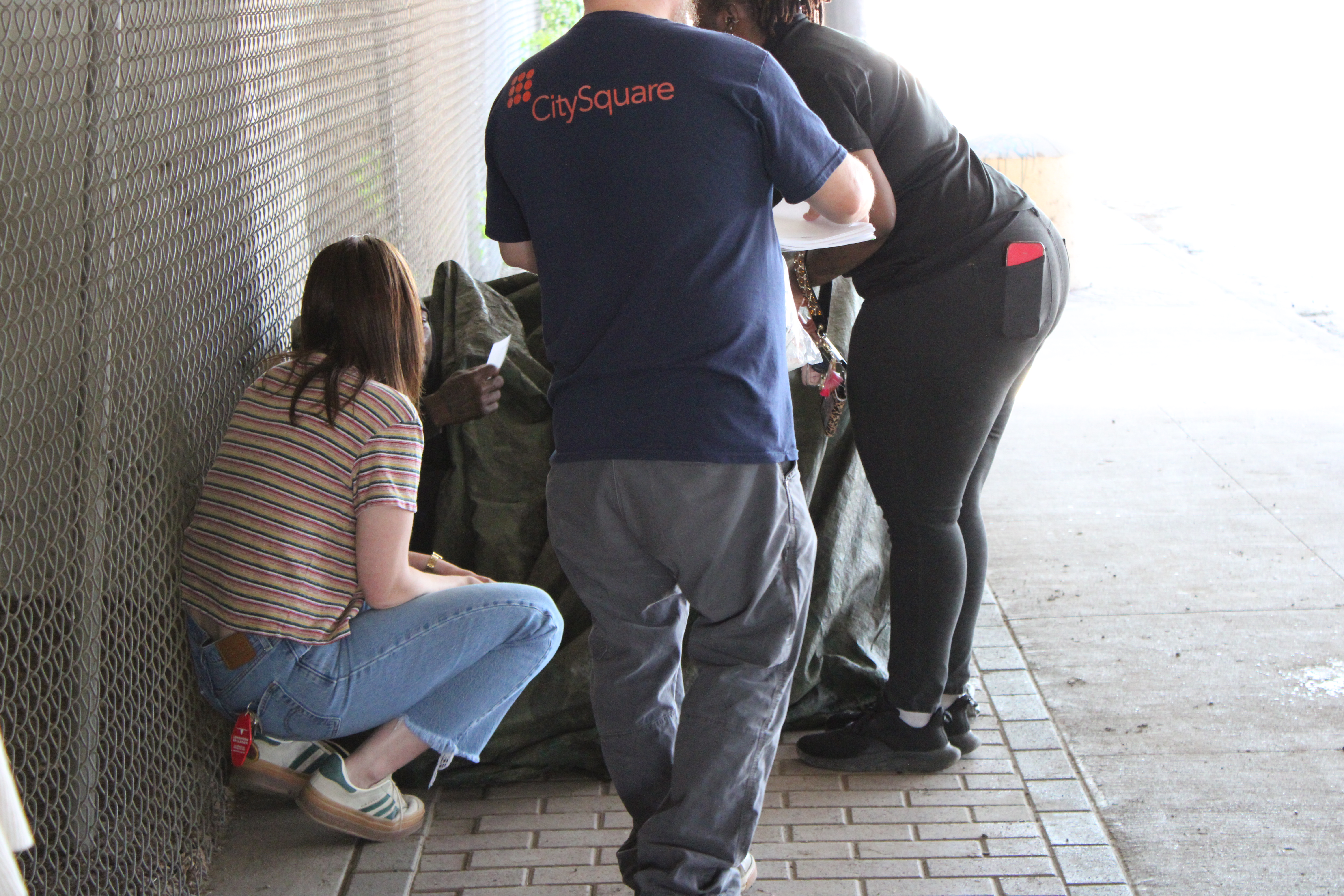
She’s pulled over at an empty lot that overlooks an in-progress condo build. Tucked behind the development but visible from this side of the street is a large tent. The same process as before follows: The group of outreach workers crosses the yard, yelling hellos. This time, a woman emerges.
She is short and tanned, wearing a billowing pair of jean shorts that are held up by a belt. A bedazzled canister of pepper spray hangs from a pant loop. The woman has no issue sharing her name with Sims, but for this article, she will be referred to by the initial J.
J tells Sims that her husband is inside the tent sleeping and that the two have been homeless for years. They lived in Dallas before the pandemic and came back last fall. On one of their first nights back in town, their wallets and IDs were stolen while they slept. Sims begins typing J’s name into a system called HMIS, which is used by shelters, law enforcement, hospitals, housing providers and social workers to keep tabs on anyone who has previously “touched” the system and coordinate resources. She’s able to pull up evidence that the couple stayed at Austin Street shelter prior to COVID, and she begins logging their updated needs.
“Code compliance could be nicer than just always threatening to throw us in jail,” says J, who adds that the condo developer bought them the tent and pays them a small stipend to live on the property and scare off copper thieves.
Sims answers that property owner permission doesn’t make outdoor camping allowable under code compliance or law enforcement.
J is immediately open to housing when Sims asks, but says she won’t go to a shelter. Her husband suffers from night terrors, and because shelters segregate sleeping quarters by gender, she wouldn’t be there to comfort him. Sims nods along and begins making calls to track down J’s birth certificate, which was stolen as well.
“Y’all seem like good, responsible neighbors,” Sims says, and J answers: “We do try.”
“I want to be transparent that things might start to move pretty quickly here,” says Sims, who is scrolling through registries and landlord contacts and available unit lists.
J clasps her hands in front of her waist and says, “I’m OK with that.”
It takes around 20 minutes to get J’s details uploaded into the system. In that time, her birth certificate is ordered, and a social worker is assigned to her and her husband’s case. Sims is certain that the outreach team will be able to get J into housing within a couple of weeks.
Kahn said that 95% of homless individuals who are offered interventions that “support that person to move back into housing and stability” ultimately say yes to the outreach. Many of those who say no have complex mental health or substance abuse needs, and the team bands together behavioral health experts, hospitals, law enforcement, outreach workers and mental health facilities to develop specialized plans for those individuals.
“Persistent engagement” can be key, as some people see what Sims’ team is offering as too good to be true.
After visiting J, the team speaks with a hesitant male-female duo who say they are hanging out at a South Dallas structure tucked into the foliage but sleep at a shelter. Next is a man whose tent is within spitting distance of the Music Hall at Fair Park. He is quiet and reluctant to talk. Like J, he says the property owners allow him to be there. Again, Sims warns that that may not matter to enforcement teams.
Finally, there is a man sleeping under an Interstate 30 entrance ramp. A green tarp hides him from view, and as Sims approaches, he pokes only the top of his head out of the shelter. A trio of outreach workers speaks with him for a few minutes, and finally, he accepts a package of hygiene products.
“He’s not super interested,” Sims says later as she walks back to her car. She knows the man, who can’t be older than 30. This underpass is used for parking during the State Fair of Texas, and she spoke to him last fall while visiting with her family. It was a no then, too.
Someone from the outreach team will return in a couple of days to try again.
“The part that I try to make clear to people is that I’m from this community, I live in this community, and I’m not OK with people sleeping outside,” Sims said. “I don’t feel like [anyone] should think this is the only option available to [them].”