Emma Ruby

Audio By Carbonatix
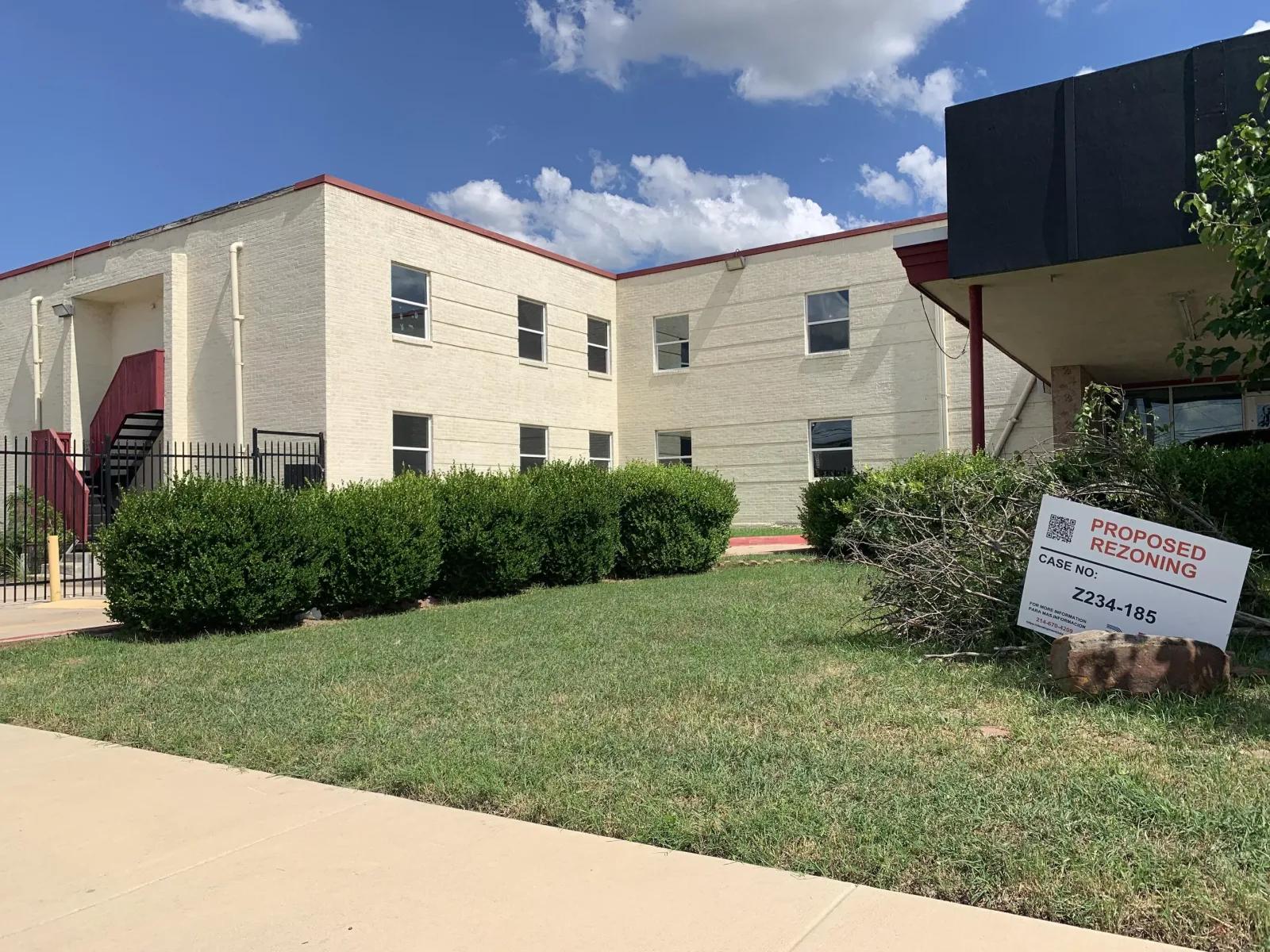
Six years after the city of Dallas purchased it to serve as permanent supportive housing for the chronically homeless, a North Oak Cliff hotel remains vacant.
Over the years, everything from neighborhood pushback to asbestos to noncommittal operators has delayed the opening of the shelter planned for the former Hotel Miramar, now known as the 1950 Fort Worth Ave. property. The latest roadblock, though, comes from Washington, thanks to changes to homelessness funding strategies announced last year by President Donald Trump.
In December, Oak Cliff neighbors were informed by the Catholic Housing Initiative (the umbrella organization that is meant to be operating the center) that “the new federal administration’s change in funding priorities” had caused “a significant delay” in the housing project, which is intended to provide 70 beds to veterans, seniors and disabled individuals experiencing chronic homelessness.
For the last year, the Department of Housing and Urban Development has attempted to rework the federal Continuum of Care Program, which many cities, including Dallas, rely on to enact “housing first” strategies. The administration’s goal has been to deprioritize long-term housing solutions and instead focus on backing time-limited initiatives that emphasize mental health and addiction treatments.
The courts have repeatedly challenged the funding changes, but it hasn’t stopped ripple effects from hitting the tenuous realm of homelessness aid.
“In the last number of years, we’ve gotten about $10,000 (in federal funds) to help us with our food budget to feed the people that we serve. And that has been stalled for probably a year and a half,” said Alice Zaccarello, executive director of The Well Community in Oak Cliff. “This is just what’s going on in the nonprofit world. It’s not a happy situation, and unfortunately, I think there are more cuts coming.”
Zaccarello has long advocated for the 1950 Fort Worth Ave. project. Her organization offers free programming — from hobby to educational to supportive — and hot meals to the neighborhood’s homeless. In her decade in the role, she’s seen the growing need for more beds firsthand, and she’d hoped that the North Oak Cliff center would have opened by now.
It appeared to be close two summers ago, when the building cleared a major zoning hurdle, and the city finalized plans for a facility manager. The idea was that the city’s most vulnerable would be brought to the facility and have a place to live for up to two years while also receiving “wraparound services,” a municipal buzzword that means everything from support for mental illness or addiction to help finding employment to healthcare. The approvals came after years of negotiations with neighbors in the area, who were finally on board.
Then, nothing.
The notice sent to neighbors in December said that involved stakeholders were “working diligently” to identify an alternative funding source for the project, but that the plan was “to begin construction in 2026.” We’re eight months into the year, though, and dirt hasn’t moved.
A representative for the Catholic Housing Initiative did not respond to the Observer’s request for comment. The city of Dallas told us that there are “no updates” on the shelter.
Housing Secretary Scott Turner has argued that the federal defunding is necessary because “housing alone will not solve a crisis driven by addiction or mental health.” Experts across Dallas, though, vehemently disagree and warn that the brunt of efforts to defund housing assistance would likely be felt by hundreds of veterans who would fall back into homelessness.
“Without [the Continuum of Care program], I don’t believe we would have the same level of success we have seen in Dallas,” City Manager Kimberly Bizor Tolbert told The Washington Post last year. “This is not the time to start having these consolidations. … When something is working, you want to amplify that. You want to enhance it.”
Dallas has recorded five consecutive years of reductions in homelessness, according to Housing Forward. Still, the 2026 point-in-time count, a federally mandated annual survey that inventories the number of people sleeping on a city’s streets on a given night, identified over 3,500 unsheltered people in Dallas this January.
The uncertainty surrounding the Miramar property is indicative of the mixed bag of results the city has ultimately had when it comes to attempting to transform run-down properties into shelters. In some cases, the success stories have spoken for themselves. In others, the discord has resulted in wasted money and a loss of community trust.
Still, champions of the project haven’t given up, even as yet another delay has unfolded and stuck.
“The city continues to work closely with Catholic Housing Initiative to identify other voucher sources to get this project back on track,” council member Chad West told the Observer in a written statement. “We remain committed to our final goal of opening this project and permanently housing 70 people who are currently living on our streets.”
Maybe that seems like just a drop in the bucket, but Zaccarello believes every drop is worth something. And if there is funding for the hotel to be found, she hopes it will be found soon.
“Seventy rooms is a small number based on the enormous number of people who do need housing in the city of Dallas, but it is 70 rooms. That’s so valuable. That’s golden,” said Zaccarello. “To be able to solve this problem, we’re only going to be able to solve it a little at a time with 70 rooms here and 70 rooms there. … That 70 people that can be taken off the street and given an opportunity to have safe and secure housing.”