Emma Ruby

Audio By Carbonatix
Next week, the state of Texas is likely to carry out its second execution in three weeks. Edward Busby Jr. has been on death row for 21 years, having been found guilty of abducting and killing a TCU professor in 2005.
Busby’s execution date looms over a group of North Texas advocates, lawyers and faith leaders, who argue that his intellectual disability should make him immune to the state’s pursuit of capital punishment. He is also a stark reminder of the way Tarrant County officials have cemented the county’s legacy as a death row hardliner.
Since 2020, Tarrant County courts have hosted 23% of death penalty trials statewide, despite the county accounting for only 7% of Texas’ population. In the last two years, that number has ballooned to 42% of the state’s capital punishment cases. Tarrant County has the most death penalty trials per capita out of the state’s 10 largest counties, beating out the next highest county by more than twice as many trials.
The sobering data was revealed in the newly released report “An Extreme Outlier,” which was published this week by the Texas Defender Service.
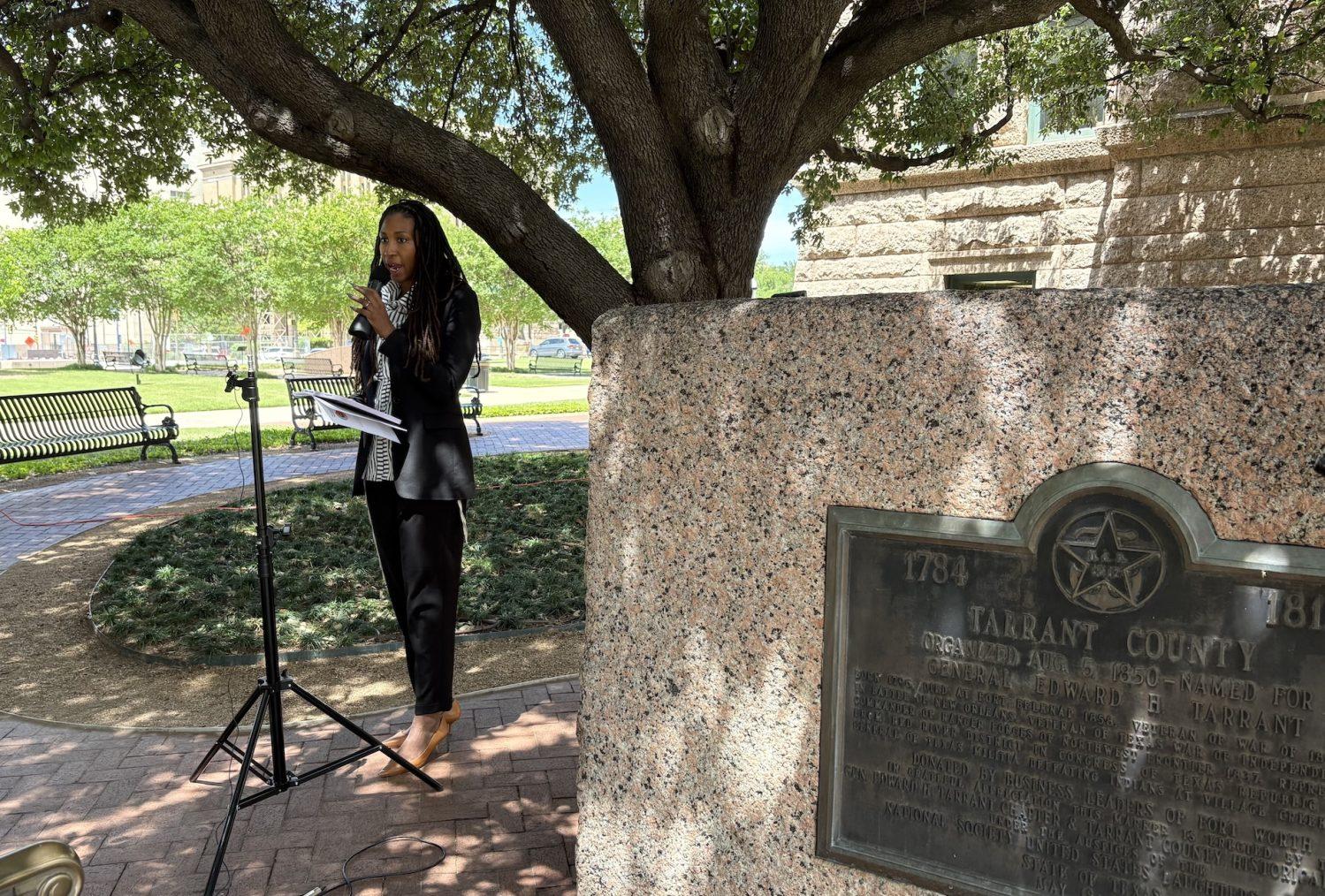
“While I know most people aren’t thinking about the death penalty in the day-to-day, this report isn’t historical. It’s very current,” said Estelle Hebron-Jones, the director of special projects for the Texas Defender Service, during a press conference on Thursday. “[Tarrant County] represents an outsized influence on what’s happening with capital punishment in Texas.”
Worrying to Hebron-Jones is what the report revealed about the way race interacts with Tarrant County’s decision to seek capital punishment.
Defendants who are sent to death row by Tarrant County juries are overwhelmingly Black, the report found. Since 2012, six Black men have been sentenced to death in Tarrant County (another three faced the death penalty but were sentenced to life without parole), while one Latino and one Native American received the same punishment.
Two white men have been sent to death row by Tarrant County in that time, the most recent of whom, Tanner Horner, was sentenced on Tuesday.
Minority defendants are also significantly more likely to face “upcharging,” a strategy where the defense attorney’s office intentionally seeks capital murder charges even when not supported by evidence. In Texas, capital murder is the only charge that can lead to a capital punishment sentence, and the report claims that the “insidious” practice of upcharging is an attempt to coerce guilty pleas from defendants hoping to avoid death row.
Over the last 20 years, 10% of the 431 capital murder cases charged in Tarrant County resulted in no jail time whatsoever, the report found. Another third failed to result in a homicide conviction. Of those who faced capital murder charges but served no jail time — whether because the charges were dropped or a jury failed to indict the defendant of the crime — 67% were Black.
“The pattern is clear that race is very much playing a role in the outcomes of these cases,” said Hebron-Jones.
In response to the report, 14 faith leaders from across Fort Worth signed on to a letter that was delivered to the Tarrant County District Attorney’s Office on Thursday, condemning the continued, aggressive pursuit of the death penalty “and the racial disparities in its use.”
Emma Ruby
One signatory, Rev. Ryon Price of Broadway Baptist Church in Fort Worth, has been an outspoken critic of the Tarrant County jail. Since 2017, at least 74 inmates have died while incarcerated. In protesting the jail’s conditions, Price has found himself on the receiving end of a year-long ban from the Tarrant County Commissioners’ Court for speaking for eight seconds over his allotted time about the jail deaths.
On Thursday, Price characterized the death penalty as a “cruel and unnecessarily vindictive form of punishment” that he stands against as a Christian.
“[The death penalty] violates both the constitutional right to life and the basic dignity of all human beings, including even those human beings who have taken the life of their fellow human beings. Taking life for life betrays the very sacredness of life itself,” Price said. “The state of Texas continues unabated in its disturbing and overzealous deployment of the death penalty … Sadly, our own Tarrant County leads the charge.”
The faith leaders and advocates are urging the Tarrant County District Attorney’s Office to follow the recommendations in the Texas Defender Service study, including implementing policies that address racial discrimination in charging and committing to end upcharging.
It also asks that prosecutors end the practice of seeking the death penalty in cases where an unplanned murder results from a robbery or burglary, and to create a racial justice dashboard that includes data and the results of an independent audit of the office’s practices.
“These types of punishments don’t lead to crimes going down … they just lead to scapegoats. Scapegoats like the crucified,” said Rev. Jeremy Williams, a professor at TCU’s Brite Divinity School and the director of the Center for Theology and Justice. “Some may say this is not their issue, but they’re doing it in your name, on your behalf.”