
Donna Bagly

Audio By Carbonatix
Before Denton had streaming, multiplexes or group chats debating what to watch on a Friday night, it had the Denton Square. And before the square’s moviegoing history settled into local memory, it flickered across storefronts, opera houses and downtown facades that kept changing names.
That long arc of Denton cinema was the subject of a deep-dive presentation at the Denton County Courthouse on May 15, where locals gathered to hear Curator of Collections Kim Cupit, Aviation Cinemas founding partner Jason Reimer and Axis Realty Group’s Brad Andrus trace the story of the Fine Arts Theatre from its 19th-century roots on North Elm Street to its next act. The event was part local history seminar, part progress report and part love letter to a building that has spent years standing silent on the square while people wondered whether it would ever live again.
The answer now appears to be yes. And not in a half-assed, museum-piece way.
The Fine Arts Theatre is being restored as a working cultural space for modern Denton: a movie theater, yes, but also a venue built for live music, comedy and the kind of communal experiences that downtowns need if they want to stay alive after dark. Based on that presentation earlier this month, the current reopening target is September. If that timeline holds, one of North Texas’ most storied theater buildings will soon return not as a relic, but as a living room for the city.
Denton Office of History and Culture
Denton’s movie history began early, and right on the square
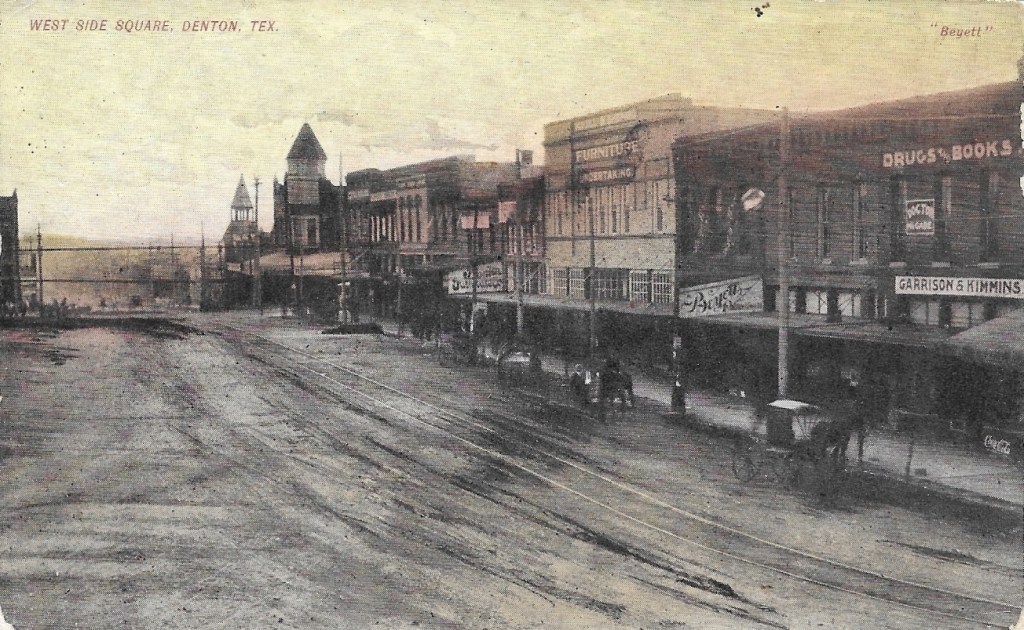
Cupit’s historical overview made clear that Denton did not stumble late into movie culture. Films were being shown on the square as early as 1904. By 1909, the short-lived Majestic Theater had opened as the city’s first dedicated movie theater. In 1913, the Dreamland arrived on North Elm Street, helping establish what became known as “Theater Row.”
From there, Denton’s cinematic geography grew richer and more crowded. The Majestic became the Princess. The Dreamland Theater (currently occupied by Cartwright’s Ranch House) joined a lineup that eventually included the Strand, the Palace, the Ritz and the Campus Theatre. Names changed, buildings were reworked and screens cycled through openings and closings. But for decades, downtown Denton was a place where moviegoing was woven into ordinary civic life.
The Fine Arts did not emerge in isolation. It belongs to a larger local tradition of exhibition, performance and downtown entertainment reflective of Denton’s reputation as an arts enclave in North Texas. The history of cinema in Denton is not solely the story of one beloved theater, obviously. But it is the story of a town that repeatedly made room for shared cultural spaces, and the Fine Arts Theatre is among the footnotes.
Denton Office of History and Culture
The Fine Arts had several lives before it became the Fine Arts
One of the most fascinating threads from the courthouse presentation was just how many identities this building has worn.
The site opened as the Graham Opera House in 1877. Long before digital projection and repertory screenings, it was already a place designed for performance and public gathering. In later years, the building became home to furniture and undertaking businesses, including Magil and Shepard Furniture and Undertaking, and later, George Morrill Furniture Store.
Then came the movie palace era.
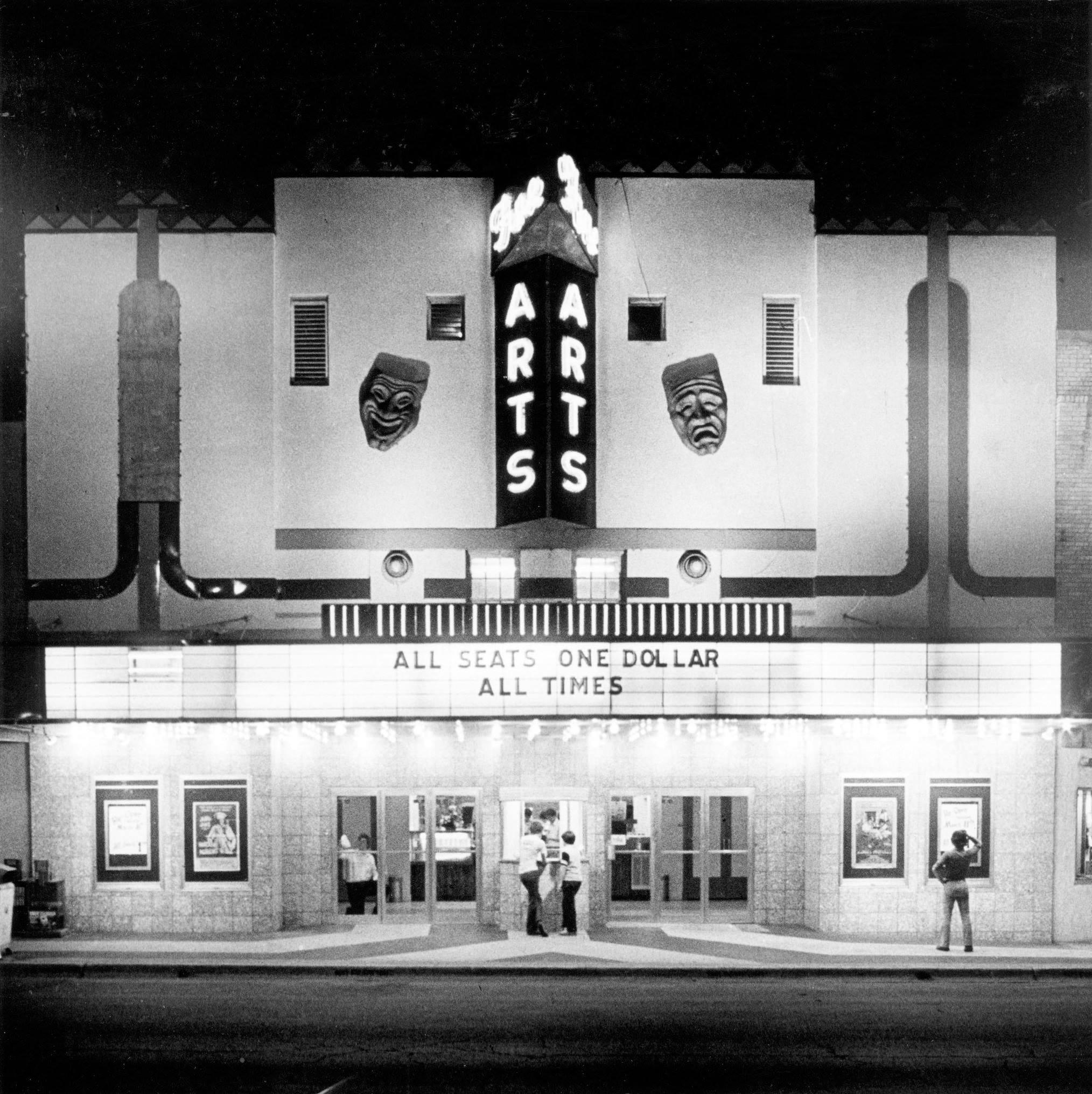
On Aug. 28, 1935, the space opened as the Texas Theatre. That chapter connected Denton to a golden age of American moviegoing, when theaters elevated the art of filmmaking. Architecture, signage and interior decoration all worked together to turn a night at the movies into an event.
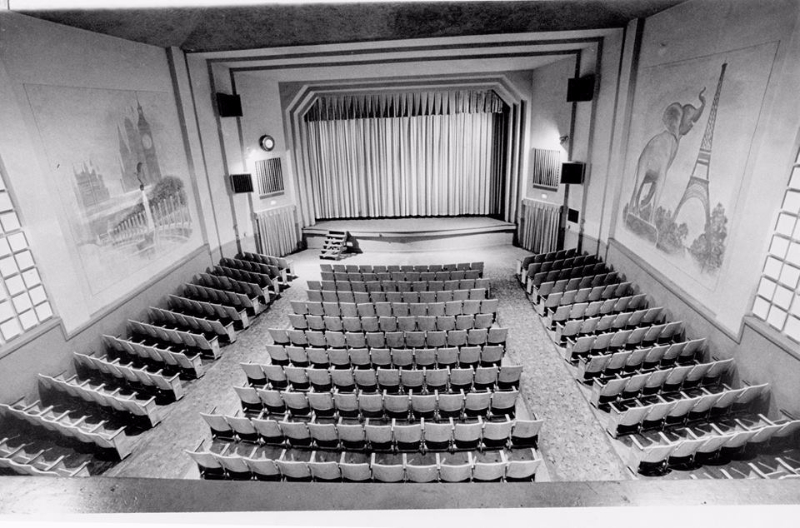
In 1957, the Texas was remodeled and reopened as the Fine Arts Theatre. The redesign gave the building the name most Denton residents still use, along with a midcentury visual identity people continue to remember vividly: the red-and-blue facade, the comedy and tragedy masks and the painted murals that became part of the theater’s mythology. The building also had a third-floor balcony that, into the 1960s, was at times used as segregated seating — a reminder that these beloved civic spaces also carried a history of racial inequities of the times.
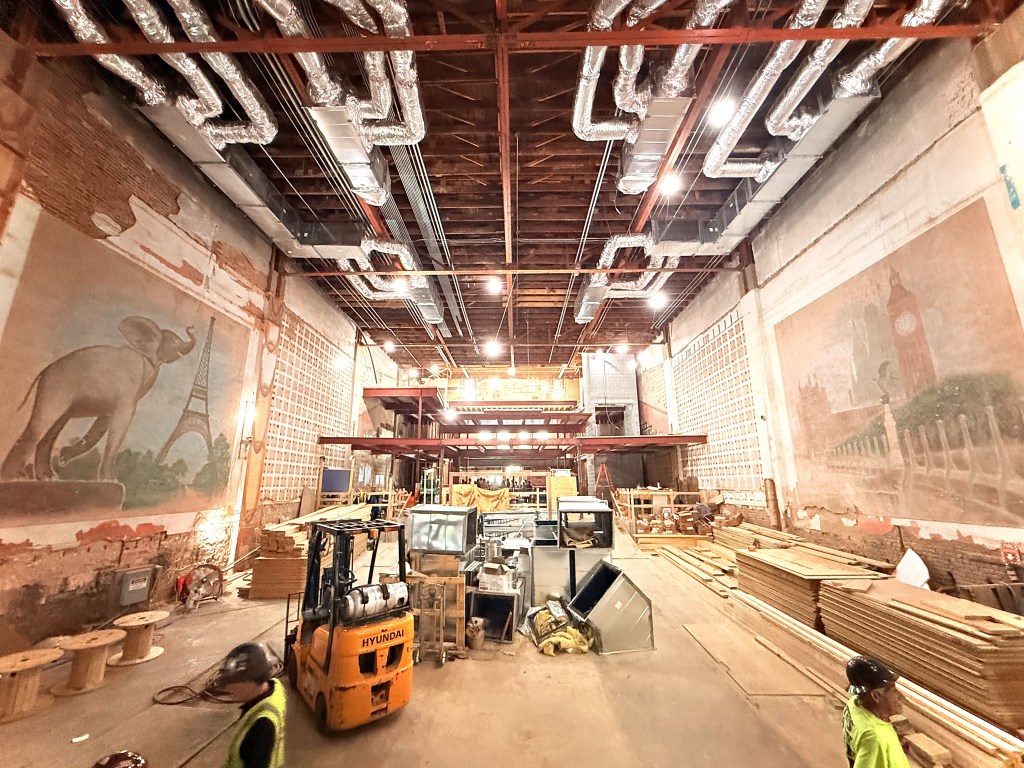
Inside, the theater once featured four large murals depicting London, Paris, Venice and Madrid. During the May 15 presentation, attendees heard the kind of detail that gives local history its texture: the murals were likely commissioned and created by students at Texas Woman’s University, painted on cardboard. The much-discussed elephant alongside the Eiffel Tower mural on the north wall, still lodged in local memory, was based on a Paris postcard image. That is the sort of accidental poetry old theaters collect over time — high style translated through local hands, then remembered for decades.
Preston Barta
The building’s rescue began with a decision not to let it disappear
Every restoration story has a hinge moment. For the Fine Arts, it came when Andrus, who had once been hired to sell the property, connected with Reimer, whose experience with Oak Cliff’s Texas Theatre made him an unusually credible steward for a building like this.
Reimer helped convince Andrus not to let the Fine Arts slip away. Too many historic theaters survive just long enough to become cautionary tales — they sit empty, then compromised, then impossible. The Fine Arts was edging toward that familiar fate before a different idea took hold.
NorthBridge Realty Holdings bought the property in 2018 and brought Reimer in to oversee programming and operations. That partnership appears to have set the project on its current course: preservation without nostalgia paralysis, and redevelopment that respects what the building was while being honest about what it needs to become.
If you have watched the Texas Theatre in Oak Cliff evolve into a genuine cultural institution in Dallas, you can see why Denton residents are paying attention. Reimer is not treating the Fine Arts like a decorative revival with nostalgia bait. The aim is a functioning venue with enough flexibility to serve present-day habits, not just past-day memories.
Denton Office of History and Culture
What the Fine Arts is becoming now
The walkthrough after the presentation gave attendees something history alone cannot provide: a look at the building in transition. Inside, the Fine Arts currently feels suspended between ruin and rebirth. Workers are in the middle of asbestos and mold remediation, the kind of unglamorous labor every serious restoration requires. Yet the future is already legible in the plans.
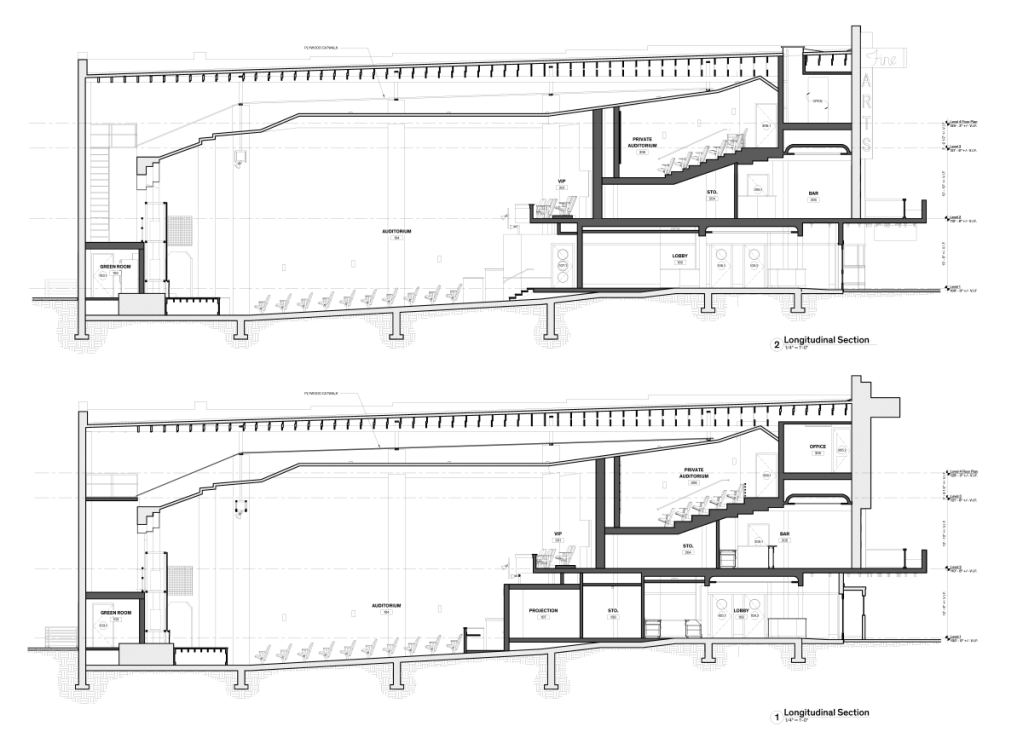
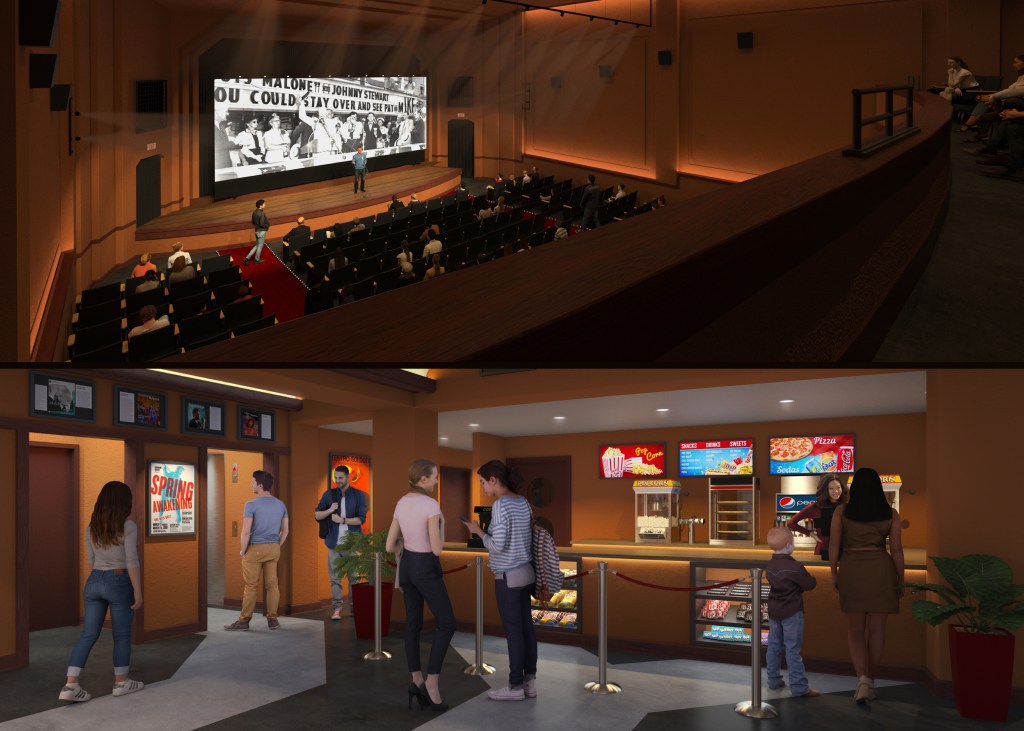
The renovated venue is expected to include downstairs seating for around 240 people, designed to accommodate live music as well as film. There are plans for a second-floor bar and a multifloor layout that broadens the building’s use beyond a single-screen theater model. That matters because survival now depends on versatility. A downtown venue cannot rely only on one type of audience, one type of event, or one type of night out.
Then there is the film side of the equation, which carries real significance beyond Denton. The Fine Arts is expected to include 70mm projection, a format that still inspires devotion because it makes movies feel physical, luminous and large in a way digital often does not. It’s not just a flashy technical feature, either. It’s a statement of intent. The theater is being rebuilt for people who still want cinema to feel like an experience.
Courtesy of Architexas
Why this project matters for North Texas
The Fine Arts revival lands at a moment when North Texas is still sorting out what preservation should look like in fast-changing cities. It’s easy to praise history in theory, but it’s harder to invest in old buildings that need expensive work, patient planning and a clear use case.
This project offers a persuasive answer, as it preserves a landmark without freezing it in amber. It respects Denton’s past while making room for how audiences gather now — for repertory films, 70mm screenings, concerts, comedy sets, special events and whatever hybrid cultural life downtowns increasingly demand. That is why the May 15 presentation felt larger than a simple update. It was a reminder that historic preservation is not just about facades or sentiment, it’s also about continuity in a city that keeps its character not by resisting change, but by guiding it through places that still carry civic meaning.
Courtesy of Architexas
For Denton, the Fine Arts could become one of those places again. Not merely a theater people point at and talk about in the past tense, but a working part of downtown life. For North Texas, it stands as another example that old movie houses can do more than survive; they can lead.
If the Fine Arts opens in September as planned, it will not just mark the return of a building. It will mark the return of a habit: gathering in the dark with strangers, in a room full of history, to watch something larger than ourselves. And in a region growing as fast as this one, that kind of continuity is worth fighting for. We’ll see you in September.