
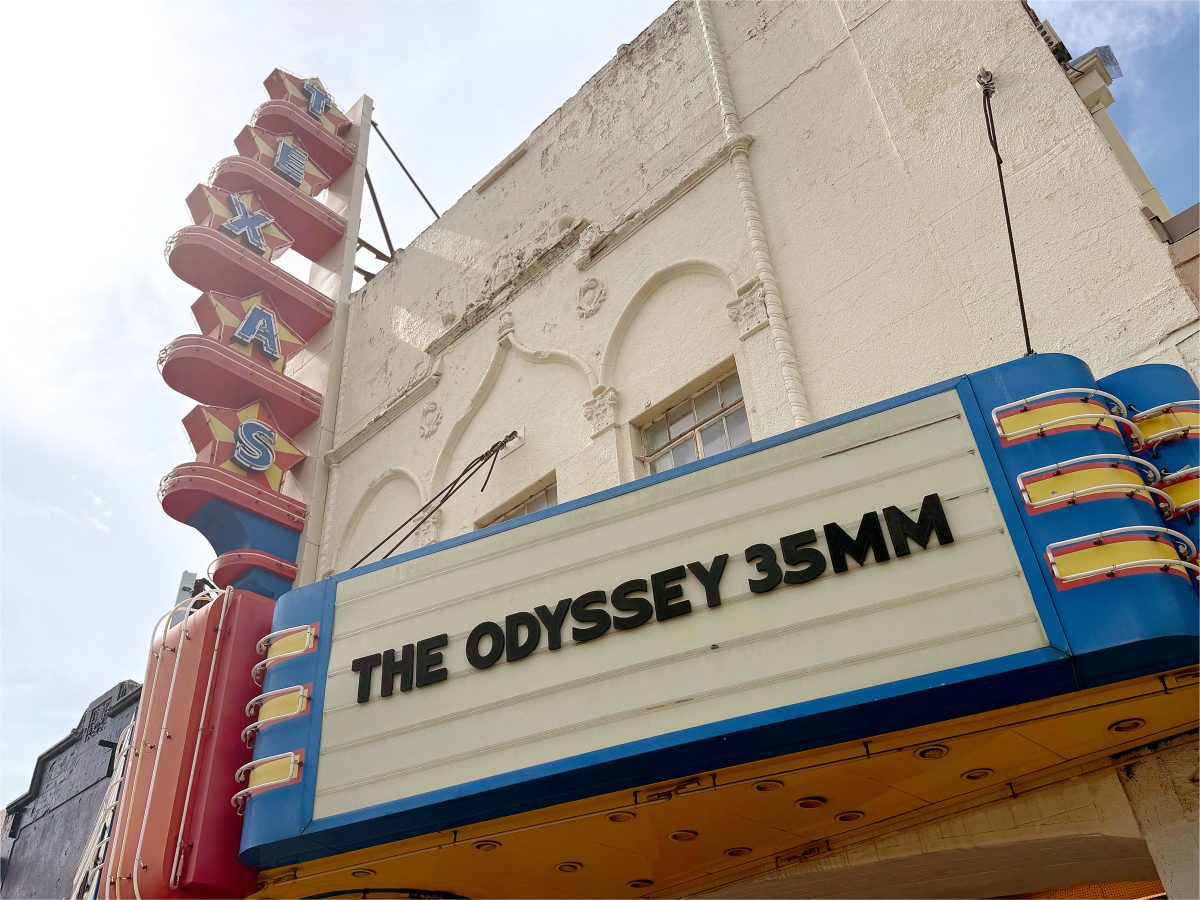
Preston Barta for Dallas Observer

Audio By Carbonatix
There’s a specific kind of hush that falls over a room when light passes through celluloid. Not the polite silence of a streaming queue, not the blue glow of a phone propped against a pillow, but the genuine reverence of watching a beam of light drag 24 frames a second across a screen the size of a small building. Christopher Nolan built his career defending that hush. And with “The Odyssey,” the first narrative feature shot entirely on IMAX film cameras, he’s basically dared the rest of us to feel it too.
The internet, bless it, floated the idea of an iPhone taped to your wall. Cute. But Homer’s hero sailed for 10 years to get home, and you can’t shortcut a masterpiece any more than Odysseus could skip the Cyclops. If you want the real thing, film — actual, physical, whirring film — is the way. And Dallas, remarkably, has it.
Four flavors of the good stuff
Nolan blesses four film formats, and they matter for reasons that are genuinely nerdy and genuinely beautiful.
- IMAX 70mm is the crown jewel. Each frame carries 15 perforations and runs horizontally through the projector, unfurling a 1.43:1 aspect ratio that essentially erases the edges of the screen. Roughly 10 times the resolution of 35mm. This is Nolan’s favorite format, and the rarest.
- IMAX 1.90:1 trades the towering square for a slightly wider window, but still swallows your peripheral vision whole.
- Standard 70mm runs vertically with five perforations at 2.20:1 — bright, deep and gloriously analog.
- 35mm, the classic, uses four perforations at 2.39:1, projecting light through celluloid to create the warm, grainy color your grandparents fell in love with.
The holy grail lives at Cinemark Dallas XD and IMAX on Webb Chapel Rd. — one of only 25 U.S. theaters showing “The Odyssey” in IMAX 70mm. We’ll wish you good luck, because hose tickets have been vaporizing for weeks. Your realistic options are to wait, or to book a screening that starts after the bars close. Devotion has a schedule, apparently.
But here’s the reassuring part: Dallas didn’t leave the rest of us out in the cold. Standard 70mm and 35mm are the next-best miracle, and two of our most beloved houses have thrown open their booths to prove it. The Alamo Drafthouse Cedars location is running 35mm too, and a few other area spots are also showing the film on 70mm — AMC The Parks at Arlington 18, AMC NorthPark 15 in Dallas and Cinemark West Plano 20 among them — so options are out there if you’re willing to hunt.
The Angelika: two projectors, one glorious flex
At the Angelika Film Center in Mockingbird Station, something happened this week that hasn’t happened here since roughly 2012: two working film projectors, running side by side, 35mm and 70mm. When the chance to grab a 70mm projector materialized, the Angelika expedited everything and muscled the machinery in to make the opening weekend for “The Odyssey.” It’s now fully operational in Theater 6, the roughly 300-seat house that ranks among the biggest on the property.
Events and marketing manager Adam Conway walked us through it, and the poetry of the moment isn’t lost on anyone: the very first digital promo the Angelika ever played, back when it went digital, was for the Matt Damon film “Promised Land.” Now Damon returns — as Odysseus, no less — on 70mm film, quietly making the case that celluloid was the right call all along. The circle closes. Homer would approve.
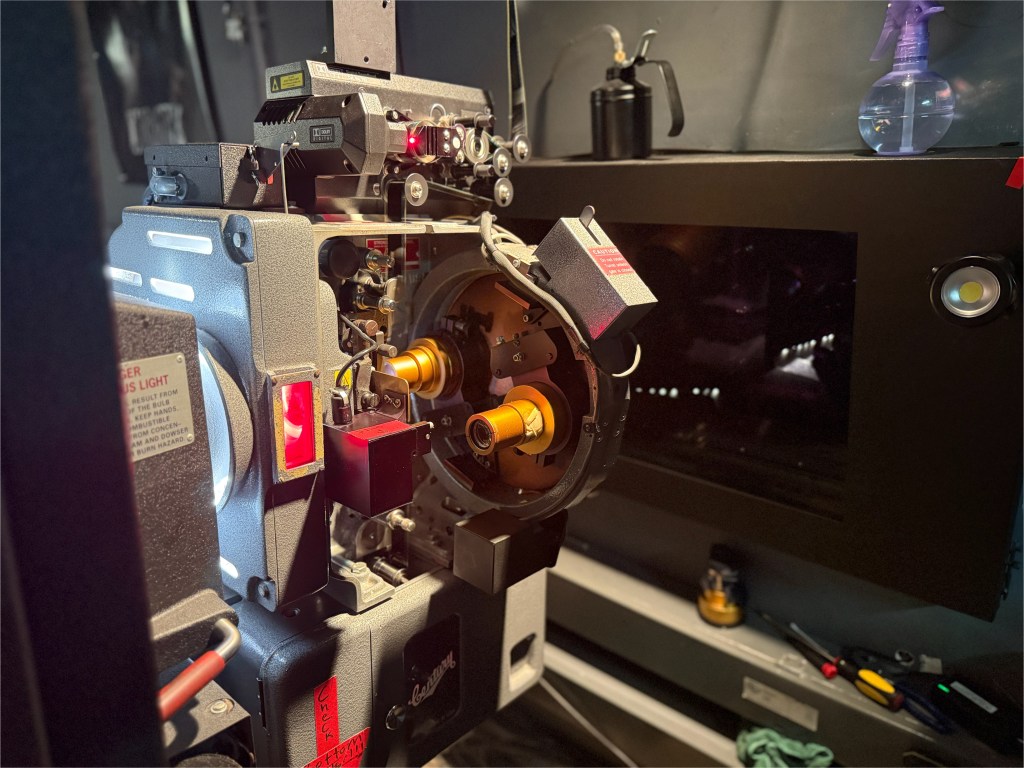
Preston Barta for Dallas Observer
Step into the booth and the first thing that hits you is the noise. It’s loud in there — the beautiful, mechanical roar of a machine doing honest work. Conversation becomes a shouting match, which is why the good quotes happen out in the hall. But the sight is the reward. Watch the film climb from the platter toward the ceiling, thread down into the projector, catch the light and throw those images onto the screen before returning home to the reel. Meanwhile, a disc plays the sound separately, because the old magnetic tracks simply aren’t made anymore. Keeping picture and sound in perfect lockstep takes meticulous timing.
The room itself is a shrine, with movie posters papering the walls, each one a small reminder of why being a film nerd is a joy rather than an affliction. And keeping the beast alive in a Texas summer is a full production. A cooling box holds the projector at a steady 23 degrees Celsius. A booster fan pulls hot air out, with a fail-safe that refuses to let the lamp glow green if airflow drops. Dust-collecting rollers get washed between showtimes and swapped every other show. Overnight, the print rests on the platter under a protective sheet, as if tucking something precious in.
And unlike 35mm, 70mm allows no automated cues. A projectionist must manually work the lights, open the dowser and ride the sound, then babysit the machine for the film’s nearly three-hour runtime. That’s not a job; it’s a vigil.
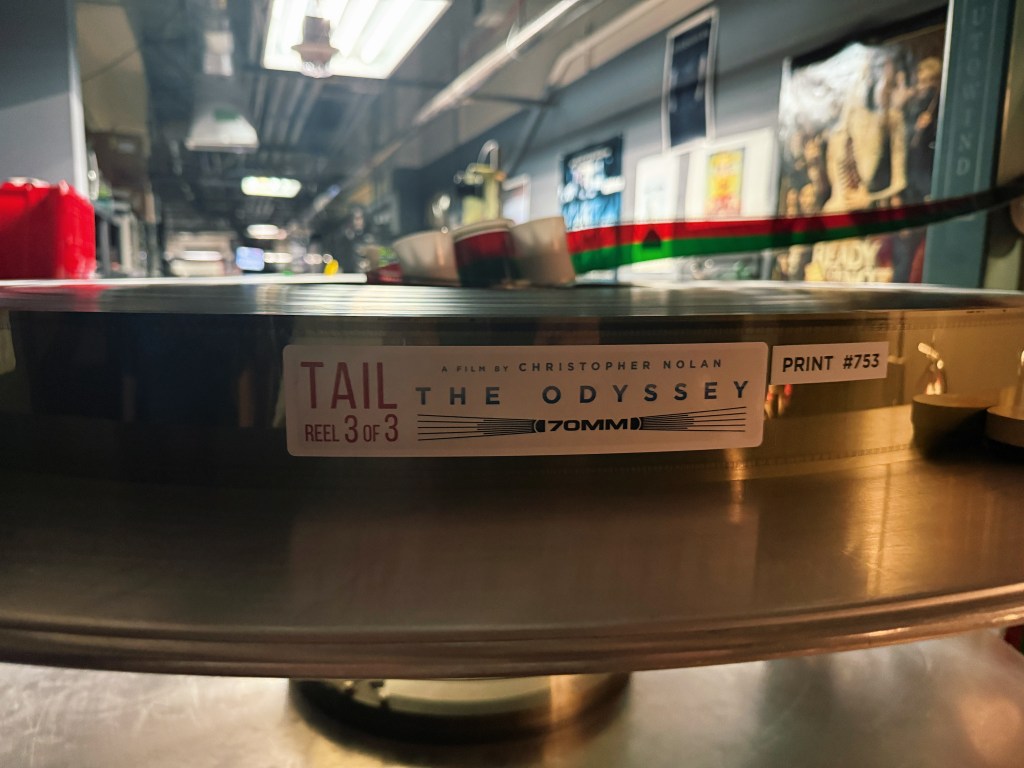
Preston Barta for Dallas Observer
Texas Theatre: the labyrinth in Oak Cliff
Getting to the projection booth at the historic Texas Theatre feels like its own odyssey, a maze of stairs and corridors that culminates at the core of the place. There, we met operator Barak Epstein and projectionist Mike Olpin, keepers of a 35mm setup with a lineage worth bragging about: projectors installed in 2011, a platter system rescued from a Cinemark in 2005 and hot spares from the ’90s sourced from Studio Movie Grill. The 35mm sound is 5.1 digital, encoded right onto the film, so there’s nothing external to sync. The furnace-hot heat from the bulbs gets routed straight to the roof.
Here’s the local detail that should make every North Texan sit up: nearly every “The Odyssey” film print in the country passes through Richardson, Texas. A company called Film-Tech Cinema Systems receives dozens of copies of individual reels — “40 copies of reel one, 40 copies of reel two” — and assembles the nine reels into sequential prints for theaters nationwide. Our backyard is, quietly, the loom where these cinematic tapestries get woven.
Olpin, who cut his teeth at Regal in the early 2000s, is passing the craft forward.
“Yesterday, we were showing one of the trainees here how to do a splice,” he told us. “You need to make a little loop like this to make sure the splice is strong.”
The film arrives in three-reel segments; two splices join them into one continuous ribbon on the platter. The upkeep is a lost art on a slow clock. “Back in the day, that type of service would happen about once a year,” Olpin said of tearing down and lubricating the platter. “Now that it’s seldom used, probably about every five years.”
As for the run itself: “The platter is pretty hands off… I’m probably going to check on it, focus and sound, every 10, 15 minutes or so,” Olpin said.
Go be part of the event
Both the Angelika in Mockingbird Station as well as The Texas Theatre are committed to three-week film runs, success permitting. So, go. Buy the ticket, take the seat and when the lights dim, remember there’s a person in the booth keeping this fragile magic alive for three straight hours. Just like the old days.
If you cross paths with that projectionist, shake their hand. They’ve turned a movie into an event in the way Nolan intended, the way Homer would’ve wanted. The screen will disappear. The hush will fall. And for a few hours, you’ll be genuinely, gloriously home.