
Austin Wood

Audio By Carbonatix
Advertising Can't Do It Alone
The challenges facing local news organizations are very real. That's why reader support matters more than ever. If you believe independent journalism matters, make a contribution today and help us reach our summer fundraising goal of $12,500 by August 9.
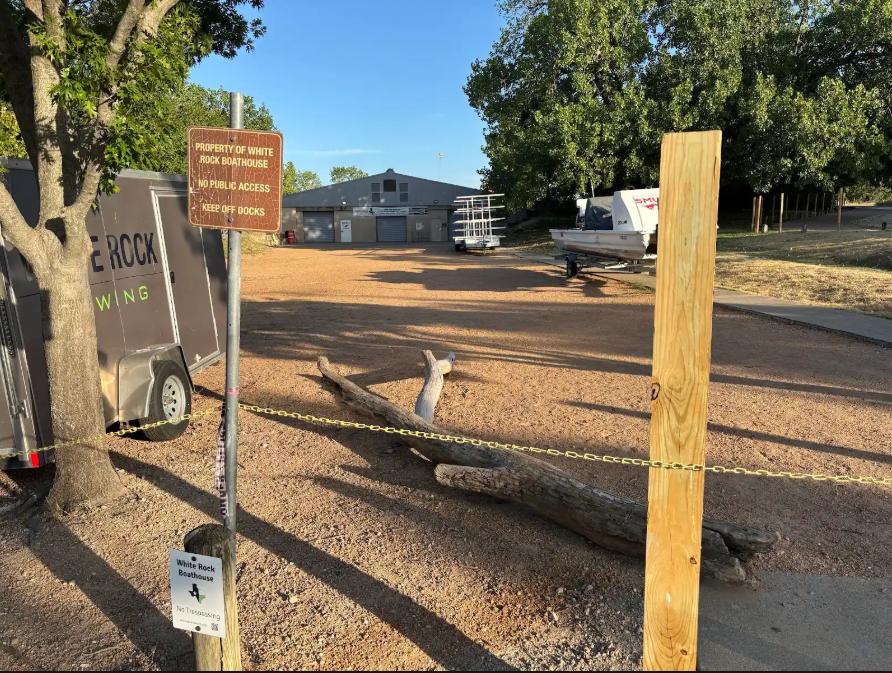
Walking up to the White Rock Boathouse building, signs stating “Property of White Rock Rowing” and “No Trespassing” come into focus. Beside them, wooden fenceposts anchored in concrete create a visible, albeit permeable, perimeter between the adjacent parking lot and the boathouse dock.
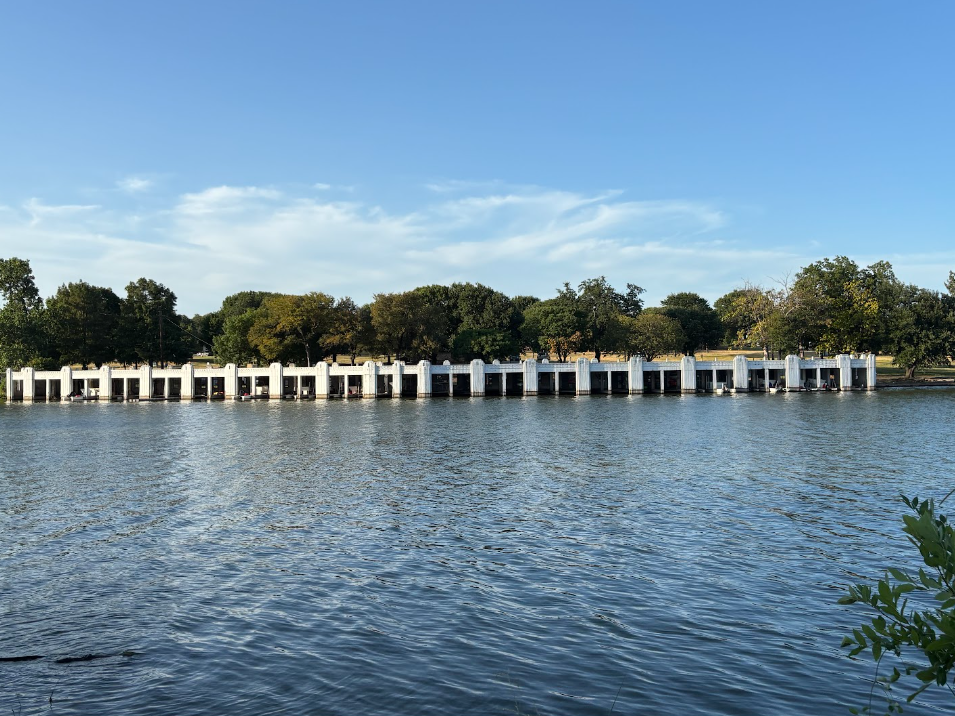
The boathouse, built in 2006, stands on city-owned park property leased to White Rock Boathouse, Inc (WRBI). It’s the site of one of the city’s more enduring disputes over park land — a dispute that has raised questions over accessibility, transparency and the expectations that come with operating a city-owned property.
Concerns have lingered since at least 2018, although in recent years they have boiled over into a public row. Park department officials triggered an audit of the operator in 2019, a park board representative resigned in 2025, and WRBI is currently suing the city over its lease renewal.
For some advocates, the halfway-built fence represents yet another barrier to access at the building. Work started in the spring but was halted in April when the city of Dallas sent a cease-and-desist letter to Sue Ellen Chambers, the president and board chair of White Rock Boathouse, Inc. In the letter, a Dallas Park and Recreation employee states that the operator did not give the city prior notice or obtain permission to begin construction. The fence posts, set a few feet apart, remain standing several months later.
Paula Miltenberger, a founder of the group White Rock Accountability, said the would-be barrier is indicative of a wider issue.
“It’s ridiculous,” Miltenberger said. “What are we doing here? Is this a park? Is this a city park? Is it a public space, or is it a members-only private space? It doesn’t feel welcoming, that people would want to come try, and I think it sends a message. Like, ‘We are a private club.’”
On July 23, Dallas Park and Recreation Director John Jenkins sent a memo to council members reporting that the city sent a breach-of-contract notice to WRBI over its code of conduct earlier in the month. The city alleges that the code of conduct was never approved in its current form by park officials, with the memo specifically citing a section that prohibits residents affiliated with other rowing clubs from renting space at the boathouse, something which WRBI enforced earlier this year to deny access to rowers affiliated with a competing rowing organization. Chambers told the Observer that WRBI’s code of conduct had been approved in 2022, although Jenkins’ letter alleges the code was adopted in 2025.
Public land
Austin Wood
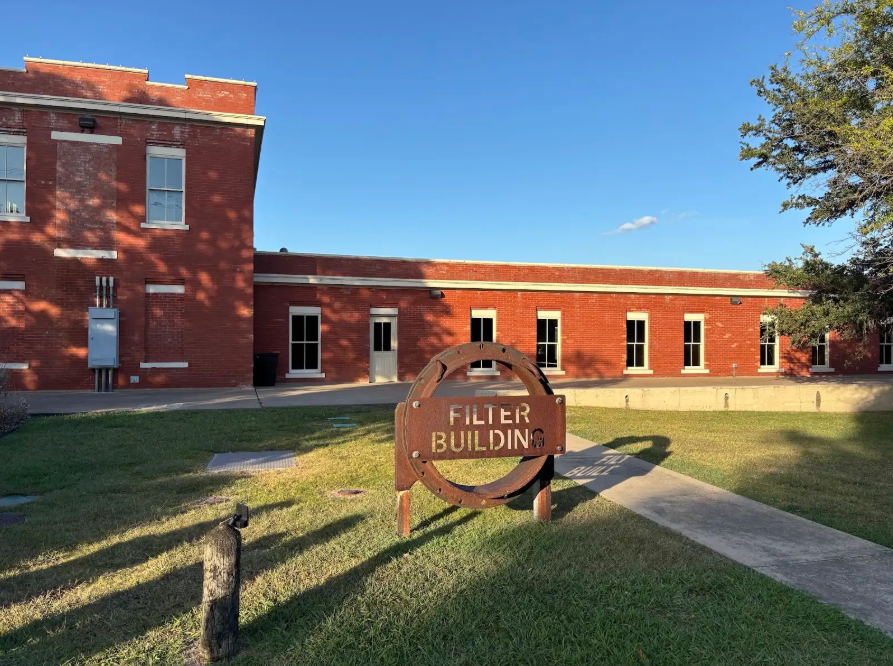
Operating as one, White Rock Boathouse, Inc. and White Rock Rowing lease and operate the 26,500-square-foot boathouse. In addition, WRBI operates the nearby Filter Building and the Boomerang Boathouse, both of which sat neglected for years before their arrival. The operator raised the $2.7 million needed to restore the two buildings and construct the boathouse. Since 2017, WRBI has spent $740,358 on repairs for the structures, according to WRBI.
“I would say we’ve been an amazing steward of public land, considering what we’ve done to what was just a crumbling down, dangerous section of the lake,” Chambers said.
Along with renting storage space to teams from Jesuit Dallas, Ursuline and SMU, White Rock Rowing organizes competitive youth teams for middle and high school students. There are also spots for adults and disabled rowers, but most of its mission focuses on youth programs, including summer sessions and introductory classes.
Chambers said the push for a fence came from repeated safety issues and loitering on the premises. She added that the organization never notified the city because they did not consider the fence a material change to the property, and stopped work immediately after receiving the cease-and-desist.
The organization is being singled out, she said, adding that she knows why. It’s part of a seemingly never-ending saga revolving around their management of the “asset,” as she calls it.
“If you were to stack up all the accusations against us, and then you put all the organizations [at the lake] in a spreadsheet together, you would see how similar we all are,” Chambers said. “We all sort of look the same. So it’s an attempt to single us out, and the only thing that makes any sense at all is the actual asset itself.
‘We got a big problem’
Austin Wood
As with several notable public-private partnership controversies overseen by the park department in recent years, all roads lead back to the contract at White Rock Lake.
In return for the nonprofit’s investments, the city granted the two contracts for the day-to-day management of the facilities in 2006. The first contract grants WRBI management rights to the Boathouse and the Filter Building, while the second allows the nonprofit to maintain and use the Boomerang for launch boats. WRBI can automatically renew the former for two 10-year renewal periods after the original 20-year term expires, while the latter requires approval from the park director for renewal. In addition to rent from the boathouse and Boomerang, the agreement allows White Rock Rowing to collect event revenue from the Filter Building to fund programming and maintenance, with the city receiving 10% of the proceeds.
Both contracts were up for renewal this year, which would have ostensibly allowed WRBI to remain the operator through at least 2026.
However, the city is arguing that WRBI improperly renewed the Boomerang lease. In response, the nonprofit has filed a lawsuit against Dallas to keep the contracts in place through 2036. A judge has denied the city’s motion for dismissal, according to prior reporting by The Dallas Morning News.
The city of Dallas did not return a request for comment.
In a text, Chambers called the breach-of-contract notice and issues with renewal “baseless.”
“Our code of conduct is consistent with the standard codes of conduct found at many rowing clubs across the country,” Chambers said. “Our attorneys are preparing a formal response to the Park’s notice of default and we are confident that the court will find the City’s position baseless, as it’s done so far in the pending lawsuit.”
Rudy Karimi, a member of the Dallas Park and Recreation Board, said WRBI has failed to be a good partner to the city.
“Here’s my biggest problem with all of this: our best partnerships, both sides need to see it as a privilege instead of an entitlement,” Karimi said. “The moment one side of a partnership sees it as an entitlement, we have a problem. We got a big problem.”
Members of the park board have previously raised concerns about the contract’s financial transparency and its automatic renewals. In 2022, an addendum to the contract was approved to add required yearly audits and minimum scholarship funding. The changes largely came in response to a 2019 audit that found the nonprofit had operated the Boomerang under an expired lease from 2013 to 2018 and failed to maintain proper financial records before 2016.
Park department officials also did not verify the revenue reports prior to 2019, according to the audit, and the city did not receive 10% of the revenue from “extras” (security reimbursements or rented items for events) at the Filter Building from 2015 to 2017, which would have totaled $24,633. Chambers said the total was found to be closer to $4,700 after consulting the city’s accountant, and that WRBI later paid the outstanding balance.
The park department has been asked by City Manager Kimberly Bizor Tolbert to cut 15% of its budget as the city faces a $51 million budget shortfall. Department officials have been vocal in their desire to maximize public-private partnerships like WRBI’s to maximize revenue.
Chambers said the pre-2016 financial records were lost after a computer failure and admitted, “we should have tightened that up sooner.” The nonprofit has hired an accounting firm to conduct its yearly audits, and she said WRBI has largely been compliant in that regard since 2022. She added that the expired lease had been the result of an oversight by the park department, and that WRBI paid rent during the lapse.
Karimi, on the other hand, said issues remain and called the 10% Filter Building return to the city “terrible” compared to other partnerships.
“I don’t think they’ve been transparent, unfortunately,” he said. “They’re supposed to give 10% back from their gross revenues. We don’t know what the gross revenues are because some of the documents that our department has seen have been redacted, heavily redacted, and so how do we know we’re getting 10% of a fair shake?”
In 2025, officials asked WRBI to submit meeting minutes from the past four years as public scrutiny on the contract continued to swell. WRBI submitted heavily redacted documents, which Chambers said were necessary to protect personnel information, and city officials consented. The nonprofit also submitted a corrected audit months late in 2025, according to an open records request obtained by White Rock Accountability.
Calls for accountability
Miltenberger started White Rock Lake Accountability around the time the cease-and-desist letter was sent. Two of her sons have trained on the lake, with one having rowed out of the boathouse with Jesuit Dallas’ crew team. The other trained with Dallas United Crew, a competing rowing organization that notably operates out of a temporary structure on the other side of the lake. Miltenberger is also the immediate past president of DUC, which formerly rowed out of the boathouse as Highland Park Rowing until being forced to leave in 2012.
She said the boathouse has failed in its mission to provide access for residents, expand participation from underrepresented communities and grow the sport at the lake. It’s been a recurring pattern largely ignored by the city thus far, Miltenberger said.
“The city’s response now has been, ‘Oh, unequivocally, we’re not going to tell the operator what to do,’” she said. “But if you look at their contract, it says all of these things need to be approved by the park board director. But there’s no response. It’s always ‘We’ll look into it,” and it goes kind of nowhere.”
To date, White Rock Accountability’s website has been used to send over 250 letters to District 9 council member Paula Blackmon, she said. Blackmon’s office declined an interview request and directed the Observer to Jenkins’ July 24 letter.
Miltenberger said the campaign is the culmination of years of recurring issues, lack of accountability from the city and stubborn management at the facility.
Chambers, on the other hand, describes White Rock Accountability as part of a “takeover attempt” by disgruntled former rowers associated with competing rowing organizations.
“It’s to get the asset, it’s to get the boathouse,” she said. “I mean, it’s just it’s that simple.”
Miltenberger disputed that characterization, and said it was a tactic meant to draw focus away from recurring problems.
“This ‘It’s about one organization trying to take over another in their boathouse,’ has deflected from all the records,” she said. “And we’re just not going to engage in that anymore because it’s not about that.”
Access and control
Austin Wood
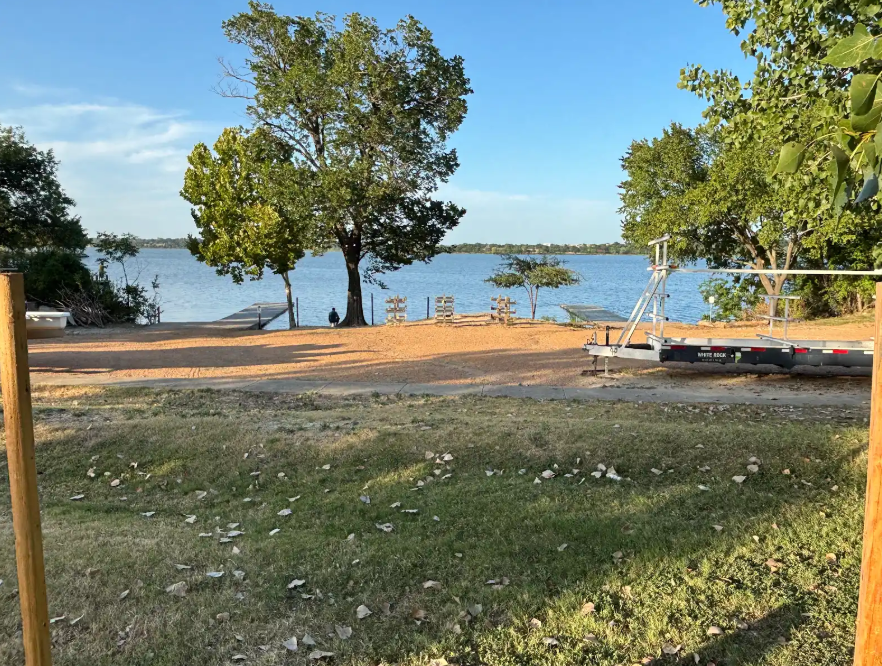
When asked about concerns over accessibility on public property, Chambers said that while it may not operate as an open-to-all park space, the facility is largely open to the public to join as a member, as is the case for similar operators around the lake.
“Accessibility is a slippery slope because it is accessible, but there are fees attached to that because it’s not free,” Chambers said. “It’s just like anything down there. Dallas United, Corinthian Sailing Club, White Rock Boat Club. Everybody’s a private club down there. You can’t just walk in the building and go, “I’m going to take a boat out, you know.”
“But anybody can join it too,” she added. “The public is welcome to join it.”
With the boathouse sitting on public park land, accessibility is a natural sticking point for community members. Members of the public cannot enter the Boathouse without authorization or rent equipment, although they can join as members and lease storage space. Once a member, residents can use boathouse training facilities and check out boats for personal use.
White Rock Accountability’s website features supporting documentation, including WRBI’s original 2006 contract, an email denying a resident access to the boathouse, audits, and the city’s cease-and-desist letter on the fence. One email appears to show a resident being denied access to the facility because of his affiliation with another rowing club, which violates the section of WRBI’s code of conduct referenced in the city’s breach notice.
Chambers said the denial was necessary to ensure the integrity of White Rock Rowing.
“You don’t open your door to your top competitor to come in and join your programs, meet your kids, meet your families,” she said. “It’s not a normal thing to do that.”
Reports of residents being denied access to the building have circulated previously, including an incident in 2018 in which more than a dozen adult rowers had their memberships revoked following infighting, according to prior reporting by White Rock Weekly.
“When I retired from the board, the people that were left turned it into a closed club,” Chip Northrup, one of WRBI’s founders, told White Rock Weekly in 2019.
Tamber Johnson, one of those rowers, is now part of the White Rock Accountability campaign, although her concerns predated her departure. She said that while WRBI is collecting large amounts of rent from private schools and event rentals at the Filter Building, it has strayed from its original mission. WRBI collected over a million dollars from programming, regatta and Filter Building revenue in 2025, according to the organization’s year-end financial report, which also shows expenses closely behind total revenue.
“What they are not doing is what they said they would originally do, which is support community youth rowing, get into an outreach program,” Johnson said. “Get into those underserved communities. Bring this asset to the benefit of everybody across the city.”
She said most of the recurring issues go back to WRBI’s board, who she said treat it “primarily as a real estate concern.” Under the organization’s bylaws, board members are self-appointed and have loose term limits. The six-member group controlling the facilities has an average tenure of more than nine years on the board, according to White Rock Accountability.
“The question is, does the city of Dallas have the tenacity to do the right thing and restore this to the public good?” Johnson said.
Chambers, who has served as president for 15 years, said that a consultant was hired in 2018, roughly corresponding with the time the dispute arose. Based on the consultant’s recommendations, board members are now limited to a three-year initial term and two three-year reappointments after WBRI amended its bylaws. The original terms took effect beginning with the adoption of the new bylaws, meaning board members could have roughly nine years to serve on top of their prior tenure. She added that she was not “present” during the dispute with the masters, but said it arose from members asking for board reform and elections.
“I think there’s things they could have done better, and we could have done better,” she said. “It’s created such a ruckus. I think it’s kind of a toxic environment for the city now. We all have a reputation now of rowing clubs are very difficult to deal with. The city doesn’t particularly like us, and the more this goes on, the worse we make it for the sport.”
‘In White Rock Rowing’s court’
Maria Hasbany has been one of the more visible figures in the dispute. She served as the park board representative for District 9 from 2019, roughly corresponding to when the city triggered an audit after concerns were raised by community members, to 2025, when she resigned following a public break with Blackmon, the area’s city council member.
“My council person was clearly on the side of this group of people that were hell-bent on getting this operator removed,” she said. “I had never had any whisper or any personal experience with them other than as an excellent partner and an excellent operator who was super cooperative.”
The audit represented another attack from disgruntled rowers, Hasbany said, who added that the continued issues appear to be driven by the fact that “Dallas United crew doesn’t like operating out of a tent” and would like to operate out of the boathouse.
“It was specifically driven by a group of individuals,” Hasbany said. “For an operator to be audited is pretty unusual, especially an operator that’s kind of like that small.”
Hasbany also said she believes the city will lose the lawsuit and added that the “city cannot compel that operator to change” its organizational structure under the contract. “It is not up to the city to dictate how you’re going to do that,” she said.
Her replacement on the board, Michael Jung, also has a long-running connection to the lake as a member of the White Rock Lake Taskforce. While he said that, to his knowledge, most of the financial concerns have been addressed, he believes broader issues remain unresolved.
“I think they view it like a tenant views his apartment lease, that the landlord has some limited rights to come in and inspect, but that it’s their private domain,” Jung said.
Jung said that WRBI has not participated in coalition meetings of various organizations operating at White Rock Lake, despite numerous overtures, but that he has not directly reached out to Chambers or other board members. He added that the Boomerang Boathouse has been neglected under WRBI. Chambers said that, due to the structure’s open-air layout, flooding makes it an “impossible building to keep clean” despite regular maintenance.
The “other parties,” as Jung puts it, are still willing to work with WRBI, he said, adding that he approved of the city proceeding with the lawsuit and breach notice.
“The ball, right now, on exclusivity is in White Rock Boathouse’s court,” he said. “They’re coming up in about 10 days or so on their response to the notice of default, and it’ll depend on what they do. They may say our code of conduct is none of your business. They may say you’re right. We’ll change it and get it approved this time. So that’s kind of a fork in the road.”
Line in the sand
According to Jenkins’s letter, WRBI has 30 days to remove the code of conduct from its website and resubmit an updated document. If not, the organization’s contract with the city allows the park department to default the agreement with WRBI.
The breach notice represents the latest and perhaps most significant line drawn in the sand by the city thus far. WRBI’s lawsuit is continuing, and the nonprofit has not yet released plans to amend the code of conduct.
Miltenberger said she will continue to press for accountability at White Rock Boathouse until the facility operates for the public good, as she put it.
“It’s time to ask these hard questions because every nonprofit should be working together to make the community better,” she said. “Having a city partnership is a privilege.”
The Park and Recreation Board will meet next on Aug. 6, one day before WRBI’s deadline to cure issues raised in the breach-of-contract notice. Chambers acknowledged WRBI has not operated flawlessly with its past bookkeeping, but said the nonprofit has otherwise been a compliant, willing partner to the city of Dallas for the last 18 years.
“It’s hard to make friends with people who hate you, no matter what you do, no matter what you provide for them in terms of information or data, or open your books,” Chambers said. “It doesn’t matter.”