
Emma Ruby

Audio By Carbonatix
Facing hundreds of millions in additional costs, Dallas City Council members voted Wednesday afternoon against returning the Kay Bailey Hutchison Convention Center to its original height.
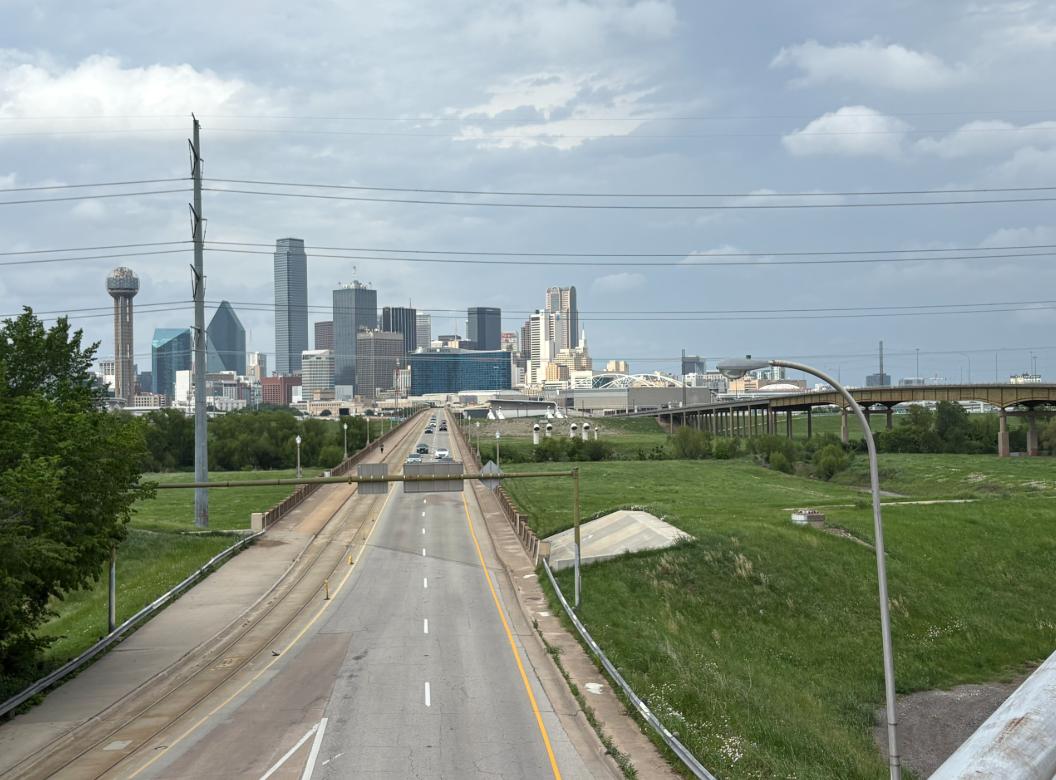
The council voted 9 to 6 to deny the transportation committee’s recommendation to move the $3.2 billion convention center to raise its design. As a result, connections north of the Trinity River from the two bridges will have to be rerouted, despite months of community activists pushing to keep the routes into downtown intact.
After nearly three hours in executive session, southern Dallas council member Lorie Blair introduced a motion to deny the transportation committee’s original recommendation to restore the convention center to its originally designed height. Staff was asked to identify $500 million in savings in January. The center’s blueprint was lowered by two stories, but it became apparent in early 2026 that a redesign would require rerouting downtown connections off the Jefferson and Houston Street Viaducts.
Delays hover
Oak Cliff residents have largely opposed the plans. At a community meeting in April, many expressed frustration at being asked to lengthen their commutes for a convention center project that is already behind schedule. Those comments were echoed by some residents at the meeting Wednesday.
“Dallas has ignored and abused Oak Cliff for too long,” resident Cynthia Michaels told council members. “Treat us as you do the consultants and developers in North Dallas.”
There were also a decent number of residents, business owners with ties to the convention center and hoteliers who spoke in support of keeping the center at a lowered height. Recent estimates from staff, who have been said by some to be “heavily lobbying” council members against raising the center again, put the total loss from redesigning it at over $1 billion, including over $273 million in lost revenue from delays. Staff presented a figure closer to $600 million in redesign costs when the initial recommendation was made in May, a figure which is included in the updated estimate.
Raising the convention center, according to staff, would result in $1.4 million in monthly losses due to completion delays. Those delays could set the project’s completion date back by more than a year, they estimated.
“I’m simply asking Dallas to deliver on time by continuing negotiations and not ceasing construction at the convention center,” Visit Dallas CEO Craig Davis told the council.
Among major concerns for Oak Cliff residents are potential impacts to travel times. Peak morning rush-hour traffic into downtown was originally expected to be delayed by up to six and a half minutes after construction is completed in 2030, with construction delays extending northbound commutes by up to 10 minutes. Staff told council members that adjustments have been made to reduce those delays, but did not offer specifics on how.
Viaducts aren’t coming down, mostly
Certain council members emphasized that — despite reports to the contrary — the bridges themselves would remain intact indefinitely. The Jefferson Avenue viaduct would have been closed and a section removed for demolition at the convention center regardless of the outcome. Several called out a wave of “misinformation” and emphasized that the city was not “cutting off southern Dallas from downtown,” a concern voiced by many on the southern side of the Trinity.
“At a time when downtown is struggling, we shouldn’t be cutting off access. We should be bringing it to Oak Cliff,” Chad West, a council member from Oak Cliff, said. “While I understand and share the concerns that some of my colleagues have about delays to the convention center, if we rush this and get this wrong, we’re making a decision that cannot be undone and will impact Oak Cliff for decades.”
West asked for clarity on when the decision to reconfigure the connections off the viaducts was made, as most of the council became aware of the issue earlier this year. Convention and Event Services Director Rosa Flemming pointed to a 2024 council decision to support a redesign of the convention center, despite schematics presented in 2025 showing that Jefferson Avenue would still run through the rebuilt center along its current path.
When asked by West whether the council should have expected the connections to be reconfigured based on information provided in 2024, Department of Transportation and Public Works Director Gus Khankarli said any changes will eventually require council approval via a thoroughfare amendment.
‘Hasn’t been ideal’
The recurring issue of the day seemed not to be the height of the convention center, which appeared to be a foregone conclusion by the time the council returned to the horseshoe shortly before 3 p.m, but concerns over how the city has approached the issue. While there was still division over the actual result, several agreed that the proposed reconfiguration to the viaducts had been poorly communicated and handled by the city.
“I’m also sensitive to my colleagues’ concerns about a process that, from this perspective, hasn’t been ideal,” Mayor Pro Tem Jaime Resendez, one of the nine council members who voted against the proposal, said. “However, I’m not convinced that responding to those shortcomings with a vote that would ultimately cause greater harm is the wisest world action.”
While addressing concerns of major disruptions, Assistant City Manager Robin Bentley acknowledged that the process had been far from ideal.
“We’re not closing anything, we’re not demolishing anything,” Bentley told council members. “There is no closure, we’re just rerouting traffic on a detour ramp, which will still provide the same access into downtown and the same access out of downtown, and I don’t think we’ve done a fabulous job as a staff of explaining that.”
After the initial vote to deny the recommendation, Deputy Mayor Pro Tem Maxie Johnson made a motion to direct the city manager to engage with a consultant to improve plans for the reconfigured connections coming off the viaducts. Community engagement will be a part of the process, City Manager Kimberly Bizor Tolbert said before the council approved the motion.
“We’ve got to start huddling up and rolling these things out in a way that the public understands it,” Zarin Gracey, District 3 council member, said. “It doesn’t feel nefarious; there’s no room for any accusations, and everyone feels like they were included in that. So that’s the fault here. It’s not the solutions; the solutions are coming. It’s how it was rolled out.”