Austin Wood

Audio By Carbonatix
One member city will leave DART in the wake of Saturday’s withdrawal elections. Officials in the two cities where exit votes failed are wondering what comes next.
By the end of January, referendums on DART agreements had been called in six of its 13 member cities. Irving, Plano and Farmers Branch struck compromises with DART on funding and governance to call off their elections. Now, only Highland Park will leave the agency after voters in University Park and Addison rejected withdrawals.
According to unofficial results from the Dallas County Elections Department, almost 70% of Highland Park residents voted to leave DART. Results were closer in University Park, where 53.6% of voters opposed withdrawal. In Addison, over 70% of voters chose to remain.
The votes represent the conclusion of months of negotiations, council votes and debates concerning the future of transit in North Texas. Highland Park, along with Farmers Branch, was the first member city to call an exit vote in November. Suburban officials have long raised concerns about the one-cent-on-the-dollar sales tax contribution each city makes to DART, as well as what some have viewed as a lopsided governance structure that gives too much power to individual members.
DART service in Highland Park will cease on May 14, the day after its town council is set to certify election results. It now joins Coppell and Flower Mound as the three DART member cities to leave the agency since its inception in 1983.
A Look Forward, From the Brink
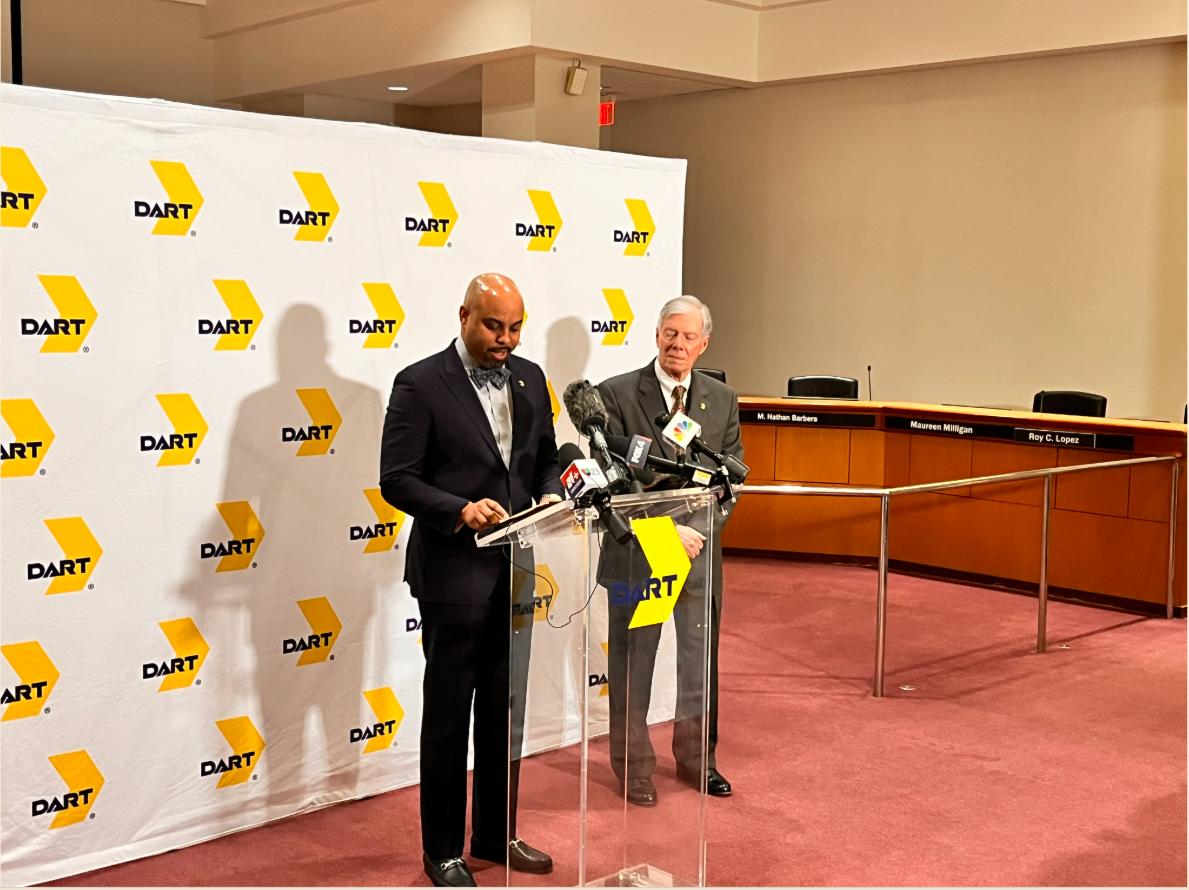
Speaking at a press conference Monday morning, DART Board Chair Randall Bryant said that while the agency “respects all decisions” made by voters, he was focused on the agency’s next steps.
“Today is not about the last six months, nor is it about this past Saturday,” he said. “Today is about what comes next, because the most important thing for us right now is not who stayed or who left. It’s the future we’re building together across North Texas and the people that are counting on us to deliver.”
Bryant outlined the agency’s priorities for the upcoming legislative session, which include finding new funding opportunities — among them the potential collection of vehicle registration fees — and action to reconfigure the composition of the DART board, which can only be done by lawmakers in Austin under state law. The reconfiguration of the board has been a major point of contention for certain member cities. In February, a resolution calling for an alternative “one city, one vote” structure was approved by the board after Dallas City Council members voted to support giving up the city’s simple majority.
The proposed reconfiguration, as well as the current makeup, will have to be reevaluated with Highland Park’s exit, Bryant said.
He also said the agency will consider expansion — something DART has failed to pursue in the past three years — as part of its post-election plans. He specifically cited McKinney and southern Dallas County cities as areas he has on his radar.
“Mesquite, Lancaster, DeSoto, Duncanville and Cedar Hill — that’s where DART’s future lies,” Bryant said. “Let me be clear: DART is strong, DART is resilient, and DART is moving forward. We are moving forward together with our member cities, our riders and our stakeholders.”
Highland Park Halts
With a population of 8,762 in the 2024 U.S. Census Bureau survey, Highland Park was the second-smallest member city in DART. The town is currently served by a single bus route, which will continue through its limits without stopping beginning May 14.
Bryant said the agency doesn’t have data on how many riders will be impacted by Highland Park’s withdrawal.
The town contributed roughly $9 million to DART in 2025, which officials have said far outweighs the value of the agency’s services. Over the next twenty years, Highland Park’s exit could result in a loss of $270 million in sales tax revenue, according to agency projections.
Highland Park Mayor Will C. Beecherl did not return requests for comment on this story. In a Dallas Morning News opinion piece from March, he wrote that “Rest assured, if the voters choose to exit DART, they can take solace in knowing that Highland Park has played a meaningful role in building a regional transit system by ultimately contributing approximately $150 million over the last 40-plus years.”
David Leininger, DART’s interim CEO and president, said Monday that the agency will connect with Highland Park officials to discuss the transition from service following May 14. Highland Park council members recently approved an agreement with Via to provide paratransit and microtransit services.
Addison and University Park
University Park’s council also recently approved an agreement with Via to provide paratransit services after May 13. City Manager Robbie Corder told the Observer that staff will likely recommend canceling the contract in light of voters’ decision to remain a DART member. If the city does not move forward with Via, it will be responsible for a $45,100 cancellation fee.
According to results from Dallas County’s election department, the vote in University Park came down to less than 200 people. 1,461 chose to remain, while 1,262 voted to leave.
Corder said he didn’t believe the other Park City’s exit would affect residents’ connectivity. He also said he is interested in seeing how DART plans to reincorporate cities like his.
“I think the question for us is going to be, how is the city received back with DART? And this isn’t the first time,” Corder said. “I think there were some elections in the 90s, for example, those cities came back after their voters decided to stay in DART, and they resumed their membership and full commitment. And I’m kind of hoping that’s what happens here.”
When the Addison Town Council voted to call an election in January, Mayor Bruce Arfsten said he didn’t “understand the rush” to call a vote and has since remained vocal in his support to keep the town in DART.
In an interview, he said he was surprised by the strong turnout (over 2,000 people voted), but had expected the result due to conversations he’d had in the run-up to the election.
“It’s a loud and clear message that they want to be part of this regional mobility solution and be part of regional connectivity,” Arfsten said. “Addison used to be in the north. We’re very central now.”
Addison had also approved an agreement with Via for a microtransit service, Addison Orbit. Arfsten said the town will reevaluate the service in late May and could keep it as a complement to DART service, something which he expressed support for.
He conceded that “historically, Dart has probably not stepped up the way they should have” and said that he is more interested in concrete actions going forward than what he hears from the agency.
“I really think that the leadership now at DART is listening,” he said. “I think Chair Randall Bryant is the right leader at this time to be there to guide them.”
Listening will be key, he said, to avoiding another round of exit elections in the future, which can only be called every six years under state law.
“I don’t think DART wants to go through this again,” he said. “I think they see what we just went through is avoidable, but it takes real results on their part. If five years down the road from now we don’t see really measurable changes and improvements, I think people will stand up and say, ‘We have to go do this again.’”