
Maria Crane

Audio By Carbonatix
Colin Allred defeated incumbent U.S. Rep. Julie Johnson in a contested runoff election Tuesday night.
Based on Dallas County Elections data, Allred enjoyed a comfortable seven-point victory over Johnson. The former NFL player and three-term congressman appears poised for a return to Washington, D.C. after securing the nomination in a solidly blue, Dallas-anchored district.
The contentious race was largely driven by Republicans’ rare mid-decade redistricting push, which forced Johnson to leave the now-overwhelmingly conservative 32nd Congressional District to run for the District 33 seat. Allred announced his campaign in December after dropping out of the Democratic primary for John Cornyn’s U.S. Senate seat, a move he said was to avoid a runoff in a crowded field that included Texas state Rep. James Talarico and U.S. Rep. Jasmine Crockett.
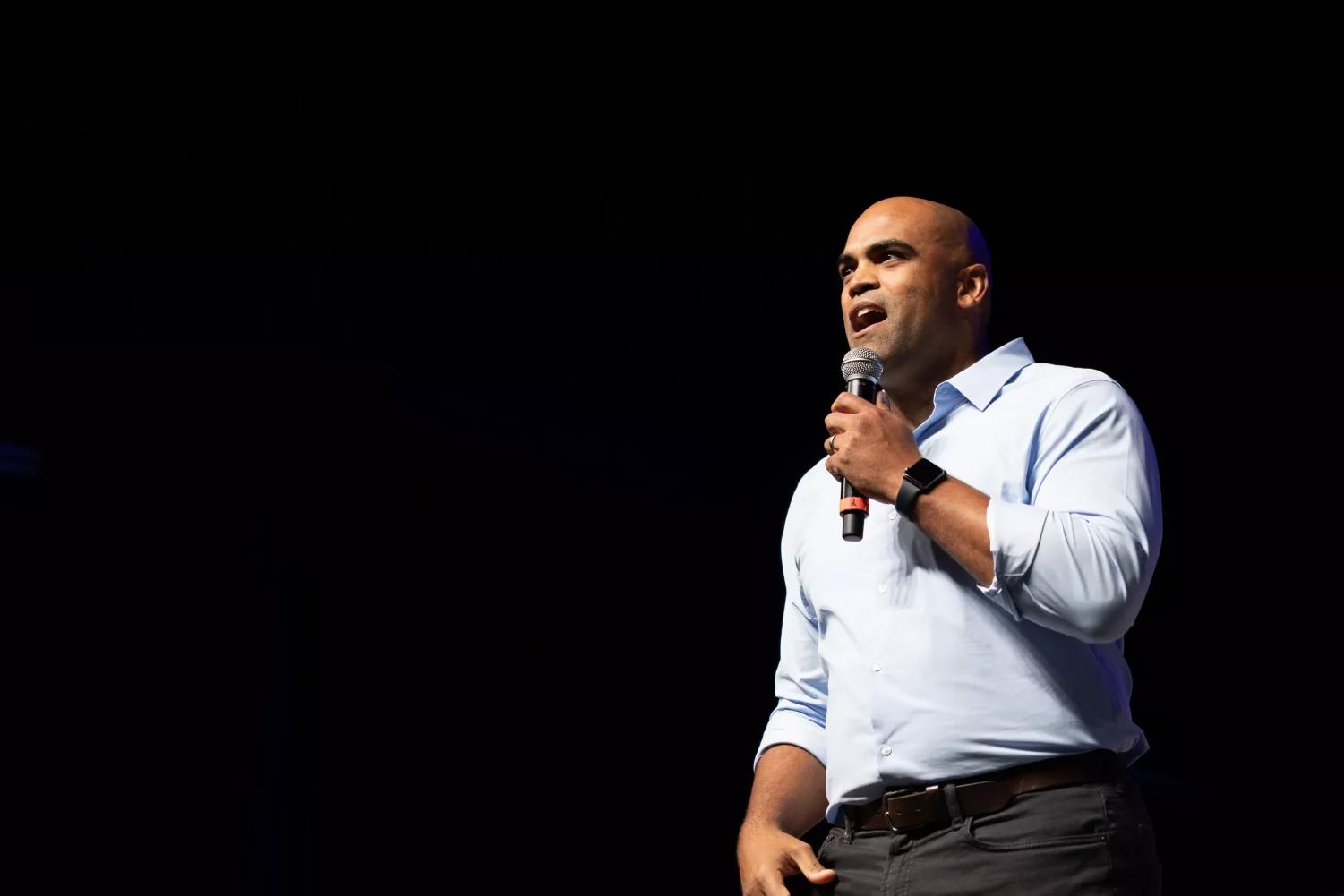
Speaking to supporters Tuesday night, Allred sent a strong message to voters while criticizing the Trump administration’s foreign policy and conservative attacks on diversity.
“Don’t let them get you down,” Allred said. “They want us to believe there’s nothing we can do about this, but when we beat them in November, and we take back the Congress, we’re going to hold them accountable. I want to see butts in seats; I want to see hearings; I want to see investigations; I want to see us hold them accountable. They’ve been breaking the law, and we’re going to make sure folks know about it.”
Allred beat Johnson by 11 points in the March primary, but was forced into a runoff after he failed to win 50% of the vote. He will face Republican nominee Patrick Gillespie in the general election to represent a district that would have favored Kamala Harris by 30 points in 2024, according to prior reporting by the Texas Tribune.
Johnson, who previously served as a Texas state Rep. and replaced Allred when he declared his Senate run against Ted Cruz in 2024, acknowledged she had likely lost Tuesday night while addressing supporters at Times Ten Cellars in Lakewood.
“We had some strong support at the polls, but if it doesn’t turn out our way, I’m going to congratulate Mr. Allred,” Johnson said. “I’m Team Democrat. I want to win in November.”
Allred’s path to victory
The race was marked by disagreements and attacks over each candidate’s positions on several highly visible issues. Immigration came to the forefront as Johnson attacked Allred for crossing the aisle to support Republican anti-immigration measures during his time in office, including his support for the Laken Riley Bill and vote to formally condemn the Biden administration for its border policies. Allred responded by criticizing Johnson for investing in Palantir, a technology company with known ties to federal immigration enforcement.
Allred was also accused of vacillating on immigration issues. The candidate has signaled support for abolishing ICE, something which Johnson’s supporters said contradicted his Congressional voting record.
Cal Jillson, a professor of political science at Southern Methodist University, said Allred adopted more left-leaning positions to appeal to staunchly Democratic primary voters and would likely pivot toward the center with the nomination in hand.
“He felt in this campaign that he had to be more harsh against ICE than he had been in the past. I’m not sure he had to be. He won by 10 points, and he had to be sure that he won. In the Democratic primary — particularly the runoff primary — the electorate is small and ideologically left, just as in the Republican Party, with social conservatives on the far right in that primary.”
Jillson pegged Allred as the more pragmatic candidate who mobilized his supporters and out-fundraised Johnson, and said that he was not surprised by the result.
“I think that Julie Johnson just had a series of too progressive positions to be successful in this state and in this campaign,” Jillson said.
Left-leaning Texas Democrats did raise doubts about Johnson’s credibility as a progressive, pointing to the funding she received from AIPAC and her Palantir shares, which she said netted her $90 and were sold before she entered Congress.
Johnson received support from high-profile Democratic figures, including U.S. Rep. Alexandria Ocasio-Cortez and House Majority Leader Hakeem Jeffries. Allred, on the other hand, was endorsed by prominent local leaders such as Crockett and Dallas County Commissioner John Wiley Price.
Brandon Rottinghaus, a professor of political science at the University of Houston, said the vote indicated a clear rejection of Johnson’s institutional support for local leadership and pointed to a wider pattern at the ballot box.
“A lot of Democrats were in the same boat, a lot of Republicans were in the same boat, too,” Rottinghaus said. “This is a very anti-establishment election, and her ability to navigate that problem was the biggest hurdle that she was going to face.”
What the result means for November
Rottinghaus added that both candidates were relatively close in policy, although he still viewed Allred as the more moderate of the two and said Democrats chose “electability over incumbency.” The muddied ideological picture in the race mirrored a wider pattern in the Democratic party, he said, which is “still trying to find itself and its approach to not just Donald Trump, but also what will be a post-Trump era.”
He also said he thinks the result indicates Democrats could enjoy a November electoral victory similar to 2018, when Democrats regained control of the House. That could be aided, he said, by Talarico’s ability to generate voter enthusiasm and support for down-ballot candidates while campaigning against Texas Attorney General Ken Paxton.
“Democrats are looking for a particular set of circumstances to give them an opportunity to be successful, and we are at that moment where you’ve got an unpopular president in office, you’ve got a sour economy for voters blame on Republicans, you’ve got an unpopular nominee at the top of the ticket and you’ve got a lot of money that’s going to fund the Democrats efforts,” he said. “Those are all circumstances and scenarios that are positive.”
Talarico publicly sided with Johnson and drew criticism for allegedly calling Allred a “mediocre Black man” in February. The Senate nominee said the alleged remarks were a mischaracterization of a private conversation, but Allred denounced the phrasing and said Talarico was “tearing down a Black man” in a video posted to social media.
Rottinghaus said that while Talarico could help Democrats in down-ballot state and House races in Texas, he would need to meaningfully engage voters in Allred’s district to have a chance in November, adding that “unity is the watchword.”
“He still needs that grassroots support from districts like the 33rd to juice up turnout against the top of the ticket,” he said. “I think that the Talarico needs to have success and support from these districts to be effective and to win in November.”
‘Want him to have a backbone’
Like her father, a union leader in West Dallas, Debbie Solis has become a community organizer for her neighborhood, which she said is too often overlooked by elected officials. Solis supported Johnson and said she was disappointed with the result, but plans to vote for Johnson in November.
She said her reasons for supporting Johnson included her stance on expanding healthcare access and visits to West Dallas, where she said Allred failed to show face.
“That’s important, to be acknowledged, because we are not acknowledged many times, and this is why it’s important that when we get people who acknowledge us,” Solis said. “We count, and I want my community to count.”
Solis also said she took issue with Allred’s support of the Laken Riley Act, which was passed in 2024 and mandates the federal detention of undocumented immigrants when charged with a crime.
Her hope is that Allred will keep her community’s priorities in mind during the general election and after November.
“I really want him to have a backbone,” she said. “To make sure that he remembers when he goes up there, it’s about the people that are voiceless, the people that need the support, the people that need to make sure that they feel safe and not being stopped just for the color of their skin.”