
Kelly Dearmore

Audio By Carbonatix
When it comes to experiencing the World Cup in North Texas, one must contend with a number of questions. Which matches should you attend? How much do you spend on tickets? Which pub or brewery or city celebration should you attend to catch your favorite team? Which days should you “work from home” so you do not miss a specific piece of the action?
For some residents and business owners in Arlington and Fair Park, where the bulk of the local World Cup action is taking place, perhaps the biggest question has been “How much should I charge people to park in my driveway?”
But for many thousands of others, the question of simply how to physically get to a World Cup match at AT&T Stadium is not only a tough one, but arguably more than any other decision can decide whether or not a once-in-a-lifetime matchday experience is a successful one or not.
Transportation was at the top of many North Texas minds years ago when AT&T Stadium was announced as the site for a whopping nine World Cup matches, more than any other of the other host cities in 2026. Arlington is one of the largest cities in America without a traditional public transportation system. Parking and traffic for Cowboys games and concerts at AT&T are notoriously headache inducing for throngs that are primarily local.
After Monday’s Argentina vs. Austria, there will still be six more World Cup matches in Arlington, which means there will be many more chances for residents and visitors to consider their transport options. We attended the first two 2026 World Cup matches in Arlington, and we’re here to tell you that getting there is a bit like a Choose Your Own Adventure book.
Remember those? The “Choose Your Own Adventure” series feature multiple storylines and diverging paths that rely on choices the reader makes. Sometimes it ends in triumph, while other times brings about endings that are decidedly less happy.
Take your own vehicle, hop in an Uber, or opt-in to the mass transit system designed especially for the World Cup? Those are, more or less, your adventurous choices for this mission. And, please, make no mistake about it, there’s no perfect, drama-free way of finally snuggling into your stadium seat before kick-off. It’s almost certain that your trip will involve some sort of drama, regardless of how you get there.
Take your own vehicle
Along with the high ticket prices, concerns over the cost and availability of parking near AT&T Stadium has been a hot topic. Prior to the June 14 match, we saw parking available for as low as $50 and and as high as $160 in lots surrounding the stadium, but not official stadium lots. There were reports of some spaces being advertised for more than $200 on that same day.
To be clear, the $50 and $60 options were about a mile away from the stadium, so you’re making yet another trade-off by saving some money, but spending a good bit of energy. It’s also important to remember, paid parking in official AT&T Stadium lots is not available on-site or even on the day of a match, as those limited spaces must be purchased online in advance.
If you leave early enough, maybe a couple hours prior to kickoff, arriving at the World Cup will likely be an easier affair than for the typical Cowboys game or concert, as the crowd’s arrival is staggered throughout the several hours before the start. Sure, things get jammed up as you get within a mile or so of the stadium, but for us, it was much lighter than it had been the last couple of times we had visited the home of the Cowboys – when arriving at least.
If you have attended a Cowboys game or a concert at AT&T Stadium before, then you know the drill when leaving the event. It’s not easy, but thanks to an increased police presence for traffic control, we found our ability to get away from the stadium and onto Interstate 30 a much simpler experience than we anticipated. As always, the space where you are parked, especially if you are close to the stadium, will dictate how thick the exodus is.
Mass Transit Train and Shuttle
Perhaps you’ve seen headlines or social media posts detailing the nightmare that public transit has been in other host cities? Before the tournament started, maybe you discovered that New Jersey and Boston were charging large sums to take public transportation to and from their stadiums? After taking the train and shuttle combo, designed especially for the World Cup, we’re happy to say that it was neither a nightmare nor costly. And for the most part, the whole operation ran rather smoothly.
Kelly Dearmor
But in keeping with our theme, should you choose this multi-step adventure, your gameday experience will look and feel wholly different than taking your own vehicle or hailing a ride-share. In our case, it gave us a completely different ending that we’re not totally sure was worth the trade-off.
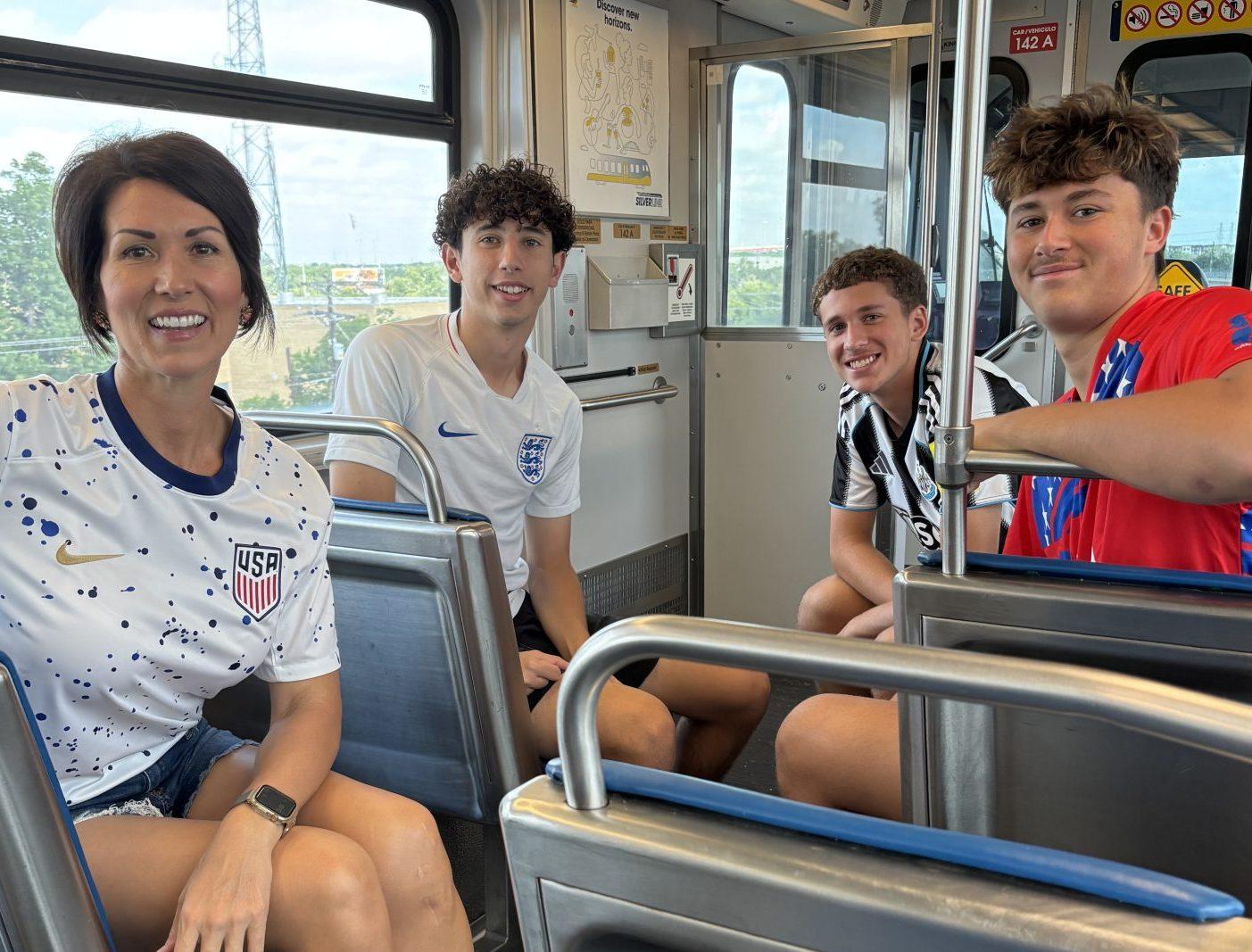
We connected to the Trinity Railway Express (TRE) at Victory Station by coming down the Green Line from Carrollton. Even on the route’s northernmost stops, packs of fans sporting England “kits” were piling on. By the time we hopped off to climb aboard the TRE near American Airlines Center, our train was nearly full, more than three hours before kickoff. Even with the crowd, getting a seat onto the westbound train was simple and we were off without a long wait.
After we hopped off the TRE at DART’s CentrePort/DFW Airport Station, we made not-short-but-not-long walk to a line of dozens of motorcoaches waiting to take match ticket holders the rest of the way. Making the 8-minute walk from the temporary bus depot north of AT&T Stadium, it was difficult to wonder if we had cheated the system somehow. Sure, the one-way trip from Carrollton to the stadium’s doorstep was just under two hours, but it was a hassle-free, wait-free two hours that cost only $9 for a regional day pass.

Kelly Dearmore
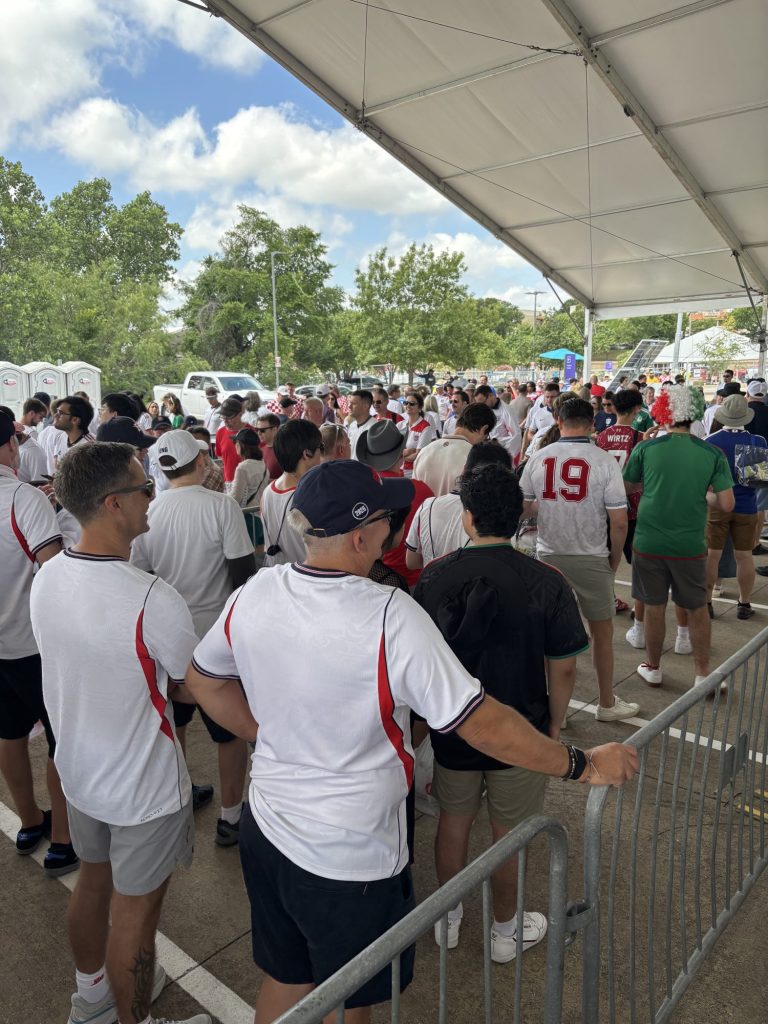
Unsurprisingly, the trip home after the match was completed didn’t go quite as smoothly. To be fair, nothing went wrong, but things were decidedly slower. But after a long day with high heat and humidity and a walk back to the bus from the stadium in that was made significantly longer thanks to the gargantuan maze of iron fencing designed to corral thousands of people, even before there were thousands waiting, it didn’t take much for us to wonder iof the trade off in price and ease of arrival had really been worth it. Because departures were not staggered the way that arrivals had been, the crowds and lines were thicker, which slowed things down to a degree. The 15 to 20 minute wait times for both the TRE headed east and again for the Green Line train headed north from the AAC added exponentially to the trip time. By the time we got to our vehicle in Carrollton, the match had been over for nearly three hours.
We didn’t spend $100 to park and we avoided the frustrations that come with traffic jams and gameday parking, but we’re not sure it was worth five hours of our time, when the back half of that offered its own share of hassle and frustration.
We can say that the entire production was well-coordinated, well-staffed and seemed to run as smoothly as it possibly could. For those who are in from out of town and don’t want to pay surge pricing for an Uber, it really is hard to beat this option, regardless of it possibly adding an hour or two to your World Cup matchday.
Most importantly, in both cases, neither adventure truly became a misadventure for us during the first two matches. Neither driving to the match ourselves nor taking public transportation took away from the main adventure that is the 2026 World Cup in North Texas.