
Preston Barta

Audio By Carbonatix
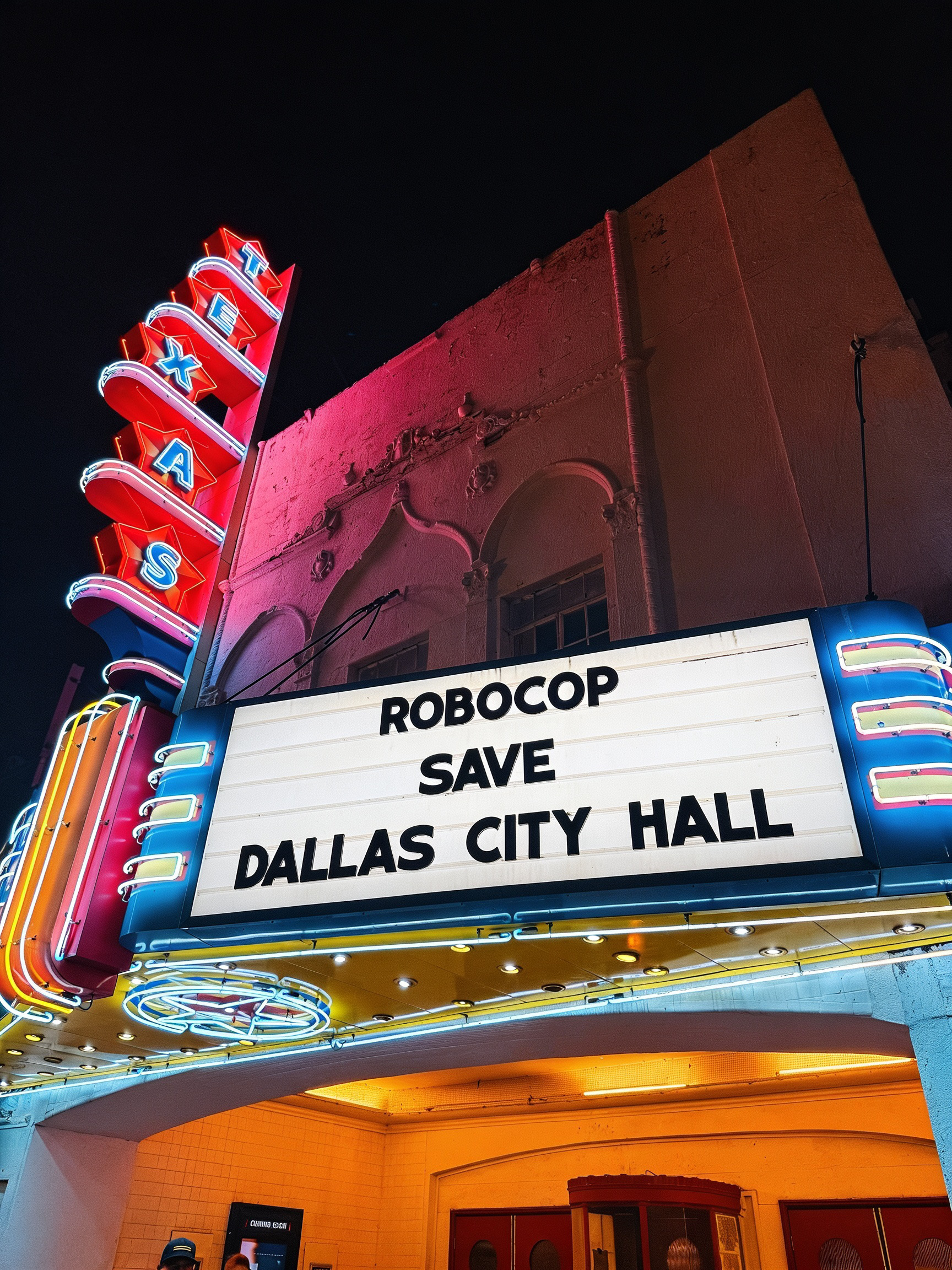
Over the weekend in Oak Cliff, the future of a 48-year-old building got pulled into the present by a cyborg cop. The Texas Theatre hosted a benefit screening of 1987’s “RoboCop” on June 13, and what started as a throwback to the movie and its deep Dallas roots became something much more. The film that put I.M. Pei’s Dallas City Hall on the silver screen as the headquarters of the sinister dystopian megacorporation that serves as the film’s antagonist, OCP, came back to town with a mission: serve the public trust, protect the innocent and maybe save a building.
Two RoboCop cosplayers set the tone in the lobby, posing for photos and showing off near the front of the theater before the lights dimmed. Folks browsed merch tables stacked with Save Dallas City Hall shirts, posters and 3D-printed City Hall models. The mood felt like a reunion and a rally at once.
A building worth fighting for
Before the projector rolled, the organizers made the stakes clear. Sarah Crain, executive director of Preservation Dallas, reminded the crowd that “there’s still hope in this effort to save Dallas City Hall,” and that “this fight is absolutely not over.”
She wasn’t speaking in abstractions. The Save Dallas City Hall Coalition has several pending legal claims, and that work, she said, is about to ramp up. Attendees were nudged toward a QR code to fund the coalition’s educational, advocacy and legal efforts, and another to contact their city council member. The ask was direct: sign up to speak at the next council meeting, because this could be the last time council considers residential feedback before deciding the building’s fate.
“What is behind you when you speak are the people of Dallas,” Crain said to the room.
Filmmaker and Dallas VideoFest founder Bart Weiss, who helped organize the night, captured the emotional shift in the air.
“We have been living through this for so long with a sense of dread, anger, anxiety by ourselves,” he said. “Now we are together as one.”
The official program featured an introduction by Reid Robinson, who does behind-the-scenes work for Save Dallas City Hall, framing the movie as more than a camp classic. Weiss echoed the point: the film warns “how technology can be misused by evil people,” and asked whether that might still be relevant today.
“A Vision for Dallas”
A short archival mini-doc, “A Vision for Dallas,” shared the building’s origin story. After President John F. Kennedy’s assassination in 1963, Dallas was looking to rewrite its reputation. Mayor J. Erik Jonsson “wanted the greatest city hall in the world,” and he hired an internationally renowned architect to deliver it. Pei’s response wasn’t a generic tower.
“This is not an office building,” the documentary said. “This is a custom-made building for the operation of the city of Dallas.”
The film placed City Hall alongside Pei’s other masterworks, like the East Building of the National Gallery of Art and the Louvre Pyramid, and recalled that New York Times critic Ada Louise Huxtable called it “one of the most important public buildings in the country.”
Opened in 1978, the concrete landmark was built to last a century. Today, city leaders are weighing relocation and redevelopment against hundreds of millions of dollars in restoration costs.

Preston Barta
Quiet in the theatre, loud at City Hall
Then came the film itself. And every time City Hall appeared as OCP’s looming corporate fortress, the crowd erupted, filling the room with a tangible sense of city pride. There’s something poetic about a roomful of Dallasites cheering for a building their own city might tear down. The dystopian backdrop of 1987 had become the beloved icon of 2026.
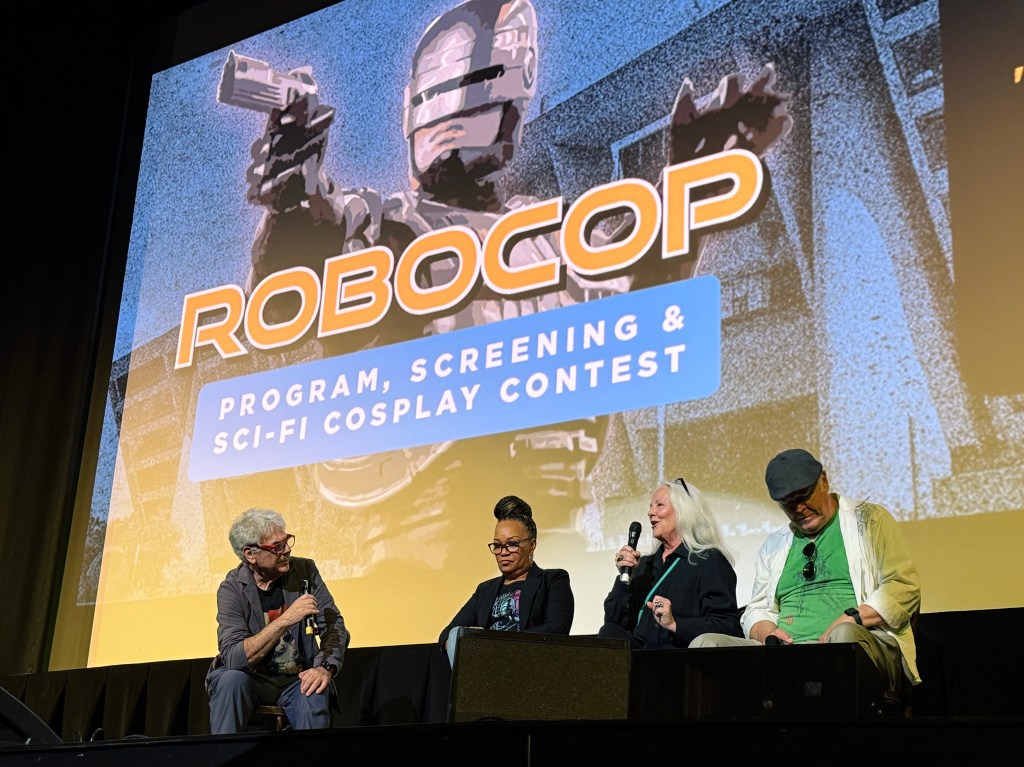
The post-screening Q&A, moderated by Weiss, brought three of the film’s local talents to the stage.
Yolonda Williams played Officer Ramirez; it was her first film role at 22. She credited it with launching her career, including her own Dallas-Fort Worth lifestyle and entertainment TV show, “Fun on the Run,” on CW33. Angie Bolling, cast at the last minute, played RoboCop’s wife, Ellen Murphy. John Davies, who played Officer Chessman, recalled grueling filming schedules.
Preston Barta
The night ended where it began, with a building and a choice. Williams left the crowd with a charge that doubled as the evening’s thesis.
“Save City Hall,” she said. “Silence means it’s gone. Don’t be silent.”
That’s the thing about a 40-year-old movie shot in your hometown. It outlasts the studio, the trends, the cynicism. Fandom, architecture and civic memory all met under one marquee in Oak Cliff, and for one night, the people of Dallas felt like they got their building back. Pei built it to endure. Now the city gets to decide if it will.