
Stephanie Aranda

Audio By Carbonatix
Update, 6/25/26, 10:25 a.m.: The Dallas City Council overwhelmingly voted Wednesday to deny awarding the Kiest Tennis Center contract to Impact Activities on a motion by Deputy Mayor Pro Tem Maxie Johnson. While Impact’s contract at the other three tennis centers was extended, the bidding and procurement process for Kiest Tennis Center management will start over with new parameters, park department staff said.
“I just want to thank our community for coming out,” Johnson said. “I believe that there’s an opportunity to strengthen the partnership with the DTA and the city of Dallas, and strengthen our partnership with our community concerning this process. I’ve heard you, heard you for a year.”
Parents, community members and athletes staged a “Rally for Kiest” before the council meeting’s scheduled start at 9 a.m. Many remained until the contract came up for consideration around 6 p.m. to give comments, with more than two dozen residents addressing the council in total.
Original article from June 22 below:
Over the last two years, Kiest Tennis Center has made the city of Dallas about the same amount of money as the City Council is apparently willing to spend repairing City Hall: $0.
The facility is managed and operated by the Dallas Tennis Association (DTA), a non-profit organization specializing in free or low-cost sports programs for neighborhood youth. DTA coaches have modeled how to serve and volley at its tennis courts for over 20 years, but now, the city is considering handing the center over to a for-profit company.
At a May 7 meeting of the Park and Recreation Board, the majority of representatives voted in favor of approving a contract with Impact Activities as DTA’s agreement expires. Impact is a McKinney-based company that operates municipal courts around North Texas, including Dallas’ three other tennis centers. Impact submitted a bid to take over management of Kiest Tennis Center in response to a 2025 call for proposals. The city’s procurement department approved the bid, and the City Council could take the final step to approve the contract at a meeting Wednesday.
Need the money
The move, Park Board representatives argued, will help pave the way for capital improvements at the center and help drive increased attendance similar to trends recorded at other facilities Impact manages. Voting on the Kiest contract was originally deferred from an April 16 board meeting. At that meeting, Dallas Park and Recreation Director John Jenkins revealed one of — if not the leading — reasons for seeking a new operator.
“The request for proposals was put out, one, because the contract was up, and two, there has been the charge of this board as well as City Council with the budget constraints going forward,” Jenkins said.
As the city faces a projected $51 million shortfall, the parks department has been asked to cut 15% of its budget, roughly totaling $14 million. At the May meeting, District 2 Park Board Rep. Fonya Naomi Mondell said the board and department have been asked to identify $258,000 in savings across the four tennis centers. Samuell-Grand, one of Impact’s facilities, is located in Mondell’s district. She supported the move, explaining that their management has bolstered participation and allowed for increased revenue required to maintain and improve the tennis center.
An agreement with Impact will net the city $284,000 over the duration of the contract, which would run for five years with one three-year renewal as currently proposed.
Some residents are at least skeptical and, at worst, extremely apprehensive. Advocates worry they will be priced out by Impact’s increased fees and that the company won’t be responsive to the needs of their diverse community. Even worse, advocates warn that the loss of free youth programming could shut some neighborhood youth out indefinitely. Tense debate at Park Board meetings led some board representatives to apologize to Impact representatives, with one saying, “You didn’t sign up to be vilified,” while a petition calling for Dallas Tennis Academy to remain at the center has amassed close to 1,600 signatures.
“None of them really even knew what the community wanted when they voted to approve this contract for impact activities like the park and recreation board members… They had no idea because they approved something, where they have not even involved the community at all,” Stephanie Aranda, the petition’s organizer, said.
The status quo
DTA has been at Kiest Park for 25 years, Craig Cole, head pro and DTA facility manager, said. The programs were started by his mother, Alberta Cole, a member of the Texas Black Sports Hall of Fame and DTA’s head of junior development. The junior Cole is an accomplished athlete in his own right, having played football at Arizona State University before competing professionally in arena football.
Most evenings, Cole can be found at Kiest Park, where he has been the director of the tennis center for eight years. The core of the offering revolves around low or no-cost youth programming coordinated with educational and character development. Tennis offers an ideal platform to reach youth, he said, because the sport’s back-and-forth tempo mirrors life.
“You have to be repetitive, you have to be disciplined, you have to be classy, you have to be an assassin, you have to be deadly, you have to be.” Cole said. “And you got to reset and rekindle, and do it all over again, and over and over and over and over.”
DTA has three levels of youth coaching: free sessions as part of the junior development program, and paid lessons for the competitive division. The excellence program, the highest tier of youth competition at Kiest, is affiliated with the local chapter of the U.S. Tennis Association’s National Junior Tennis and Learning network. Founded in 1969 by Arthur Ashe, the first Black player to win a singles title at Wimbledon, the NJTL was created to provide low or no-cost tennis lessons and life lessons to under-resourced youth.
Cole’s curriculum includes tutoring sessions and mandatory service hours for players in junior competitive and enrichment programs. Some programming, like the girls’ and boys “On the Moon” initiative, doesn’t require a racket and instead focuses on mentoring children in the area and keeping track of grades, he said.
“They meet once a month on Sundays,” Cole said. “All the kids in the program have to do 60 hours of community service after turning in their report cards, they have to have decent attendance, and then in the competitive program, it’s a lot more life skills.”
He said that DTA submitted a bid to renew its contract at Kiest Park, but was ruled “non-responsive.” Non-responsive bids are typically those deemed incomplete or ineligible for acceptance, although that did not appear to be an issue when DTA renewed its contract in 2018.
“Very few” athletes would be able to continue playing without the program, Cole said, adding that he has been anxious since the news broke last year that Impact would bid for the facility.
“I’m not against other people expanding,” he said. “I get it, but this one doesn’t make any sense.”
‘Kind of broken’
According to the petition’s Change.org webpage, 65% of its signatories were registered from three ZIP codes immediately surrounding the center — 75208, 75211 and 75224.
Aranda signed her kids up full-time for the development program a little over a year ago. Her family could afford lessons at another facility if DTA moves, she said, adding that some parents in the program might not have the same options. Her main concern is keeping her son with the coaches he knows and training alongside other athletes from his neighborhood, which is part of what led her to launch the petition after hearing the news.
“I was kind of broken,” she said. “Especially for my older kid, who is now a teenager, who’s 13, he loves the program. Just not having it in the community, and not knowing where it’s going to be located next. I know he was going to be heartbroken… We’re not going to be able to drive a few hours a week just for tennis, five days a week.”
The Observer spoke with six community members who either send their children to DTA programs at Kiest or compete in league play there. All of them agreed that the existing programming should remain at Kiest in some form, and most said they just don’t see why their tennis center needs a new operator.
One parent, Najjaa Agyei, said his daughter has been in the program for eight years and trained at national events with DTA coaching. He’s lived in southern Dallas most of his life and said while there were similar programs for area youth when he was growing up, they didn’t involve tennis.
“Programs like these gave us not just a place to be, but like a sense of purpose, and put in front of us examples of individuals to try to model and pattern ourselves after,” Agyei said. “Gave us things to reach toward. This is a huge boom to this community.”
Especially worrisome to some community members are concerns about increased fees if Impact takes over the facility’s operations. Whereas junior development is currently free at Kiest, classes for youth at Fretz Park Tennis Center run up to $30 per class, with sessions scheduled three to five times a week.
Also concerning is the prospect of losing a program that has drawn community support through cultural and educational initiatives, such as summer camps and cultural heritage events, which are also free. They’re unsure if Impact will be able to engage their community as DTA has.
“My worst nightmare is coming in here and not feeling like this is part of my community, or being outside, kind of looking in,” Bianca Beltran, whose two children have been in the program for close to a decade, said.
Beltran’s husband, Gabriel, said he has seen Kiest evolve over the time his children have spent at the facility.
“Has it increased awareness of tennis? Absolutely, has it increased attendance 100% Has it increased the look of the facility? Absolutely, but the one thing in the eyes that the city wants that it hasn’t gotten from this place is a big financial gain,” he said.
Attendance and revenue

Courtesy of Fretz Tennis
According to materials delivered to the Park Board in April, Kiest has the lowest attendance among the four city-owned tennis facilities. Staff calculated three-year attendance averages from 2023-2025 for the four centers, with Kiest’s average attendance coming out to 10,734 visitors each year. That’s compared to LB Houston, which logged an average attendance of 38,269, and Samuell-Grand, which averaged out to 31,124 visitors. Fretz Park Tennis Center, the third facility managed by Impact Activities, averaged just under 52,000 annual visits.
Even though – as some park board representatives noted in April – Kiest doesn’t have the same draw that the other centers get from pickleball offerings, the attendance gap is large. Shrinking the gap is something Impact President Matt Hanlin said his company could help with if given the contract at Kiest. In addition to Dallas, his company manages some or all of the tennis centers in other North Texas cities, including McKinney, Garland and Carrollton.
“We’ve managed to grow attendance at all those facilities,” Hanlin said. “Specifically, with the city of Dallas, over the last eight years, we’ve taken over three facilities, and they were very lowly attended, and had very few programs.”
Revenue is also something Impact hopes to help the city increase at Kiest Park. The company will pay the city $13,000 in rent during the first year of the contract, and commit to $20,000 in capital projects at the facility. Staff told park board members that the company will pay for new courts and other improvements in April.
Hanlin said funding is especially important in a sport like tennis, which requires paying experienced pros to execute at the highest level.
“You have to be able to pay good people to stay,” he said. “If they’re not able to charge what the going rate is in the community in the area, then they’ll certainly leave and go to the next club up the street or the country club. So we are, we are kind of in a place where we don’t have a lot of turnover.”
He said his company is “all about community” and that Impact has given out over $100,000 in scholarships annually. The company does offer some free youth classes, Hanlin said, and has added programming for residents with Down syndrome in recent years.
Court fees have been a concern with Impact possibly taking over the facility. However, the city has capped court fees at $6.50 per person, with Impact currently charging $5 per 90-minute session at Fretz Park in Far North Dallas. At Kiest, that session is $4. League fees are also a concern for some residents, who note that Impact requires substantial upfront payments at the beginning of the season, as opposed to the current program’s pay-as-you-go model. Impact has committed to maintaining league fees in their current form during their first year at Kiest if the contract is approved.
“We’ve come in and we’ve kept the pricing exactly within what the city wants us to charge,” Hanlin, who noted pricing is dictated by location, said. “We haven’t blown it out, we haven’t wanted to blow it out and we can’t do it anyway.”
Impact Activities has had talks with DTA about retaining some form of programming at Kiest, which Hanlin said he would be interested in. As the park department director noted at an earlier board meeting, the terms of Impact’s potential contract were finalized during the procurement process, meaning the city cannot compel the company to retain Kiest’s current programming.
Hanlin said the specifics are still being worked out and that an arrangement may include reducing DTA’s footprint at the facility to allow for more growth in other programming and adult activities.
“I think people are always scared of change,” he said. “But if any of these people would like to go back to our facilities from day one, when we started to where they are today, all of them have gone on to grow.”
‘Gotta get some things across now’
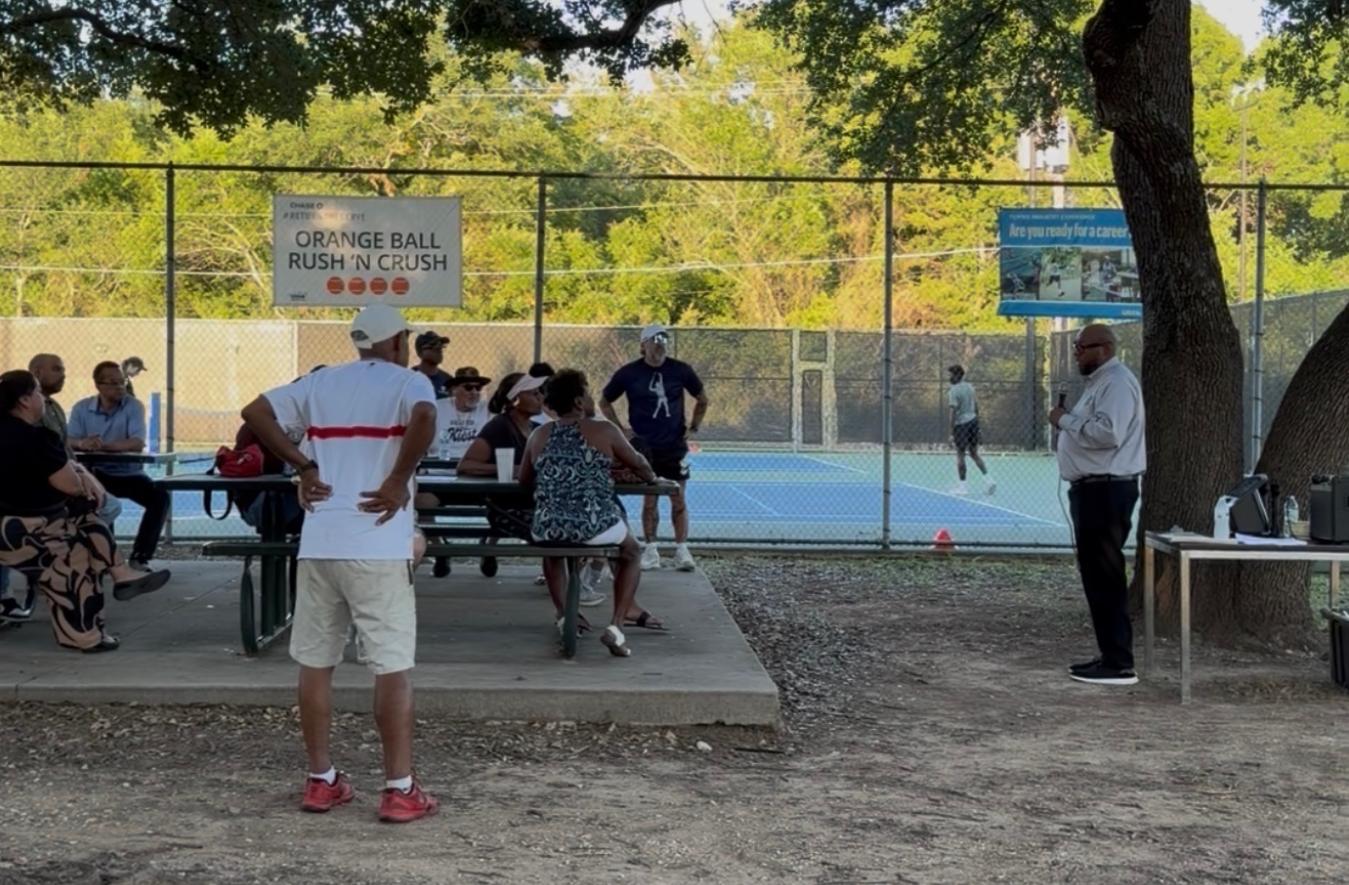
At a June 16 community meeting held with the squeaks of tennis shoes on Kiest Park courts in the background, District 4 Council member Maxie Johnson told residents he intends to fight for the status quo at the facility and has attempted to open a line of communication with the park department.
“If it ain’t broke don’t fix it,” Johnson said. “The community has made it very clear that the organization has been great with our children and a whole bunch of stuff with African American communities and all of our communities. District 4 is very diverse, and we need everybody to respect that. My understanding is that’s not the sentiment that everyone has.”
The contract will go to a full council meeting on June 24. Beltran, Coach Cole, Aranda and several community members are planning to make public comments before the vote. While Johnson appears prepared to vote no, it remains unclear if other council members, whose park board appointees voted overwhelmingly to approve the contract, will follow his lead.
“When the community says this is who we have relationships with, this is who we want and they have been great partners in our community, and we’re standing with them, then I’m standing with our community,” Johnson said at the community meeting.
Cole said he hasn’t slept well since the news broke and called the potential loss of the program at Kiest “debilitating.”
“With some of the kids I’ve had for so long, it’s like crap, we gotta, we gotta get some things across now,” he said. “There’s some that I can see potential in, but I’m looking at where they’ll be in three years, then it’s very worrisome and stressful.”