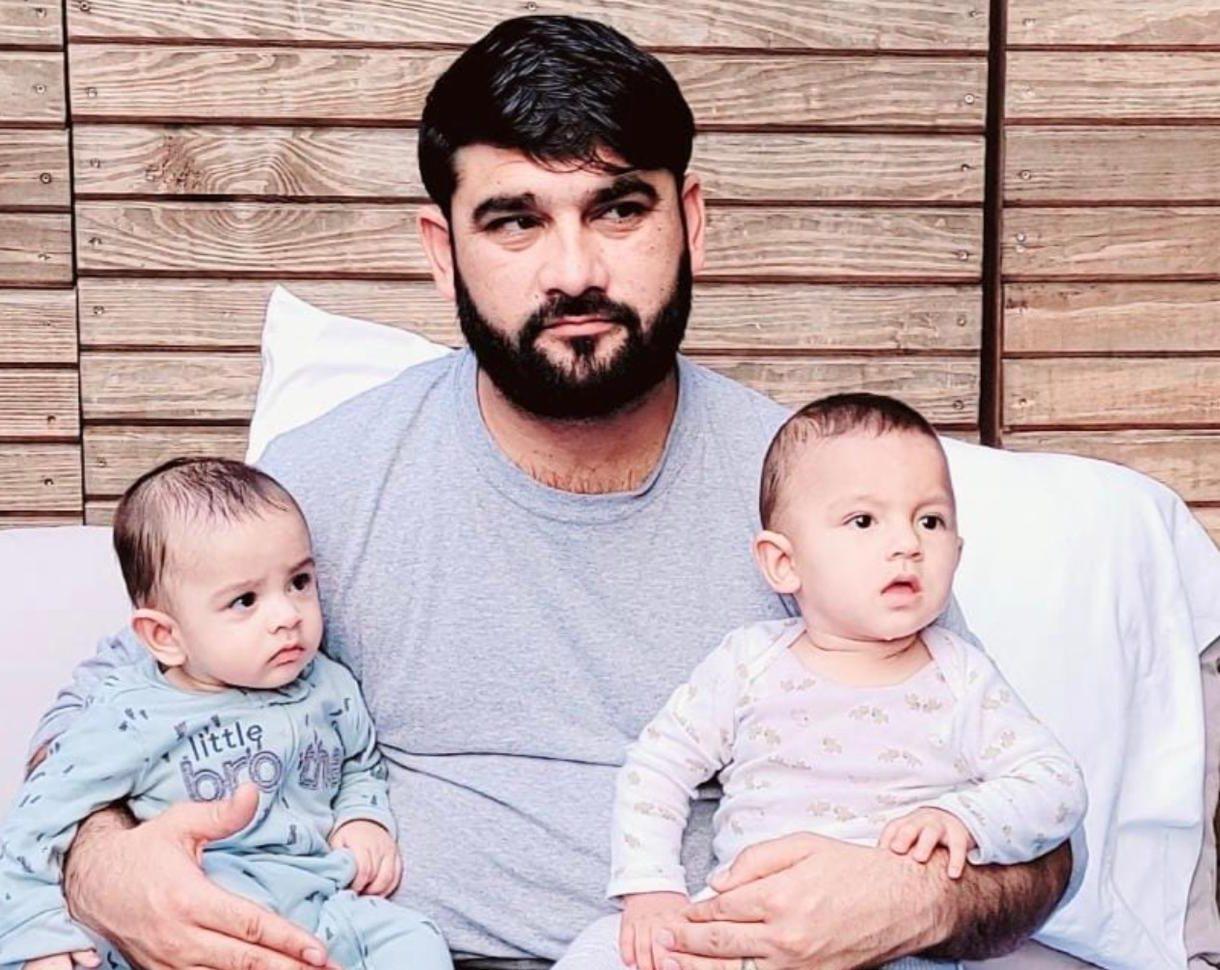
Provided by family of Nazeer Paktiawal

Audio By Carbonatix
Nearly four months after Mohammad Nazeer Paktiawal died in ICE custody, newly released documents show his death certificate contains a discrepancy over the timing of his fatal injury, and that Dallas County officials have agreed to keep the underlying autopsy report sealed.
Paktiawal, 41, an Afghan immigrant whose family says partnered with U.S. Army Special Forces for more than a decade in Paktika province before they were evacuated to the United States in 2021, was taken into ICE custody outside his Richardson home on the morning of March 13, as he was getting his six children ready for school. He was hospitalized that evening after complaining of shortness of breath and chest pain, and was pronounced dead the following day, less than 24 hours later.
At the time, ICE said Paktiawal’s tongue had become swollen while he was eating breakfast and that medical staff attempted lifesaving measures before he died. The agency also pointed to a prior arrest history, including a 2025 SNAP fraud case and a separate theft charge, without clarifying whether either had resulted in a conviction. Advocacy groups, including AfghanEvac, the Afghan-American Association and the Council on American-Islamic Relations, called at the time for a full investigation, and U.S. Rep. Julie Johnson, whose district includes Richardson, publicly demanded answers from ICE.
The Dallas County medical examiner’s office did not certify a cause of death until June 25 — 103 days after Paktiawal died. AfghanEvac says the resulting certificate, obtained through a records request and shared with the media during a Monday press conference, lists the date of his fatal injury as March 12, a day before he was taken into custody. Advocates and Paktiawal’s family are asking the medical examiner’s office to correct or at least explain the discrepancy.
U.S. Sen. Richard Blumenthal of Connecticut joined the press conference by video, saying this situation calls for quick answers from the government. As for the incorrect date listed on the death certificate, Blumenthal, who added that he is a former prosecutor and state attorney general, said that in his experience, the errors suggest “extreme carelessness, bordering on pure negligence and possibly worse.”
The certificate lists the manner of death as accidental, with the immediate cause as anaphylaxis complicating an acute asthma exacerbation. Notably, it also lists toxic effects of methamphetamine, atherosclerotic cardiovascular disease and cigarette smoking as contributing conditions. Paktiawal’s younger brother, Naseer Ahmad Paktiawal, says he, nor anyone else in his family, ever knew his older brother to use methamphetamine or any other illegal drug. He added that his brother had not smoked cigarettes in years.
During the press conference, Shawn VanDiver, president of AfghanEvac, said no government agency has explained how a man held for less than a day could have been exposed to an illicit substance, or whether officials believe that exposure happened before or after he entered custody.
An independent forensic pathologist hired by Paktiawal’s family reportedly found nothing unusual in Paktiawal’s underlying health for a man his age, but by the time of that exam he had already been embalmed and no blood remained for toxicology testing — meaning the family’s expert could not independently verify or dispute the methamphetamine finding.
Compounding the dispute, the Dallas County district attorney’s office reportedly notified Texas Attorney General Ken Paxton on June 24 that it intends to continue withholding the full autopsy report — citing a request from ICE Assistant Field Office Director Yousuf Khan, who said its release could interfere with a pending federal criminal investigation that has not been publicly described. When asked why the county has not supplied Paktiawal’s family with the requested documentation, a spokesperson for the DA’s office told the Observer in a statement on Monday afternoon that this “case is being handled at the federal level,” and confirmed that the county did send the Texas attorney general a letter indicating the requested documents were “excepted from disclosure.”
“This is a federal law enforcement matter,” the Dallas County district attorney spokesperson wrote. “Though the [Privacy Impact Assessment] request was made to Dallas County [Southwest Institute of Forensic Sciences], we communicated with federal law enforcement handling the case which then asserted the law enforcement exception to the records being released due to it being an ongoing investigation.”
“Let me say this very bluntly – I’m going to demand the autopsy report and ask what kind of criminal investigation there could be to justify the refusal to release it,” Sen. Blumenthal said. “That’s the excuse that’s been given by ICE, that there’s a criminal investigation. Well, what crime is being investigated?”
VanDiver said the family has been waiting since March for the government to explain what happened, and criticized the pace and content of the certification process. The organization has retained legal counsel to appeal the county’s withholding decision and is calling on Paxton to weigh in on the family’s right to the records, and on ICE to publicly identify the investigation it has cited as grounds for secrecy.
Paktiawal was among at least a dozen people to die in ICE custody in Texas so far in 2026, following a 2025 that advocacy groups and the Texas Tribune have described as the deadliest year for ICE detention deaths in over two decades.
On Monday, he called his brother “a wartime hero” who served with American soldiers in “the most dangerous places.” Naseer is now raising his older brother’s six children, and he still doesn’t know what to tell them when they wonder about their father. He and his family are hoping the government will soon help them with that.
“What we’re going through, nobody can imagine,” Naseer said. “Every morning when I wake up, I’m looking at their faces, and they ask me about “baba,” which means dad. ‘When is baba coming home…’ And it’s pretty hard to give answers to the kids without the information we need, which is not asking too much.”