
Asterios Moutsokapas

Audio By Carbonatix
There’s a particular kind of American ruin that doesn’t make the history books: the dead shopping mall. No battlefield markers, no preservation funds, no elegies in stone. Just a husked-out atrium, a few ghostly storefronts and fluorescent lights dying slowly overhead. Kane Parsons understood something about that space so well that he used one from right here in Dallas as inspiration.
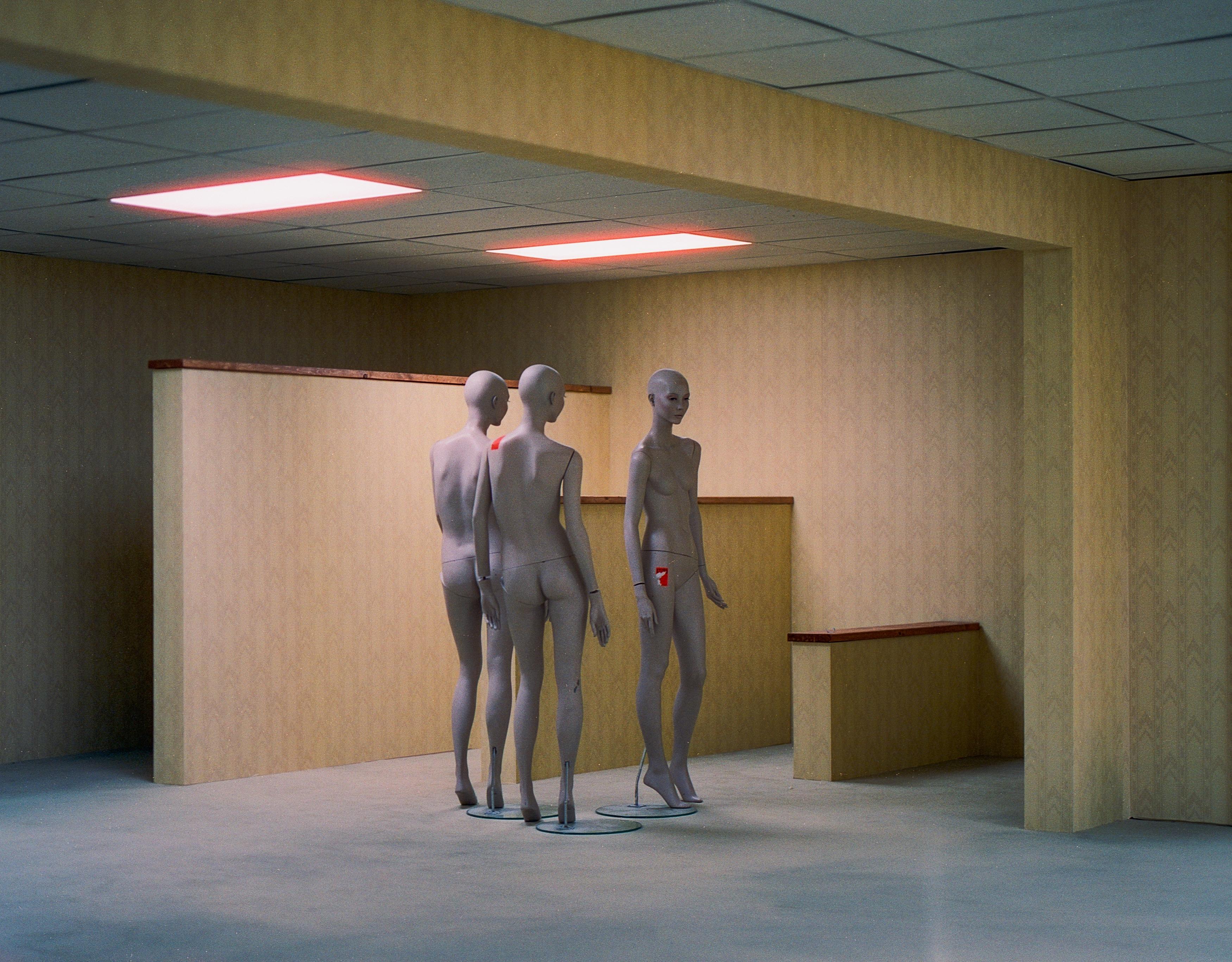
Over the last weekend, Parsons’ feature film “Backrooms” opened to $81 million domestically and $118 million worldwide, boasting a staggering return on an estimated $10 million budget that rattled the industry and broke the internet all over again. At 20 years old, the YouTube filmmaker who built a cult following by turning a single grainy internet image into an immersive horror mythology is now officially a box-office phenomenon. The film, starring Chiwetel Ejiofor, Renate Reinsve and Mark Duplass, carries all the atmospheric dread Parsons perfected online: liminal spaces, institutional fluorescence, the creeping sense that something vast and indifferent is watching.
But before any of that, there was a mall in Dallas. And Parsons was already inside it.
Valley View and the art of the afterlife
Valley View Mall opened in North Dallas in the early 1970s and spent decades as a genuine local institution with big-name retail anchors, discount floors and families moving through its corridors as if it would always be there. (Spoiler alert: It wouldn’t.) By the time demolition formally got underway in 2017 and was completed in stages through 2023, Valley View had become something else entirely: a canvas for the people the city had largely stopped paying attention to.
In 2012, new ownership made an unusual call. Rather than let the empty wings rot in silence, they opened the Gallery at Midtown and Artist Studios, inviting Dallas’ artistic community to occupy the hollowed-out halls. It was strange, beautiful and quietly radical — a shopping mall repurposed as a bohemian incubator, fluorescent-lit and cavernous, where studios filled spaces that once housed food courts.
Among the artists who moved in was Kevin Obregon, a local Dallas-Fort Worth creator who had built something remarkable: a towering papier-mâché figure on wheels depicting Julien Reverchon, a 19th-century French botanist with deep roots in Dallas history (more on him later). The piece was originally created to march in the 2012 Parade of Giants celebrating the opening of the Margaret Hunt Hill Bridge over the Trinity River. That figure, known as the Rolling Giant, eventually found a permanent home outside Obregon’s studio inside the mall. It was at once a tribute and something stranger — a silent, looming likeness of a long-dead Frenchman who once cataloged the Texas wild, now haunting the fluorescent corridors of a dying American mall, watching from a short distance as the city quietly forgot both of them.
This is the imagery that threads through Parsons’ CGI web series “The Oldest View,” the project that came before the new “Backrooms” film and helped establish his eye for liminal dread. It remains one of the stranger, more haunting pieces of internet filmmaking in recent memory.
Julien Reverchon and the ghost in the flora
“The Oldest View” is built around a specific piece of history most Dallasites wouldn’t recognize at first sight. In the 19th century, Reverchon emigrated with his family to the south bank of the Trinity River in Dallas County, settling with the utopian colony of La Réunion, a short-lived French socialist experiment that nonetheless left its fingerprints on Dallas’ early cultural DNA. Reverchon became a professor of botany at Baylor University College of Medicine and Pharmacy in Dallas, spent decades cataloging the flora of Texas, and was eventually honored with Reverchon Park, which still stands in the Oak Lawn area today.
In “The Oldest View,” Reverchon is a character who appears as a black-and-white wanderer, drifting through the forest, pausing over plants. He’s a figure at home in a world that no longer exists. The series follows Wyatt (played by Parsons), a young YouTuber who documents his travels as he trespasses into a private park and stumbles upon a hidden tunnel beneath an oak tree. When he climbs down, what he finds on the other side is a deeply unsettling, vast space that mirrors the layout of Valley View Mall — familiar and wrong at the same time. Parsons’ ability to recreate the shuttered Dallas institution despite never actually stepping foot inside the mall is worth commending.
The walls are covered in imagery that shouldn’t belong together but somehow does: a portrait of Victor P. Considerant, founder of the utopian La Réunion colony; photographs from the Parade of Giants; images of excavators mid-demolition, tearing into the mall’s concrete bones; and there, among them, the face of Reverchon with a single plant placed on the ground before him. The whole space feels like a museum no one was meant to find, dedicated to a version of Dallas that no longer exists.
And there, in the corner, stands the Rolling Giant, with Reverchon’s own likeness rendered in papier-mâché, towering and silent, watching everything.
Dallas as mythology
This is what makes Parsons’ “Backrooms” origin story richer than a simple “kid goes viral” narrative. Before the film that made him a new horror phenomenon, there was “The Oldest View” — and before that, there was a North Dallas mall discovered through the kind of late-night internet rabbit hole that defines a generation. Parsons had saved an uncanny photo he stumbled across online, drawn to it out of curiosity, and eventually traced it back to its source: an abandoned mall in Dallas. The building blocks of his aesthetic — liminal architecture, buried local history, figures who outlast the spaces that housed them — were assembled in Valley View before “Backrooms” took theaters by storm. Dallas’ own layered, complicated past gave him the material that would eventually shape everything that followed.
And now, in a twist that feels almost too on-brand for this city, that same vacant lot is slated to become the future home of the Dallas Mavericks. The franchise announced this week that it has entered into an option agreement for the potential purchase of 104 acres at the former Valley View Mall site, with plans for a new state-of-the-art arena and entertainment district in time for the 2031-32 season. The place that once housed the Rolling Giant and a gallery of artists reclaiming a dying mall will soon house an NBA franchise reclaiming its own identity. Dallas, as ever, builds new myths on top of old ones.
The city has a habit of demolishing things before it realizes they mattered. Parsons noticed before we did — and the box office receipts suggest the rest of the world was ready to follow him in.
“Backrooms” is now playing in theaters.