Austin Wood

Audio By Carbonatix
Independent Journalism in Dallas Needs You
We need to raise $12,500 by August 9 to support the reporting our community depends on. Reader support keeps us independent and is playing a larger role in funding local journalism and shaping what comes next. If you believe independent local journalism matters, make a contribution today.
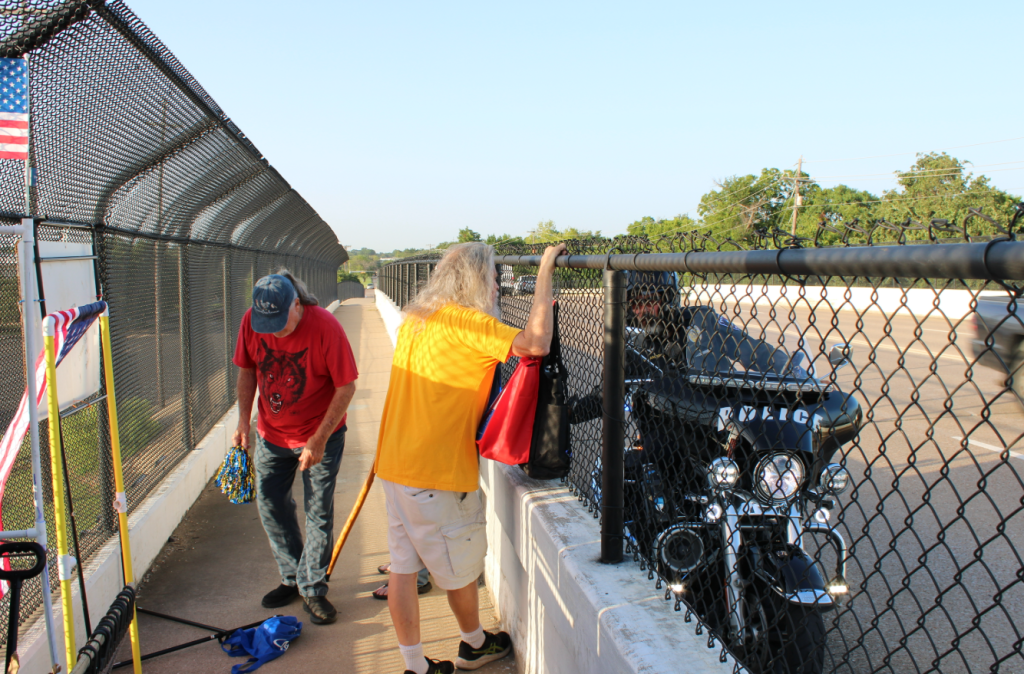
It’s a little after 7:30 a.m. in West Arlington. Standing on an overpass bridge near Lamar High School, Andrew Kocher can hear the rush of morning commuter traffic below. A grumbling, mechanical growl grows closer behind him, and as he turns to identify the source, relief is evident in the absence of flashing lights.
“It’s the cops,” he says.
The Arlington police officer circles his motorcycle a few times, then stops to talk to the people dotting the bridge. Kocher has had run-ins with law enforcement on the bridge previously, but today, the officer seems to be stopping by more out of curiosity than concern.
“What’s the message for today?” the officer asks.
Austin Wood
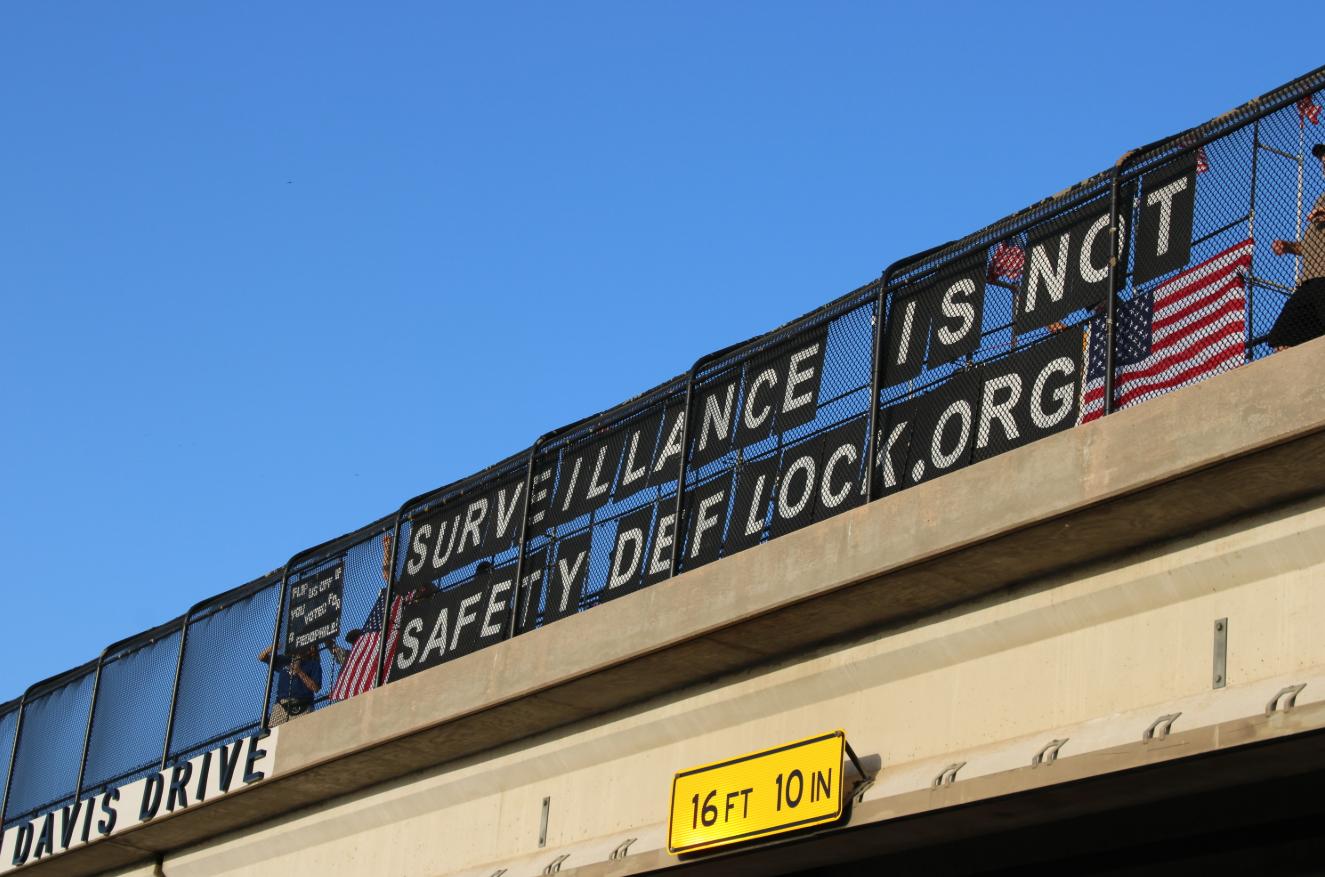
In front of Kocher, facing thousands of westbound cars on Interstate 30, exactly 34 panels paint a clear picture of his thoughts. Every Tuesday and Wednesday, Kocher and his fellow activists display their thoughts to scores of morning commuters on various issues. The issue for today? Flock Cameras.
“Surveillance is not safety,” the panel reads, with a URL for the advocacy group DeFlock following.
Thousands of police-contracted Flock cameras and automatic license plate readers (ALPR) now scour hundreds of roadways in North Texas. Police officials have lauded the technology for its investigative and deterrent capabilities; however, advocacy groups have raised concerns over data protection and privacy.
While Flock cameras are the issue of the day and have been targeted previously, the group’s message shifts week to week. Similar messages have begun popping up around D-FW since the beginning of the Trump administration, and are part of a wider national effort.
‘We all deserve better than this’
Austin Wood
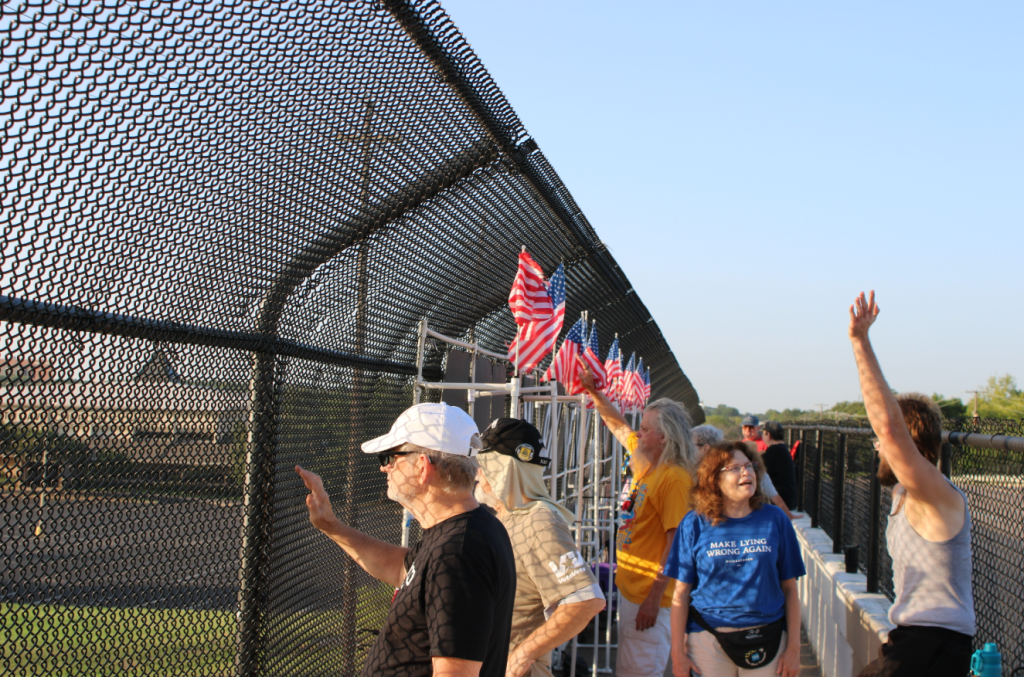
Kocher, 61, started his bridge protests in September of last year. His group heads to the Davis Street bridge each Tuesday and, occasionally, to an overpass on Highway 360 on Wednesdays to deliver politically charged messages to commuters below. Kocher and other activists start setting up as the sun rises before 7 a.m. to catch peak rush hour traffic.
Last week, the decidedly older group’s message was “Only losers go to war without a plan,” while a month ago, panels assured passersby that “We all deserve better than this.”
“When I started this, my thought was to try to come up with messages that both sides could agree on,” he said.
It’s not a large group — Kocher estimates most protests draw five to eight people weekly. But that’s part of the reason the protests are so effective, he said, because only a few people are needed to make an impression on scores of drivers.
Kocher said he considers himself left-leaning, but has not always felt represented by the Democratic Party. He has been somewhat politically active in the past, but said his first serious foray into activism came with the first protest last September, which offered an opening for an introvert like him.
“I’m much happier when I’m not talking to people, and going out there and doing that is one thing,” he said. “This was a way for me to express my frustration with the way things are going.”
Austin Wood
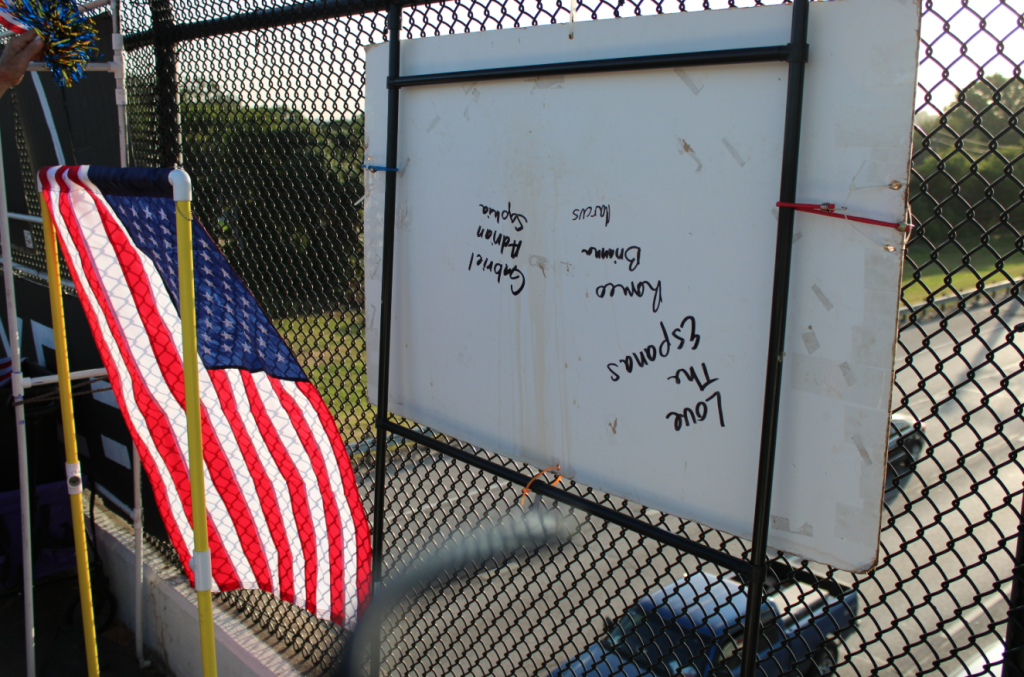
At his home, Kocher has a collection of roughly 130 interchangeable black poster board panels with letters stenciled and painted on both sides. To comply with TxDOT rules prohibiting signage from being posted directly onto the bridge itself, he built a PVC pipe frame that can fit up to roughly 40 characters. The messages need to be kept short to capture eyes going 60-plus miles per hour, he said.
Unlike some groups engaged in similar activities, the Arlington activists select their own message each week. The signs cover some local politics, but Kocher mostly sticks to national issues when deciding what message to display. While profanity is off-limits, on certain mornings, they will push the envelope.
“Some messages are more provocative than others,” he said. “We get more negative or more positive, just depending on what the message is.”
In March, shortly after the beginning of the Iran War, the bridge was ornamented with the words “Hate has never made America great.” A few weeks later, Kocher went with “The President has lost his mind.” And beside the main message and a collection of American flags, each protest also features a sign that says “Flip us off if you voted for a pedophile.” Which happens a decent amount, he said.
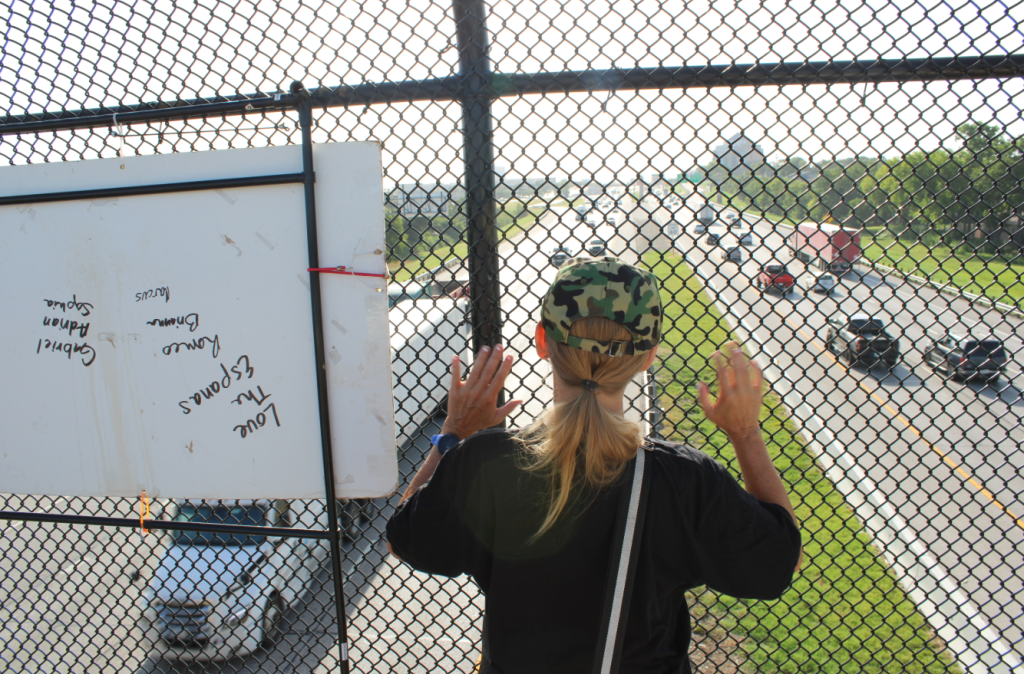
What is more common, however, is audible endorsement from the vehicles below. Kocher said 90 percent of passing cars are indifferent, but the majority of the remaining commuters use car horns or flash their lights to signal support.
“It’s also valuable so that people out there who think they’re alone in the way they feel can see that there are other people out there that are frustrated,” Kocher said.
Rush hour resistance
Austin Wood
While the Arlington group operates independently, they are still part of a nationwide mobilization. Hundreds of bridge protest groups broadcast messages across the country, with North Texas protests organized in Dallas, Fort Worth, and Richardson.
Most groups fall under the umbrella of the Visibility Brigade, a national organization which coordinates messages and connects organizers with resources for their next bridge protest. The organization was founded in 2020 at an overpass bridge in New Jersey to bolster political awareness and activation. Over 400 chapters now participate in what the group describes as “Rush hour resistance.”
One of those groups is run by Indivisible Dallas, a local left-wing advocacy group tied to the national Indivisible movement. Samantha Mitchell, the group’s co-leader, said the protests in Dallas began in earnest last year and typically take place on the Northaven Pedestrian Bridge.
“It’s a wonderful way to protest that kind of minimizes your risk a little bit, and also sends a really profound message,” Mitchell said. “And it’s a good social media opportunity because a lot of people take pictures and share.”
The group gets most of its messaging from the national Visibility Brigade movement, Mitchell said. Protests are organized using online platforms such as Mobilize, which effectively functions as an online signup forum for activism. The protests are not regularly scheduled and aren’t held in extreme heat or cold, as many of the activists are older, she said.
When there are a large number of protestors, organizers attach messages to both sides of the bridge and steer clear of the middle lane, which is kept open for pedestrians and cyclists. Permits are also filed with the city for large demonstrations, and while past pro-Palestine protests have drawn scrutiny from the park board, Mitchell said the group tries to stay in the city’s good graces.
“Indivisible Dallas has a really good relationship with DPD,” she said. “They’ve been really understanding and have tried their very best to keep everybody safe in all of our actions, so we want to maintain that good relationship with the city and with DPD.”
In January, hundreds of protestors gathered on the bridge after Renee Good was killed by ICE agents in Minneapolis. That day, the protestors displayed signs reading “Dallas says ICE out for good” on one of the busiest highways in the Dallas-Fort Worth area.
“I think that visible displays of dissent against a fascist government are incredibly important for the survival of humanity, not just in Texas, but everywhere in the world,” Mitchell said. “So it’s a great antidote to despair.”
Bumps in the road
In Fort Worth, the protests take place weekly on three bridges: an overpass of I-30 near Arlington Heights High School, another near West Loop 820 and a third on Interstate 35W. The protests are organized by Fort Worth’s Indivisible 12 group, which runs the local Visibility Brigade chapter. While it is associated with the national organization, each bridge has its own “host,” who independently dictates morning messages. One of the hosts, Deborah Guerrero, started the protests shortly after President Donald Trump’s reelection.
Of the three bridges, the group has addressed ICE violence and other national issues while also maintaining a focus on local matters. Messages have criticized the state-appointed Fort Worth ISD board of directors for program cuts amid a TEA takeover. At the end of June, the group branded Fort Worth Mayor Mattie Parker’s husband as a “data center lobbyist.”
“I think I’m surprised at how effective I think it is,” Sabrina Ball, president of Indivisible 12, said. “I feel like we’re reaching thousands of people every time we’re on the bridge.”
There have been confrontations with authorities, she said. The group has not had many negative interactions with Fort Worth PD, though one officer told activists to vacate the bridge during a prior protest. Most of the issues are with TxDOT, representatives of which have told protestors to take their signs down when they are directly attached to the bridges. Under Texas state law, it is illegal to affix political messages in the right-of-way, according to the TxDOT website.
“If they just continually harass you, it’s better just to alter how we do it so that we can still do it,” she said. “Because it’s a pain in the ass to go get all your stuff together and figure out a message, and then get out there and erect it or hold it, and then be harassed or be told to leave.”
The Arlington protestors were also told by local police to remove signage that featured an endorsement of an Arlington City Council candidate.
Ball said the group has gotten a more positive response from commuters with each successive protest, although there are still a decent amount of middle fingers flashed at protestors.
Still, there have been incidents. At one protest, an elderly man holding an upside-down American flag was accosted by another man who parked his car near the bridge to heckle protesters. Ball said the man was “dragged onto the street” before other protesters de-escalated the situation.
“This guy is an older white gentleman, and he wears sun protection, like head to toe,” she said. “He’s completely covered, and when the guy finally looked him in the eyes, he stopped and he said, ‘I’m sorry. I thought you were a Mexican.’”
Ball said that the group’s persistence and visibility could be key to changing perceptions.
“If they come close, they see that it’s mainly senior citizens out there struggling in the heat,” she said. “I think that changes hearts and minds, that they just see the dedication and that people are passionate about something.”
‘Showing our faces’
Austin Wood
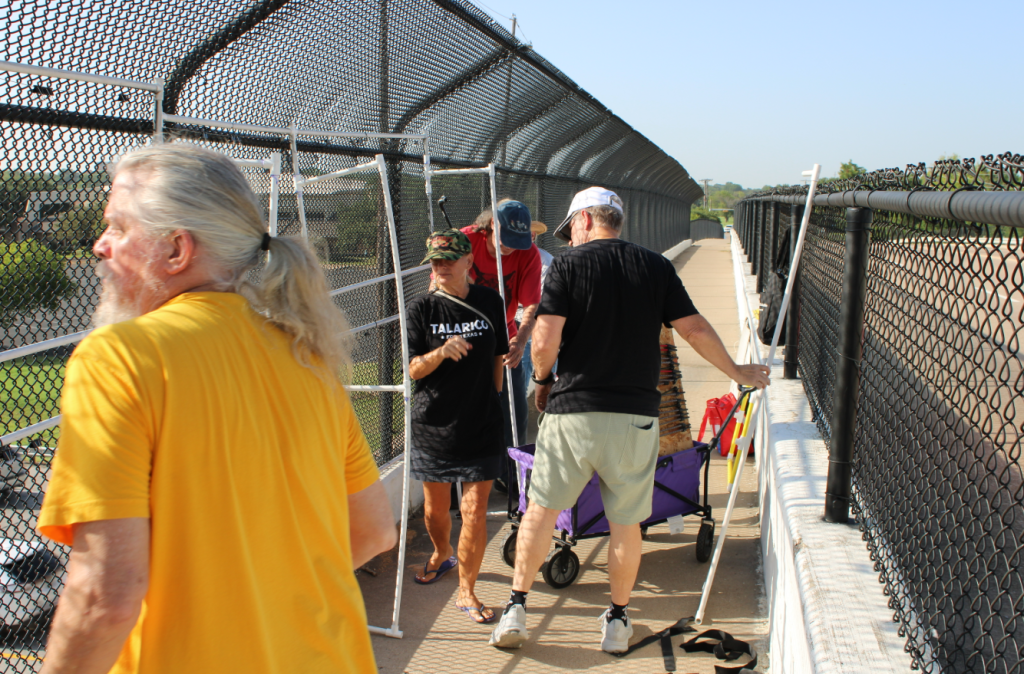
As the heat becomes uncomfortable and traffic starts to slow, Kocher and his fellow activists begin taking down the signage around 9 a.m. Each panel and American flag are carefully loaded onto hand-pulled carts as other protestors get to work disassembling his PVC frame.
There were considerably more honks than middle fingers, and the only interaction with local police was far from confrontational. It was a successful morning for Kocher, who said he plans to continue the protests for as long as he has a message to share.
“I don’t know how much it is standing up to power or truth to power,” Kocher said. “I mean, we’re just a bunch of old guys up on the bridge, but we are out there. We’re showing our faces.”