photo by Alison McLean

Audio By Carbonatix
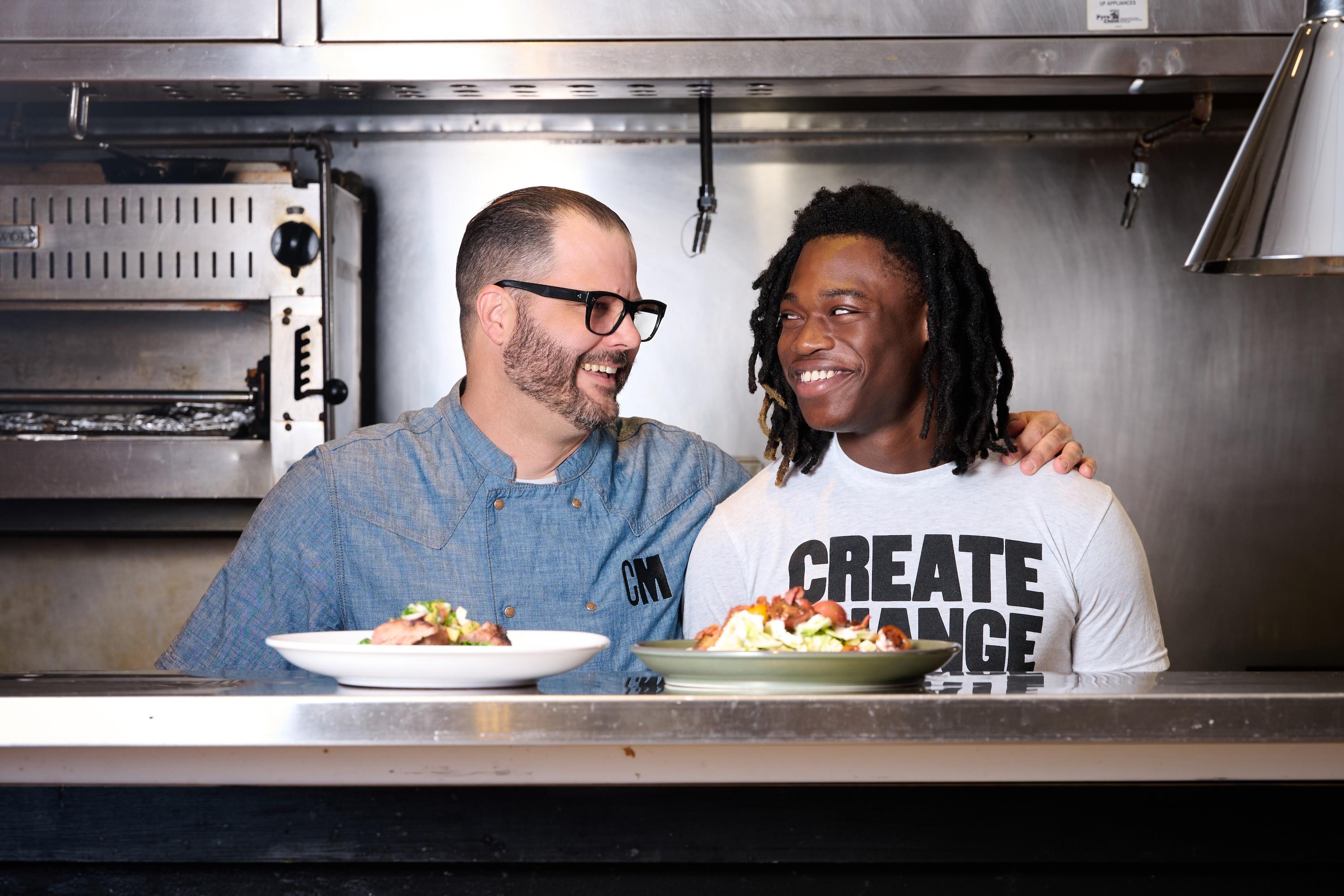
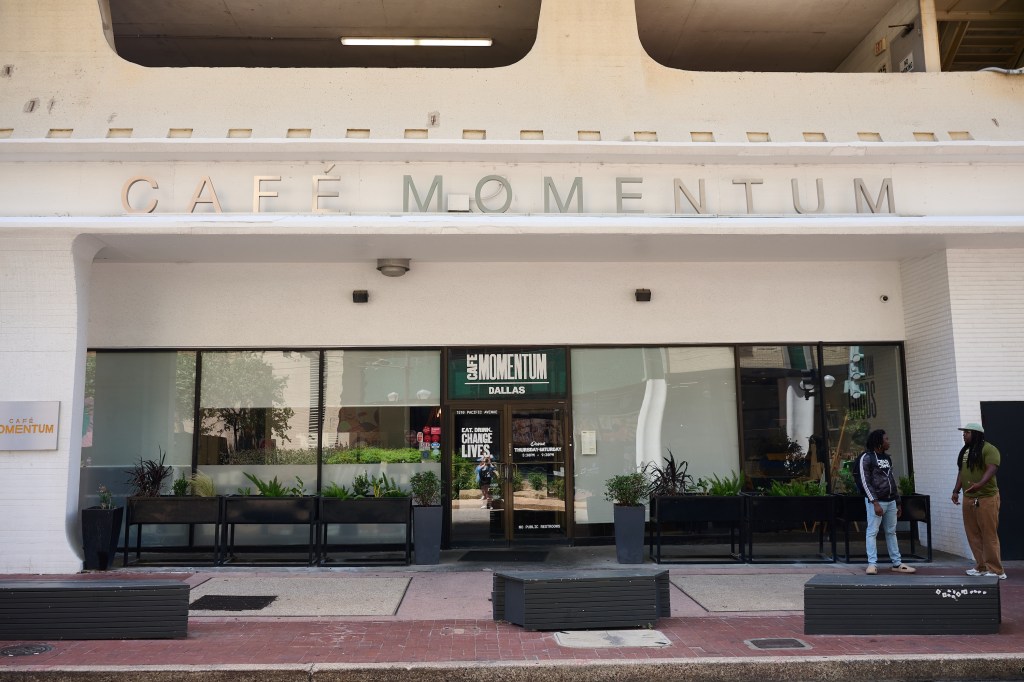
Sitting at a high-top table in his downtown restaurant, Cafe Momentum, Chad Houser coolly checks email on his laptop, a stout coffee mug at his side. The dimly lit space — tucked into the ground floor of a parking garage — is mostly quiet aside from the faint clatter of silverware and plates from the kitchen as staff prepare for dinner service.
Houser looks up from the screen behind a pair of thick black-framed eyeglasses. As he starts to talk, his demeanor is noticeably laid back yet still intentional — warm but restrained, thoughtful and measured with each word. The kitchen is where his career was shaped, but today, he’s selling a vision. And like any great visionary, Houser can talk about it for hours, but knows when to make a succinct yet salient point.
A half hour later, he is joined on his right by 19-year-old Anton, who recently completed Houser’s program for justice-affected youth. Whereas Houser’s eyes brighten, or occasionally gloss over with emotion, when talking about his mission, Anton’s smiling enthusiasm shines through on a variety of subjects: pastries, high-yield savings accounts and welding among them. Despite a generational gap, the two play off each other like old colleagues. Houser intuitively sets the teen up, while Anton has an uncanny ability to contextualize some of Houser’s broad ideas with real-world perspectives.
“This is always been a part of me,” Anton says. “I just had to be exposed.”
Together, they tell the story of Cafe Momentum. Launched by Houser in 2015, the restaurant employs justice-involved youth aged 15-19 and creates opportunities for growth beyond the kitchen.
Alison McLean for the Dallas Observer
Later this year, Cafe Momentum will leave downtown. The nonprofit is relocating its flagship location to a new campus in East Dallas’ Wilson Historic District, just north of Deep Ellum. From there, Houser says, the nonprofit will look to expand its reach nationally into a conversation about how communities can do better for their young people.
“This is what the next 10, 15, 20 years of impact is going to look like. So I am beyond excited, but I’m not naive or ignorant to not know what the bet is that we’re placing, and I take it very serious and very personal,” Houser says.
Biscuits
The menu at this lauded restaurant (the kitchen stands on its own), they explain, turns over every couple of months as new ingredients come into season. While rotation can be favorably looked on by critics in fine dining, it is especially important in a kitchen that doubles as a teaching environment for its interns.
But even as last season’s entrees make way for new additions, two features remain fixed. The first, the Momentum Salad, is made with mixed greens, radish and vinaigrette. The second, smoked chicken and biscuits, is probably the one thing Houser will never touch.
First, the dish outsells every other entree by at least a 2-1 ratio. The crispy, golden-fried chicken sits on a bed of creamy potatoes with a smack of collard greens on the side. But the main feature is likely Cafe Momentum’s pillowy buttermilk biscuits.
They are based on a recipe from Houser’s late friend, chef Randall Copeland, who was an early advocate and mentor at Cafe Momentum.
“It’s kind of a beautiful homage to Randall,” Houser says. “Like, his legacy goes into all of our locations through his biscuits.”
Moving Up
As with the menu, Cafe Momentum has kept the ball rolling in its evolution. What started as impromptu pop-up dinners at Dallas restaurants now unfolds at a dedicated downtown flagship with an attached high school.
The concept has since expanded: a Pittsburgh restaurant opened in 2023; followed by Atlanta in 2025; and a Denver location is expected to open in 2027. National attention has followed. Good Morning America hosts presented them with a $10,000 check in 2023. Interns met celebrities at a Super Bowl pop-up in 2025. Houser received a humanitarian award from the James Beard Foundation that same year. Just this year, he was named a Visionary by Time magazine.
As they so often do, awards and recognition follow results. To date, over 1,700 interns have graduated from its four-tiered internship program nationwide, which runs for roughly one year. Education is required; 100% of interns leave with a bank account (compared with 22% entering the program), and 77% receive mental health counseling. Houser gives the credit for those numbers to the interns, who he says have done more to change the narrative than anyone else.
“Twelve years ago, 13 years ago, 14 years ago, I was answering questions around, ‘What are you going to do when the kids stab each other in the kitchen?’” Houser says. “Now, it’s not. The questions are ‘When do you open and how can I help?’ Which tells me that our kids have succeeded in changing the way the world talks about them.”
‘Elevate’
Like Cafe Momentum, Anton says he’s ready to move forward, although it is a bittersweet proposition.
He says he came to Cafe Momentum after making a series of bad choices while spending time with “not the right people,” adding that working on the floor and interacting with customers came easily to him as well. Working in the program and meeting customers broadened his perspective.
“I was raising a good household, but my environment was still toxic,” he says. “So I just kind of soaked it up, and then made a mistake, and realized, ‘Oh, this is not really me.’ Now I’ve just stuck to myself and separated my crowd.”
As all interns do, Anton works each station of the kitchen. The dishpit is where he collects his thoughts, while pastry work is something he especially enjoys. He also works the dining room floor as a server, where his easy-going and ebullient earnestness is plain to see. It’s also where he says his perspective has broadened the most.
“We only know what we were taught,” he says. “The fact that we have people here, and also customers that have done other things, or know people that did things — we’re vulnerable to other things now that we never even thought of. Or stuff that we wanted to do, and it wasn’t in our reach.”
Anton is the youngest brother in his family, but has enjoyed the impact of being one of the older teens in the program, which includes four tiers over 12 months. The first tier, stabilization, addresses basic needs interns may have and allows staff to build relationships with them. The second and third tiers, workforce development, offer counseling and confidence-building. The capstone tier ends with a presentation to other interns on their journey at Cafe Momentum. Each intern chooses the format of the presentation. For his capstone, Anton went with a Steve Harvey game show approach.
Now set to leave Cafe Momentum before the flagship’s completion, Anton says he is ready for his next chapter but doesn’t know if he’s ready to shut the book on his last. Financial literacy workshops have stimulated an interest in cryptocurrency and stocks. He also completed welding training as an intern, and now he wants to return to learn the electrical trade, with the goal of opening his own one-stop shop. His enrollment in business school will probably help with that.
“It’s almost like you don’t want to leave,” he says. “In a year you’ll be so surprised how much you grow, and it’s like when you’re around just great people that just show you and influence you to do great stuff, you don’t really want to leave.”
“But we have to elevate, and one day I will come back, maybe work here with the staff, or maybe donate.”
The Space
“Casting a wider net,” as Houser puts it, is one way Cafe Momentum can develop at its new East Dallas location. Enrichment programs at Cafe Momentum run past paid shifts at the restaurant. In addition to mental health support, case managers address housing instability, food insecurity, and legal advocacy by connecting interns with advocates and other nonprofit organizations.
The flagship is being built on land donated by the Meadows Foundation in the Wilson Historic District, which houses 35 other nonprofits on rent-free properties, including Hugs Cafe and Healthy Futures of Texas. Houser says that proximity will help Cafe Momentum secure more resources for interns.
“The Meadows Foundation stepped up and said, ‘Look, we believe in you so much, we believe in the kids, we’re going to give you the land,’” he says. “Which I think is really special and sets a precedent for future expansion, hopefully, but also I’m excited to see what comes of us being immersed in that ecosystem.”
The $10 million flagship will span 11,000 square feet of operational, administrative and programmatic space. The expanded footprint, complete with a private dining room, patio and indoor restaurant space, will allow the nonprofit to host more events and cooking classes similar to those interns led during the run-up to the Cotton Bowl in 2021.
At the heart lies the kitchen, designed to accommodate two separate cooking islands and a dedicated prep area. More counter space will give kitchen staff leeway to experiment with new techniques.
The Cafe Momentum Academy will also get more space. Schooling is required for interns, some of whom may have been away from the education system for a year or longer. Around 67% choose to enroll at the academy, where instruction is delivered through online curriculum and in-person classes.
Dr. Porshia Haymon, a licensed psychologist and director of programming at Cafe Momentum, said the new space has been built to allow a technology-adapted classroom to be split into separate spaces, enabling instructors to lecture on multiple subjects to two groups of students concurrently.
“It just allows us to better serve those young people, and more of the young people who need this education from us at the same time,” Haymon, also known by interns as Dr. P, says. “We’re not having to choose or put anyone on a wait list or anything like that.”
Expanding the conversation
Expansion, for Houser, isn’t just physical. He wants to broaden the scope of Cafe Momentum’s work, with an end goal of working himself out of a job, as he puts it.
More space will help with that. He says he wants to begin offering GED programs for parents at the flagship and potentially host job fairs, both of which address underlying factors driving the need for his organization.
“It’s great that our kids are getting their support, but if the same support is not being received at home, there’s a disconnect,” Houser says. “There’s still a level of anxiety that’s not been removed, a weight that hasn’t been lifted off of their shoulders.”
Beyond its immediate impact on the Dallas community, Houser says the new space will help elevate a national conversation about justice-affected youth. In 2025, an ice cream shop opened in Delaware, run by justice-affected youth. The local ABC affiliate subsequently reported that Scoop on Loockerman drew inspiration from Cafe Momentum.
“If we’re doing our job right, then we’re not putting Band-Aids on waterfalls,” he says. “We’re going upstream, and we’re getting to the root, and we’re understanding how our kids got to where they are.”
‘The kids we serve’
A decade into his mission, and despite the flow of awards and growth Cafe Momentum has earned, Houser is quick to hand credit to interns, staff and cities like Dallas for creating that success. He’s still humble, and says it’s easy to stay grounded because, as he puts it, “I’m the absolute least important person in this whole thing.”
Just as the people around him keep Houser grounded, he says his old friend’s biscuits provide consistency on an ever-changing menu. They are a common thread, he says, “grounding everything in the roots of the organization.”
When asked what the metaphorical biscuits will be throughout the next decade of Cafe Momentum’s progression, he answers quickly — as if it’s obvious.
“It will always be led by the kids we serve,” Houser says. “They built this and they continue to. We continue to listen, we continue to learn, we continue to move and pivot and shape and reshape and think and rethink based on what we’re learning from them.”